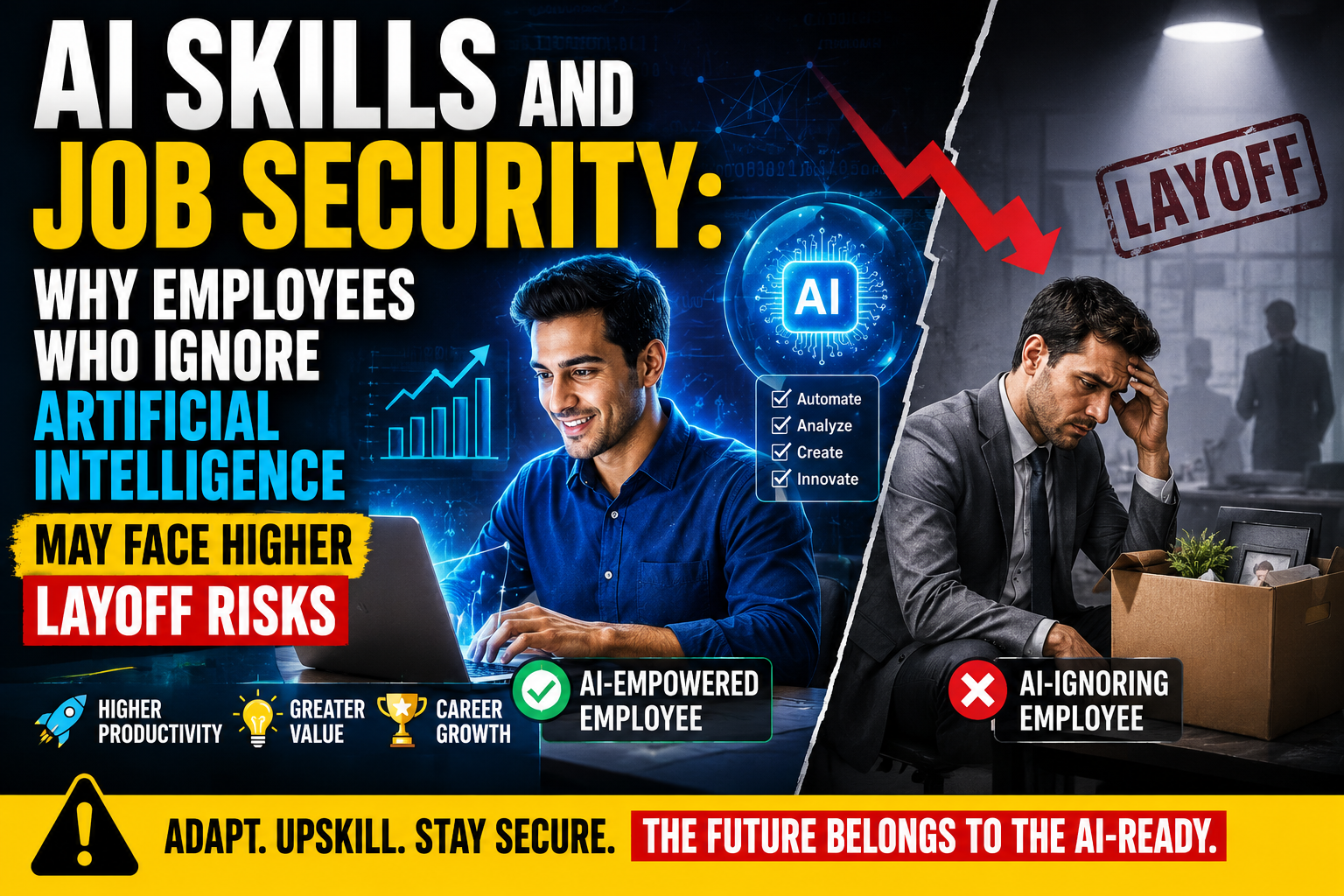
Artificial Intelligence has rapidly evolved from a futuristic concept into a core business tool used across industries. From software development and customer service to marketing, finance, healthcare, and education, AI is transforming how work gets done. But according to new workforce research, the impact of AI extends beyond productivity—it may also influence who keeps their job during periods of corporate restructuring.
A recent study conducted by Gallup suggests that employees who actively use AI tools are significantly less likely to face layoffs compared to those who rarely use them or avoid them entirely. The findings highlight a major shift in workplace expectations, where AI literacy is increasingly viewed as a valuable professional skill rather than an optional competency.
As organizations invest heavily in automation, data analysis, and AI-powered workflows, employees who understand how to leverage these technologies may find themselves better positioned for career growth and long-term job security.
The Growing Connection Between AI Usage and Employment Stability
The workplace has experienced several technological revolutions over the past few decades. Employees once had to adapt to computers, the internet, smartphones, cloud computing, and digital collaboration platforms. Artificial intelligence appears to be the next major transition.
According to Gallup’s findings, workers who regularly use AI tools demonstrate greater adaptability and technological readiness. These qualities are becoming increasingly important as companies seek ways to improve efficiency and remain competitive.
The study found a substantial difference in layoff risk between employees who actively engage with AI and those who do not. While AI usage alone does not guarantee employment security, it appears to be associated with a stronger position within modern organizations.
This trend suggests that employers may increasingly view AI proficiency as an indicator of future workplace value.
Why Companies Are Prioritizing AI Literacy
Businesses across the world are facing mounting pressure to improve productivity while controlling costs. Artificial intelligence offers a way to accomplish both objectives simultaneously.
As a result, companies are increasingly looking for employees who can:
- Use AI tools to automate repetitive tasks.
- Analyze data more efficiently.
- Improve decision-making processes.
- Enhance customer experiences.
- Increase overall operational efficiency.
- Adapt quickly to technological changes.
Employees who understand how to work alongside AI are often viewed as contributors to organizational transformation rather than observers of it. During periods of restructuring, this distinction can become highly significant.
From an employer’s perspective, workers who embrace AI may be better equipped to support future business goals and technological initiatives.
The Evolution of Workplace Skills
Historically, workplace success was largely determined by education, experience, and technical expertise. While those factors remain important, modern employers are increasingly evaluating an additional criterion: adaptability.
The ability to learn new technologies has become one of the most valuable professional traits in today’s economy.
Artificial intelligence represents a particularly important test of adaptability because its influence extends across nearly every business function. Employees who quickly learn AI-powered tools often gain productivity advantages that can improve their visibility and value within an organization.
This shift mirrors previous technological transitions.
Workers who learned to use spreadsheets gained advantages over those who relied on manual calculations. Employees who embraced email communication often became more efficient than those who resisted digital workflows. AI appears to be following a similar pattern, albeit on a much larger scale.
Why Employees and Employers View AI Differently
One of the most fascinating aspects of recent workforce research is the disconnect between employee perceptions and employer actions.
Many workers who experience layoffs attribute their job loss to familiar factors such as budget cuts, organizational restructuring, economic uncertainty, or management decisions. Few directly identify artificial intelligence as the primary cause.
However, business leaders often evaluate workforce decisions through a broader lens.
When organizations implement AI systems that improve efficiency, they may require fewer employees to complete certain tasks. In other cases, companies may prioritize retaining workers who can effectively use AI to increase productivity.
This means AI’s influence may often be indirect rather than obvious.
Instead of replacing a worker outright, AI may alter the criteria used to determine which employees are retained during workforce reductions.
The Rise of the AI-Skilled Employee
A new category of professional is emerging across industries: the AI-augmented worker.
These employees do not necessarily possess advanced technical expertise or programming knowledge. Instead, they understand how to use AI tools strategically to improve performance.
Examples include:
- Marketers using AI for content research and campaign analysis.
- Developers leveraging AI-assisted coding tools.
- Sales teams using AI for lead prioritization.
- Customer service professionals utilizing AI chat support systems.
- Analysts employing AI-powered data visualization tools.
- Human resource teams using AI for recruitment screening.
In many cases, these professionals become more productive without replacing human judgment, creativity, or strategic thinking.
The combination of human expertise and AI assistance is increasingly becoming the preferred workplace model.
Industries Most Likely to Experience AI-Driven Workforce Changes
While technology companies are currently experiencing the strongest impact, AI adoption is spreading rapidly throughout the broader economy.
| Industry | Potential AI Impact |
|---|---|
| Technology | Software development, automation, testing, analytics |
| Finance | Risk assessment, fraud detection, forecasting |
| Healthcare | Diagnostics, administrative workflows, research |
| Marketing | Content creation, audience analysis, optimization |
| Education | Personalized learning and administrative support |
| Manufacturing | Predictive maintenance and operational efficiency |
Employees working in these sectors may increasingly benefit from understanding how AI tools are being integrated into daily operations.
The Real Risk Is Not AI—It Is Resistance to Change
A common misconception is that artificial intelligence itself is the primary threat to employment. In reality, the larger risk may be an unwillingness to adapt.
Technological disruption has historically rewarded individuals who embrace learning and punished those who resist change.
The introduction of AI does not necessarily eliminate jobs. Instead, it often changes how jobs are performed.
Workers who develop new skills tend to remain valuable even as industries evolve. Those who ignore emerging technologies may find it increasingly difficult to compete with colleagues who can complete tasks faster, analyze information more effectively, and contribute to digital transformation initiatives.
The lesson is clear: adaptability remains one of the strongest predictors of long-term career success.
How Employees Can Improve Their AI Readiness
The good news is that developing AI literacy does not require a computer science degree.
Many professionals can begin building relevant skills through practical experimentation and continuous learning.
- Explore AI-powered workplace tools.
- Take introductory AI training courses.
- Learn prompt-writing techniques.
- Understand AI limitations and ethical considerations.
- Use AI to enhance productivity rather than replace critical thinking.
- Stay informed about industry-specific AI developments.
Employers increasingly value employees who demonstrate curiosity and initiative when learning new technologies.
Even basic familiarity with AI can provide a meaningful competitive advantage.
What This Means for the Future of Work
The workforce is entering a period of transformation comparable to the rise of the internet or cloud computing. Organizations are investing billions of dollars in AI technologies, and that investment is reshaping workforce expectations.
In the coming years, AI literacy may become as fundamental as digital literacy is today.
Job descriptions are already beginning to include AI-related skills. Hiring managers are increasingly evaluating candidates based on their ability to work effectively with AI systems. Performance expectations may continue evolving as organizations integrate artificial intelligence into everyday workflows.
This does not mean every employee must become an AI expert. However, understanding how to collaborate with AI tools may become a basic requirement for career advancement in many industries.
A Hidden Opportunity Most Professionals Are Missing
One overlooked aspect of the AI revolution is that it may create more opportunities than it eliminates.
Historically, major technological breakthroughs have generated entirely new categories of jobs. AI is already creating demand for specialists in prompt engineering, AI governance, model evaluation, automation strategy, and human-AI collaboration.
Professionals who invest in AI skills today may be positioning themselves for career opportunities that did not exist just a few years ago.
Rather than viewing AI solely as a threat, forward-thinking employees increasingly see it as a career accelerator.
Conclusion: AI Literacy Is Becoming a Career Necessity
The latest workforce research sends a clear message: artificial intelligence is no longer a niche technology reserved for engineers and data scientists. It is becoming a mainstream workplace skill that influences hiring decisions, productivity expectations, and potentially even layoff outcomes.
While AI alone does not determine who stays employed, employees who actively learn and use AI tools appear better positioned for success in a rapidly changing economy. Organizations are increasingly rewarding adaptability, technological fluency, and a willingness to embrace innovation.
For professionals across every industry, the question is no longer whether AI will affect their career. The more important question is how prepared they are to evolve alongside it.
In the modern workplace, learning AI may not simply be a way to get ahead—it may be one of the most effective ways to remain competitive, valuable, and future-ready.
For breaking news and live news updates, like us on Facebook or follow us on Twitter and Instagram. Read more on Latest Careers on thefoxdaily.com.






COMMENTS 0