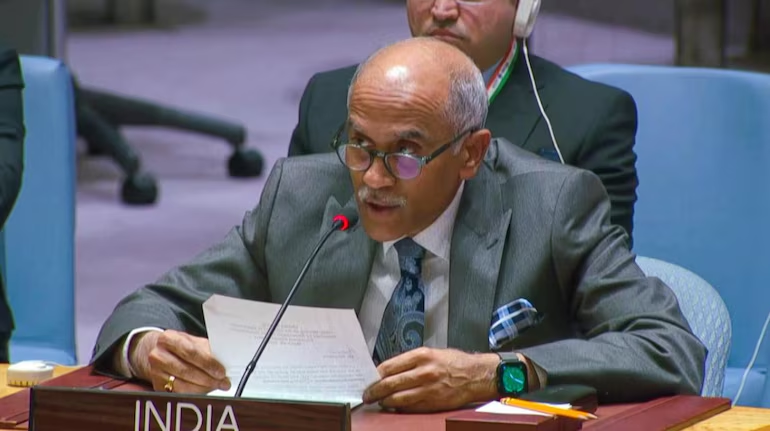
India has renewed its longstanding call for a coordinated global response to terrorism, urging all United Nations member states to reject selective approaches and eliminate double standards in counter-terrorism efforts. Speaking during the adoption of the Ninth Review of the United Nations Global Counter-Terrorism Strategy, India’s Permanent Representative to the United Nations, Ambassador Harish Parvathaneni, stressed that terrorism remains one of the gravest threats to international peace, security, and Human Rights.
The statement reflects India’s consistent position that terrorism cannot be justified under any circumstances, regardless of political grievances, ideological motivations, or strategic interests. As countries continue to face evolving security threats ranging from cross-border terrorism to cyber-enabled extremist activities, India argued that only genuine international cooperation can effectively combat this global menace.
India’s Core Message: No Justification for Terrorism
At the center of India’s intervention was a clear and uncompromising message: terrorism must be condemned in every form and manifestation.
Addressing the General Assembly, Ambassador Harish Parvathaneni stated that nations must avoid creating distinctions between so-called “good” and “bad” terrorists or allowing political considerations to weaken collective action.
India argued that attempts to rationalize terrorism based on historical grievances, political disputes, or ideological differences ultimately undermine Global Security and embolden extremist organizations.
The country reiterated that protecting the right to life remains the foremost human right and that terrorism directly attacks this fundamental principle.
India’s Experience Shapes Its Counter-Terrorism Policy
India highlighted that its position is rooted in decades of firsthand experience with terrorism.
For several decades, the country has faced cross-border terrorism, insurgent violence, and attacks targeting civilians, security personnel, public infrastructure, and places of worship.
According to India’s statement, these experiences have demonstrated that terrorism causes long-lasting consequences beyond immediate casualties, including:
- Loss of innocent lives.
- Psychological trauma for families.
- Economic disruption.
- Social instability.
- Regional security challenges.
India argued that these realities reinforce the need for an uncompromising international approach.
The Ninth Review of the UN Global Counter-Terrorism Strategy
The United Nations Global Counter-Terrorism Strategy was originally adopted in 2006 as the first consensus-based global framework designed to strengthen international cooperation against terrorism.
The strategy focuses on multiple areas, including:
- Preventing terrorism.
- Building member states’ counter-terrorism capacity.
- Protecting human rights while combating terrorism.
- Strengthening international cooperation.
- Addressing conditions that may contribute to terrorism.
The Ninth Review marks two decades since member states first agreed on a coordinated international strategy, providing an opportunity to assess emerging challenges and strengthen global mechanisms.
India Warns Against Double Standards
A significant part of India’s address focused on what it described as inconsistent approaches adopted by some countries toward terrorism.
India argued that effective counter-terrorism requires equal treatment of all terrorist organizations without political bias.
According to India’s position, selective implementation weakens international cooperation and allows terrorist networks to exploit geopolitical divisions.
The country emphasized that:
- No terrorist should receive political protection.
- No sponsor should escape accountability.
- No financier should remain beyond international scrutiny.
- No jurisdiction should become a safe haven for terrorism.
Combating Terror Financing Remains a Global Priority
India placed particular emphasis on disrupting financial networks that enable terrorist organizations to recruit members, acquire weapons, conduct operations, and expand internationally.
The country urged greater cooperation in:
- Financial intelligence sharing.
- Cross-border investigations.
- Asset freezing.
- Monitoring illicit financial flows.
- Implementing Financial Action Task Force (FATF) standards.
Strengthening global financial oversight, India argued, is essential to denying terrorist groups the resources needed to sustain their activities.
The Growing Threat of Emerging Technologies
India also expressed concern over terrorists’ increasing use of modern technologies.
Advances in digital communications, encrypted messaging, Artificial Intelligence, unmanned aerial systems, cryptocurrencies, and cyber tools have transformed how extremist organizations operate.
India noted disappointment that negotiations on the latest review failed to produce stronger commitments regarding the misuse of emerging technologies by terrorist groups.
Security experts increasingly warn that technological innovation, while beneficial for society, also presents new challenges for law enforcement and intelligence agencies worldwide.
The Long-Pending Comprehensive Convention on International Terrorism (CCIT)
India once again urged the international community to finalize the Comprehensive Convention on International Terrorism (CCIT), a proposal first introduced by India in the United Nations in 1996.
The proposed convention seeks to establish a universally accepted legal framework defining terrorism and strengthening international legal cooperation.
Its objectives include:
- Creating a common legal definition of terrorism.
- Improving extradition cooperation.
- Strengthening prosecution mechanisms.
- Closing legal loopholes exploited by terrorist groups.
- Enhancing international coordination.
Despite decades of negotiations, member states have yet to reach consensus on several legal and political issues surrounding the convention.
India argued that this prolonged delay continues to hamper global counter-terrorism efforts.
India’s Contributions to Global Counter-Terrorism
India highlighted its active participation in international initiatives aimed at strengthening cooperation against terrorism.
Among its notable contributions are:
- The Delhi Declaration on countering the use of new and emerging technologies for terrorist purposes.
- The No Money for Terror Conference series.
- Capacity-building partnerships.
- Support for multilateral counter-terrorism cooperation.
These initiatives focus on improving information sharing, financial monitoring, technological safeguards, and operational coordination among participating countries.
Balancing Human Rights and National Security
India acknowledged that counter-terrorism operations must continue to respect international law and human rights.
However, the country emphasized that protecting innocent lives remains the foremost responsibility of governments.
According to India’s position, safeguarding the right to life should remain central to every counter-terrorism policy, while ensuring that security measures remain consistent with the rule of law.
This balance continues to be one of the most debated issues in international security policy.
Recognizing All Forms of Religious Hatred
India also called for a broader and more inclusive approach to combating hatred motivated by religion or identity.
While reaffirming opposition to Islamophobia, antisemitism, and discrimination against Christians, India argued that international discussions should recognize prejudice directed toward followers of all religions equally.
The country maintained that combating intolerance should remain universal rather than selective, reflecting the inclusive principles of the United Nations.
Global Terrorism Is Rapidly Evolving
The nature of terrorism has changed significantly over the past two decades.
Today’s security threats increasingly involve:
- Online radicalization.
- Encrypted communications.
- Cross-border financing.
- Cyber-enabled attacks.
- Drone technology.
- Artificial intelligence-assisted propaganda.
- Cryptocurrency transactions.
These developments require governments to continuously modernize intelligence capabilities, legal frameworks, and international cooperation mechanisms.
Why International Cooperation Matters
Terrorism rarely remains confined within national borders.
Modern extremist networks often operate across multiple jurisdictions, making international collaboration essential for:
- Intelligence sharing.
- Border security.
- Financial investigations.
- Law enforcement cooperation.
- Judicial coordination.
- Sanctions implementation.
Without coordinated action, terrorists can exploit legal differences, weak enforcement systems, and geopolitical tensions to evade accountability.
India’s Key Counter-Terrorism Priorities
| Priority Area | India’s Position |
|---|---|
| Zero tolerance | No justification for terrorism under any circumstances |
| International cooperation | Greater collaboration among all UN member states |
| Terror financing | Strengthen FATF implementation and intelligence sharing |
| Emerging technologies | Prevent misuse of AI, digital platforms, and advanced technologies |
| Legal framework | Finalize the Comprehensive Convention on International Terrorism |
| Sanctions | Ensure transparent, evidence-based listing mechanisms |
Why This Matters for Global Security
India’s intervention comes at a time when geopolitical tensions, regional conflicts, technological change, and transnational extremist networks continue to reshape the global security landscape.
While military operations remain an important tool against terrorist organizations, experts increasingly emphasize that long-term success depends on coordinated Diplomacy, intelligence cooperation, financial regulation, technological safeguards, and strong international legal frameworks.
The discussions at the United Nations illustrate that despite two decades of global counter-terrorism efforts, achieving universal consensus on several key issues remains an ongoing challenge.
India’s address reinforces a consistent principle that has guided its international security policy for decades: terrorism cannot be categorized, justified, or selectively condemned. Effective global counter-terrorism requires political will, legal cooperation, financial accountability, technological vigilance, and unwavering international unity.
Future Outlook
As terrorist organizations continue adapting to technological advances and evolving geopolitical realities, international cooperation is expected to become even more important. Future counter-terrorism strategies will likely place greater emphasis on artificial intelligence, Cybersecurity, financial surveillance, cross-border intelligence sharing, and stronger legal coordination among nations.
For India, the adoption of the Ninth Review represents another opportunity to push for comprehensive reforms, including the long-pending Comprehensive Convention on International Terrorism. Whether member states can bridge longstanding political differences and develop a universally accepted legal framework will significantly influence the effectiveness of global counter-terrorism efforts in the years ahead.
For breaking news and live news updates, like us on Facebook or follow us on Twitter and Instagram. Read more on Latest World on thefoxdaily.com.






COMMENTS 0