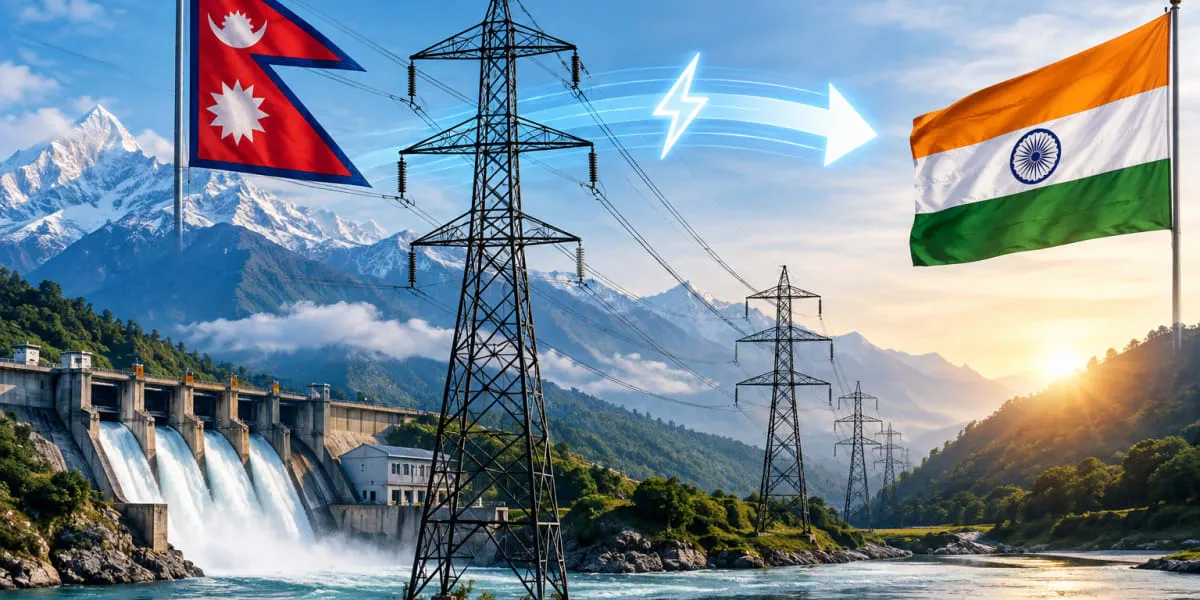
Nepal continued exporting electricity to India despite extensive damage to its Hydropower infrastructure during the devastating floods in August, generating more than Rs 725 crore in export revenue over the following two months. The continued electricity supply was possible because the country retained a seasonal surplus of hydropower, even as several power projects and transmission facilities were damaged.
Data from the Nepal Electricity Authority (NEA) shows that Nepal exported approximately 1,262 million units (MU) of electricity to India between August 27 and October 27, a period beginning one day after the floods struck the country. The volume was equivalent to nearly one-third of Nepal’s total electricity exports to India during the 2025-26 financial year.
The figures raised questions about how Nepal managed to maintain cross-border electricity supplies despite damage to hydropower plants, including facilities that contribute to exports. The floods also disrupted transmission infrastructure and reduced the country’s available power generation capacity.
Indian government officials had initially expressed concern about possible interruptions to electricity supplies from Nepal. In September, the Union Ministry of Power approved Nepal’s request for early electricity imports from India, citing damage to hydropower infrastructure and a reduction in domestic generation capacity.
However, Nepal’s continued exports demonstrate that the impact of the floods did not eliminate its seasonal electricity surplus. A combination of remaining generation capacity, seasonal power availability and potentially lower domestic consumption helped the country maintain exports.
Nepal Continued Electricity Exports Despite Flood Damage
The August floods caused significant damage to Nepal’s energy infrastructure, affecting hydropower projects, transmission lines and electricity evacuation systems. According to an earlier statement from Nepal’s Energy Ministry, 13 hydropower plants were affected, including projects still under construction. A solar power plant was also among the facilities impacted.
The damage disrupted the generation and transmission of electricity in several areas. NEA spokesperson Achyut Babu Ghimire said approximately 430 MW of capacity was knocked out of the system because of damage to transmission lines and other infrastructure that affected the evacuation of electricity.
However, the total figure of 430 MW did not represent only physically damaged generating equipment. Around 74 MW of hydropower capacity was directly damaged by the floods, while transmission-related disruptions affected the ability to evacuate electricity from other projects.
Among the affected facilities was the 14-MW Devighat hydropower plant, which supplies electricity to India. Its disruption added to concerns about the reliability of Nepal’s electricity exports.
Two other hydropower plants, Chilime and Trisuli, which supply electricity to Bangladesh, were also affected. Despite these setbacks, Nepal managed to maintain exports to India and later resumed electricity supplies to Bangladesh as well.
Seasonal Hydropower Surplus Helped Nepal Maintain Exports
The main explanation for Nepal’s continued electricity exports lies in the seasonal nature of its power generation. Nepal relies heavily on hydropower, and electricity production generally increases during the monsoon season when rivers and water flows support higher generation.
During this period, domestic hydropower production can exceed the country’s immediate electricity requirements. The surplus is exported to neighbouring countries, particularly India, which accounts for the bulk of Nepal’s electricity exports.
The situation changes during the dry winter months. Lower river flows reduce hydropower generation, making it more difficult for Nepal to meet domestic demand entirely through its own power plants. The country therefore imports electricity, including from India, to manage seasonal shortages.
This arrangement makes electricity trade between Nepal and India largely seasonal. Nepal exports surplus power during periods of higher generation and imports electricity when domestic hydropower output declines.
NEA spokesperson Achyut Babu Ghimire attributed the continued exports after the floods to this seasonal surplus. He said Nepal had applied to Indian authorities for approval to export electricity from additional projects within a week of the August 26 floods.
Speaking to The Indian Express, Ghimire said Nepal had enough surplus electricity during the monsoon to continue supplying India despite the damage caused by the floods.
The seasonal surplus was therefore an important factor in preventing the disruption of cross-border electricity trade. Although some projects were affected, the remaining operational generation capacity helped Nepal continue supplying power to India.
How Much Electricity Does Nepal Export to India?
India is Nepal’s largest electricity export market. Nepal also supplies electricity to Bangladesh, but the volume exported to that country is considerably smaller.
According to the Nepal Electricity Authority’s annual report, Nepal had total available energy of 18,624 million units in the 2025-26 financial year. Of this, 12,394 MU was consumed domestically, while 3,817 MU was exported to India and 148 MU to Bangladesh.
The figures show the importance of India as a destination for Nepal’s surplus electricity. India’s share of Nepal’s cross-border power trade is substantially larger than Bangladesh’s, making the Indian market central to Nepal’s electricity export earnings.
The previous financial year also recorded substantial exports. Nepal had 15,641 MU of available energy in 2024-25, of which 11,343 MU was consumed domestically and 2,380 MU was exported to India.
The increase in electricity exports reflects the expansion of Nepal’s hydropower generation and its growing role in regional electricity trade. The country has increasingly used cross-border transmission arrangements to sell electricity that would otherwise exceed its domestic requirements during periods of high generation.
Nepal’s Electricity Export Earnings Have Increased
The growth in electricity exports has also strengthened Nepal’s earnings from the energy sector. According to NEA’s annual report, revenue from electricity exports increased from Nepalese Rupees (NPR) 17.47 billion in 2024-25 to NPR 29.3 billion in 2025-26.
The increase highlights the economic importance of cross-border electricity trade for Nepal. Hydropower is not only a major source of domestic electricity but also an increasingly important export industry.
India’s large electricity market provides Nepal with an opportunity to sell surplus generation, particularly during the monsoon. The availability of a nearby buyer is important because electricity production must be balanced with demand and supported by suitable transmission infrastructure.
Bangladesh has also emerged as a destination for Nepal’s electricity, although the volume remains much smaller than exports to India. The expansion of regional electricity trade could provide Nepal with additional opportunities to earn revenue from its hydropower resources.
India Approved Early Electricity Imports From Nepal
Despite Nepal’s continued exports, the floods raised concerns within India about the reliability of electricity supplies from its neighbouring country. Damage to hydropower facilities and transmission networks created uncertainty over how much electricity Nepal would be able to deliver.
In September, the Union Ministry of Power approved a request from the Nepal government for early imports of electricity from India. The ministry said the floods had caused significant damage to Nepal’s hydropower infrastructure, reducing domestic generation capacity and creating an additional requirement for electricity.
The approval reflected the potential for Nepal to face power shortages as the consequences of the floods affected its generation and transmission systems. It also highlighted the two-way nature of electricity trade between the countries.
During the monsoon, Nepal can supply surplus electricity to India. During the winter, when hydropower generation declines, Nepal can rely on imports to meet domestic requirements.
The early import approval did not necessarily mean that Nepal had stopped exporting electricity. Instead, it provided flexibility to manage a possible shortfall while the country dealt with infrastructure damage.
Did Lower Domestic Electricity Demand Also Help?
While Nepal’s seasonal surplus provides the main explanation for continued exports, Indian government officials have pointed to another possible factor: a decline in domestic electricity demand following the floods.
The floods damaged homes, roads, public infrastructure and transmission networks in affected areas. Such disruption may have reduced electricity consumption in some locations, leaving more power available for export than would otherwise have been required domestically.
This possibility offers a different perspective on the export figures. Continued electricity exports do not necessarily mean that the floods had only a limited effect on Nepal’s power sector. The country may have maintained exports partly because seasonal generation remained high and electricity demand in some affected areas fell.
However, the available information does not establish precisely how much of the continued export volume resulted from surplus generation and how much was influenced by reduced domestic consumption.
The distinction is important because electricity availability depends on both supply and demand. Even when power generation is disrupted, lower consumption can help maintain a surplus for export.
How Much of Nepal’s Hydropower Capacity Was Affected?
Nepal has an installed hydropower capacity of approximately 4,200 MW, of which around 3,750 MW is currently operational. This generation base provides the foundation for its domestic electricity supply and export capacity.
The August floods affected 13 hydropower plants, including several projects under construction. The damage also extended to transmission infrastructure, which is essential for moving electricity from power stations to domestic consumers and cross-border transmission points.
Ghimire said approximately 430 MW of capacity was knocked out of the system because of damage to transmission lines and disruptions to electricity evacuation. Of this, around 74 MW of hydropower capacity was directly damaged by the floods.
He also said that three damaged plants with a combined capacity of 60 MW had export approval, including 55 MW of capacity approved by India’s Central Electricity Authority (CEA) for electricity exports to India.
The distinction between installed capacity, operational capacity and export-approved capacity is important. A power plant may have generating equipment capable of producing electricity, but damage to transmission lines can prevent that power from reaching the grid or being exported.
For Nepal, restoring transmission infrastructure is therefore as important as repairing damaged generating facilities. Reliable electricity exports depend on both the availability of power and the ability to transport it to cross-border connections.
Nepal’s Electricity Trade With Bangladesh
Although India remains Nepal’s principal electricity export destination, Bangladesh has become part of its regional power trade network.
Electricity exports from Nepal to Bangladesh began in November 2024 under a tripartite agreement involving the Nepal Electricity Authority, the Bangladesh Power Development Board (BPDB) and India’s state-owned NTPC Vidyut Vyapar Nigam Limited (NVVN).
The agreement allows electricity generated in Nepal to be supplied to Bangladesh through India’s transmission network. This arrangement makes India an important transit country for the electricity trade between Nepal and Bangladesh.
The annual figures show that Nepal exported 148 MU of electricity to Bangladesh in 2025-26, compared with 3,817 MU supplied to India. The difference demonstrates that the Indian market continues to account for the overwhelming majority of Nepal’s electricity exports.
The floods also affected the Chilime and Trisuli hydropower plants associated with supplies to Bangladesh. However, Ghimire said Nepal had resumed electricity supplies to Bangladesh in the week before the report.
The resumption indicates that Nepal was working to restore its regional electricity trade despite the disruption caused by the floods.
What Nepal’s Continued Exports Reveal About Regional Power Trade
Nepal’s ability to continue exporting electricity after the August floods illustrates the importance of seasonal energy planning and cross-border electricity connections. Its hydropower system produces more electricity during the monsoon than the country may need domestically, creating opportunities to supply neighbouring markets.
At the same time, the floods exposed vulnerabilities in the country’s energy infrastructure. Damage to power plants and transmission lines can reduce generation availability and disrupt electricity evacuation, even when overall installed capacity remains substantial.
The experience also highlights the interconnected relationship between Nepal, India and Bangladesh. Nepal relies on India as its largest export market and as a source of electricity imports during periods of lower hydropower generation. Bangladesh has become an additional destination through an arrangement that uses India’s transmission network.
For India, electricity trade with Nepal provides access to surplus hydropower during the monsoon, while its own power system can support Nepal when domestic generation declines. This seasonal exchange helps both countries manage changing electricity availability.
Nepal’s exports of approximately 1,262 MU between August 27 and October 27 show that the floods did not completely interrupt its electricity trade with India. Seasonal surplus generation, remaining operational capacity and possible changes in domestic demand helped sustain supplies despite significant infrastructure damage.
However, the disruption also underlined the need for resilient hydropower projects and transmission networks. As Nepal expands its role as a regional electricity supplier, the ability to withstand floods and restore damaged infrastructure will remain essential to the reliability of its exports.
For breaking news and live news updates, like us on Facebook or follow us on Twitter and Instagram. Read more on Latest World on thefoxdaily.com.





COMMENTS 0