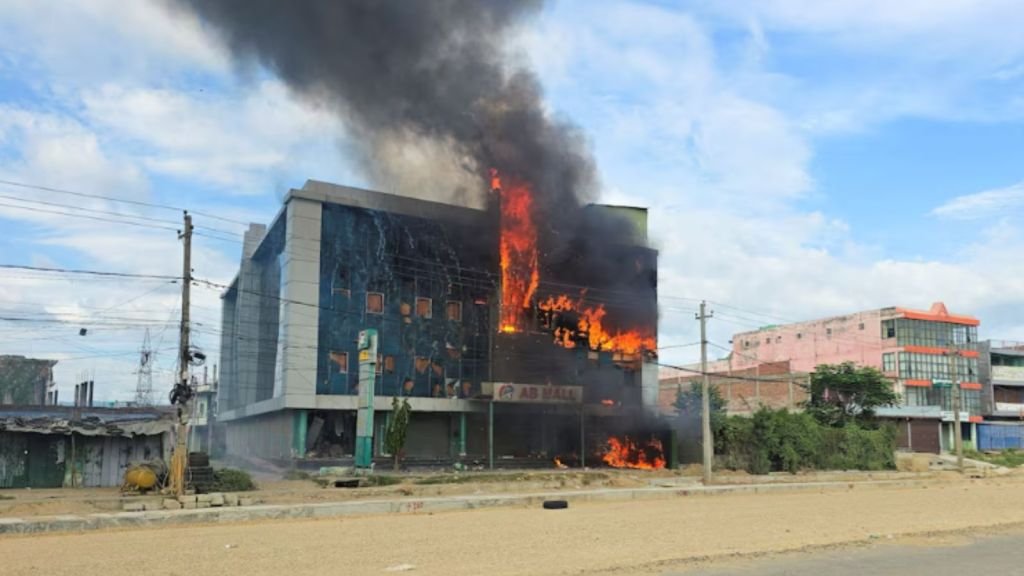
Communal violence in Nepal‘s southeastern districts bordering India has once again highlighted the complex relationship between religion, ethnicity, Politics, and regional identity in the Terai plains. The latest unrest, which left at least three people dead and dozens injured, prompted authorities to impose curfews in multiple districts while security forces worked to restore order.
Although the immediate confrontation reportedly began over religious flags, loudspeakers, and a local procession, analysts caution that such incidents rarely arise from a single event. Instead, they often expose deeper social tensions that have existed for years beneath the surface.
The violence has also renewed debate over Nepal’s secular identity, Border Security, communal harmony, and the challenges of maintaining peace in one of South Asia‘s most interconnected border regions.
What Happened in Sunsari and Siraha?
The unrest began in the market area of Kaptanganj in Nepal’s Sunsari district, located only a few kilometres from the Indian state of Bihar. According to police, tensions escalated after disagreements surrounding religious symbols, loudspeakers, and a procession during a local event.
Authorities stated that an argument between groups quickly intensified into stone-pelting and large-scale violence. Security personnel initially attempted crowd control measures before opening fire after the situation deteriorated further.
Within days, the violence spread to neighbouring Siraha district, while precautionary restrictions and curfews were also imposed in nearby Saptari and Dhanusha to prevent further escalation.
Officials confirmed multiple fatalities and injuries during the disturbances, while additional security forces were deployed across affected areas.
Timeline of the Recent Violence
| Date | Key Development |
|---|---|
| July 26 | Tensions begin in Kaptanganj, Sunsari district. |
| July 26–27 | Dispute escalates into stone-pelting and violent clashes. |
| Following days | Curfews imposed in multiple districts to restore order. |
| July 30 | Fresh violence reported in Siraha despite restrictions. |
| Current Situation | Security remains heightened while investigations continue. |
Why the India-Nepal Border Region Is Especially Sensitive
The Terai region forms Nepal’s southern plains and shares an open international border with India. Unlike many international boundaries, movement across the India-Nepal Border is relatively unrestricted for citizens of both countries under long-standing bilateral arrangements.
This openness has supported trade, employment, tourism, Education, and strong family ties for generations. However, it also means that political developments, religious movements, economic pressures, and social tensions on one side of the border can quickly influence communities on the other.
Districts such as Sunsari, Siraha, Saptari, Dhanusha, Parsa, Bara, and Sarlahi are home to highly diverse populations where multiple religious, linguistic, and ethnic communities have lived together for decades.
Understanding the Terai Region
The Terai is one of Nepal’s most economically and strategically important regions.
- It contains some of Nepal’s most fertile agricultural land.
- It serves as the country’s primary trade corridor with India.
- It has one of the highest population densities in Nepal.
- Communities often share close cultural, linguistic, and family connections across the border.
Its diversity has historically been one of its greatest strengths, but it has also made the region particularly vulnerable to identity-based conflicts during periods of political or social tension.
Immediate Trigger vs. Underlying Causes
Police indicated that the immediate trigger involved disputes over religious flags, loudspeakers, and a local procession. However, conflict researchers emphasize that such incidents usually become flashpoints only when broader grievances already exist.
Factors that can contribute to heightened tensions include:
- Competition over local influence.
- Political polarization.
- Economic inequality.
- Misinformation and rumors.
- Historical mistrust between communities.
- Disputes during religious festivals or public processions.
These structural issues often determine whether a local disagreement remains isolated or develops into widespread unrest.
A Region With a History of Social and Political Conflict
The Terai has witnessed several significant episodes of violence over the past two decades. Importantly, many earlier conflicts were driven primarily by political representation, ethnic identity, or regional demands rather than religion alone.
Previous periods of unrest have involved disputes related to:
- Madhesi political movements.
- Federal restructuring.
- Representation in government institutions.
- Competition over local governance.
The current violence differs because it reportedly involved members of different religious communities, adding another sensitive dimension to an already complex regional landscape.
Nepal’s Religious and Constitutional Context
Nepal underwent a major constitutional transformation after abolishing its monarchy.
With the adoption of its Constitution in 2015, Nepal officially became a secular federal democratic republic, ending its long-standing status as the world’s only officially Hindu kingdom.
The constitutional change guaranteed freedom of religion while recognizing Nepal’s diverse cultural and religious traditions.
However, the issue continues to generate political debate. Some political groups advocate restoring Nepal’s previous identity as a Hindu state, while others strongly support maintaining its secular constitutional framework.
| Before 2015 | After 2015 Constitution |
|---|---|
| Official Hindu Kingdom | Secular Federal Democratic Republic |
| Monarchy | Republic |
| Limited constitutional secular framework | Constitutional protection of religious freedom |
Why the Open India-Nepal Border Matters
The India-Nepal border stretches over 1,700 kilometers and is one of South Asia’s most unique international boundaries.
Citizens of both countries have historically enjoyed relatively free movement for:
- Employment.
- Business.
- Education.
- Healthcare.
- Family visits.
- Pilgrimage.
While this openness brings significant economic and social benefits, authorities from both countries also face challenges related to cross-border crime, misinformation, and maintaining law and order during periods of unrest.
Government Response
Following the violence, Nepal’s government imposed curfews in affected areas and deployed additional security personnel to prevent further clashes.
Senior government officials appealed for calm, announced compensation for affected families, and promised impartial investigations into the incidents.
Political leaders across the spectrum also called for dialogue, while opposition parties sought an independent judicial inquiry to examine the circumstances surrounding the violence and the official response.
The Humanitarian Impact
Beyond the political debate, communal violence has significant consequences for ordinary residents.
Curfews disrupted:
- Daily business activities.
- Schools and educational institutions.
- Transportation.
- Cross-border commerce.
- Healthcare access in some areas.
Small businesses and daily wage workers are often among the hardest hit whenever prolonged restrictions are imposed.
Expert Insight: Why Local Incidents Escalate So Quickly
Conflict specialists note that disputes involving religious symbols, public processions, or community events can escalate rapidly when misinformation spreads through Social Media or word of mouth.
In densely populated border regions where communities live in close proximity, rumors can Travel quickly, making timely communication by authorities essential for preventing wider unrest.
Experts also emphasize that sustained peace depends not only on policing but also on long-term community engagement, dialogue, and trust-building between local groups.
What Happens Next?
Authorities are expected to continue investigating the incidents, reviewing the circumstances that led to the violence, and determining whether additional security measures are required in sensitive areas.
Community leaders, civil society organizations, and local administrations are also likely to play an important role in restoring confidence between affected communities.
Long-term stability will depend on addressing both the immediate causes of the unrest and the deeper social, political, and economic issues that contribute to recurring tensions.
Lessons From the Latest Clashes
The violence in Sunsari and neighbouring districts demonstrates that maintaining communal harmony requires more than emergency policing. Early conflict prevention, transparent investigations, responsible public communication, and cooperation between community leaders are equally important.
It also highlights the importance of protecting the peaceful traditions that have historically allowed diverse communities in Nepal’s border regions to coexist despite political and cultural differences.
Conclusion
The recent clashes in Nepal’s southeastern border districts are a reminder that local disputes can quickly evolve into larger security and humanitarian challenges when underlying tensions remain unresolved. While authorities have largely restored order through curfews and increased security, the incident has reopened broader discussions about communal relations, constitutional identity, and governance in Nepal’s diverse Terai region.
As investigations continue, the focus will remain on establishing accountability, supporting affected families, and preventing further violence. The long-term challenge, however, lies in strengthening dialogue, building trust among communities, and ensuring that future disagreements are resolved peacefully before they escalate into wider conflict.
For breaking news and live news updates, like us on Facebook or follow us on Twitter and Instagram. Read more on Latest World on thefoxdaily.com.





COMMENTS 0