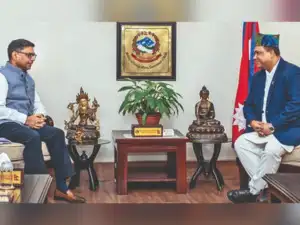
India has expressed its readiness to support Nepal‘s reconstruction of infrastructure damaged by devastating floods, while both countries are exploring opportunities to strengthen energy cooperation, trade and regional connectivity. The discussions took place during Indian Foreign Secretary Vikram Misri’s two-day official visit to Kathmandu on November 4 and 5, 2026.
During the visit, Misri met Nepal’s Prime Minister Balendra Shah, popularly known as Balen Shah, and held discussions with senior government officials, including Foreign Secretary Amrit Bahadur Rai, Foreign Minister Shishir Khanal, Finance Minister Swarnim Wagle and Energy Minister Biraj Bhakta Shrestha.
One of the central issues was India’s potential assistance in rebuilding infrastructure damaged by the Rasuwa-Bhotekoshi floods of August 2026. Misri indicated that New Delhi was prepared to consider Nepal’s requests and project proposals as the country moves towards reconstruction and rehabilitation.
The discussions also covered hydropower development, electricity trade, cross-border connectivity and preparations for Shah’s upcoming visit to India. Several India-supported development projects are expected to feature during the visit, making the diplomatic engagement important for the future direction of bilateral relations.
India Offers Support for Nepal’s Post-Flood Reconstruction
The reconstruction of flood-damaged infrastructure emerged as a major priority during Misri’s meetings with Nepalese officials. The August 26 disaster along the Bhotekoshi river system caused extensive damage to roads, bridges, buildings, hydropower facilities and other critical infrastructure.
The impact extended across several districts, including Rasuwa, Nuwakot and Dhading, disrupting transportation networks, local communities and economic activities.
For Nepal, rebuilding this infrastructure is not simply a matter of repairing physical structures. Roads, bridges and electricity facilities are essential to restoring access to markets, public services, transportation routes and economic opportunities in affected areas.
Misri acknowledged the scale of the destruction and said India was ready to consider the assistance Nepal requires during the reconstruction phase.
His remarks indicate that India’s involvement could extend beyond the immediate humanitarian response towards longer-term rehabilitation and infrastructure development.
What Vikram Misri Said About India’s Assistance
During discussions with Nepali Foreign Secretary Amrit Bahadur Rai, Misri highlighted the longstanding relationship between the two neighbouring countries and their cooperation during difficult circumstances.
He acknowledged that the floods had caused considerable damage to Nepal’s infrastructure and reiterated that New Delhi was willing to consider specific requests and project proposals from Kathmandu.
Importantly, India’s readiness to provide assistance does not mean that a complete reconstruction funding package has already been approved. The scale, financing arrangements and implementation details will depend on further discussions between the two governments.
This distinction matters because Nepal needs to identify its reconstruction priorities and determine which projects require financial assistance, technical cooperation or direct infrastructure support.
India’s Earlier Humanitarian Response to the Floods
India had already provided assistance to Nepal during the emergency response following the disaster.
According to Nepal’s government, Indian support included relief supplies and specialised technical assistance. Indian rescue specialists also participated in efforts involving tunnel rescue operations, while a team of forensic experts assisted with DNA-related identification work.
India’s assistance was part of a wider international response that included support from several neighbouring countries and international partners.
The transition from emergency assistance to reconstruction is a different stage of disaster management. Relief operations focus on immediate survival needs, including food, medicine, rescue and temporary shelter. Reconstruction requires longer-term planning, engineering assessments, financial resources and coordination between government departments.
For Nepal, cooperation with India could be particularly relevant because of the countries’ geographical proximity, established transport links and existing development partnerships.
Nepal Seeks Financial Assistance for Rebuilding Flood-Hit Infrastructure
Nepal is also looking towards India for substantial financial support to rebuild infrastructure damaged by the floods.
According to reporting by The Kathmandu Post, Nepal has discussed seeking an economic assistance package worth more than $2 billion through a combination of grants, lines of credit and other support mechanisms.
The reported proposal includes a request for approximately $1 billion in credit facilities and $500 million in grants, alongside another $500 million earmarked for reconstruction and rebuilding. These figures represent reported requests under discussion rather than a confirmed Indian funding commitment.
The distinction between grants and credit is important for Nepal’s recovery strategy.
- Grant assistance: Funding that does not require repayment and can help finance reconstruction without adding to government debt.
- Lines of credit: Financing that provides access to funds for approved projects but generally carries repayment obligations.
- Project-based assistance: Support directed towards specific infrastructure developments, potentially involving technical expertise and implementation by designated agencies.
For a country recovering from extensive flood damage, the balance between these financing options can influence how quickly projects move forward and how much financial pressure falls on the government in the future.
The final structure of any Indian assistance package will depend on negotiations, project assessments and decisions by the relevant authorities in both countries. India has not yet publicly confirmed the reported $2 billion package as an approved commitment.
India-Nepal Energy Cooperation Gains Importance
Beyond disaster reconstruction, energy cooperation was another major subject during Misri’s visit.
Nepal has considerable hydropower potential, while India offers a large electricity market and access to regional transmission infrastructure. Cooperation between the two countries can therefore create opportunities for electricity generation, cross-border power trading and investment in transmission networks.
During his visit, Misri met Energy, Water Resources and Irrigation Minister Biraj Bhakta Shrestha to review ongoing cooperation and discuss ways to expand collaboration in energy and water resources.
The discussions build on an existing framework of energy cooperation rather than representing an entirely new initiative.
The 10,000 MW Electricity Trade Agreement
One of the most significant milestones in India-Nepal energy relations was the long-term power trade agreement signed on January 4, 2024.
Under the agreement, India and Nepal agreed to work towards increasing electricity exports from Nepal to India to 10,000 megawatts within ten years.
The arrangement is intended to encourage investment in Nepal’s hydropower generation capacity and the transmission infrastructure required to deliver electricity across the border.
For Nepal, access to the Indian electricity market provides an opportunity to generate revenue from its hydropower resources. It also creates incentives for investment in new power projects that may otherwise face limitations because of the size of the domestic market.
For India, electricity imports from Nepal can contribute to regional energy cooperation and provide access to hydropower that can complement its broader electricity supply system.
Why Hydropower Investment Matters for Nepal
Hydropower is an important part of Nepal’s long-term economic development strategy. However, turning water resources into commercially viable electricity requires substantial investment in power plants, transmission lines, access roads and supporting infrastructure.
Cross-border transmission capacity is particularly important. Electricity generation alone cannot support large-scale exports if the infrastructure needed to transport power is insufficient.
India’s role as a neighbouring electricity market therefore has significance beyond purchasing electricity. Cooperation can also involve transmission infrastructure, technical coordination and investment partnerships.
The two countries have already established mechanisms for discussing power-sector cooperation, including joint working and steering committees.
The latest discussions involving Misri and Nepal’s energy minister provide another opportunity to review existing initiatives and identify areas where implementation can be accelerated.
However, the 10,000 MW objective remains a long-term target. Achieving it will depend on project development, financing, regulatory approvals and the expansion of cross-border transmission capacity.
India-Funded Projects Expected During Balen Shah’s India Visit
Preparations for Nepal Prime Minister Balendra Shah’s upcoming visit to India were another important part of Misri’s diplomatic engagement.
The visit is expected later in November 2026 and will mark Shah’s first bilateral overseas engagement since becoming prime minister.
According to reporting by The Kathmandu Post, the two governments are considering several development projects for inauguration during the visit. The proposed programme is also expected to include the launch of construction work on additional India-supported infrastructure initiatives.
These projects demonstrate that the bilateral relationship extends beyond diplomatic exchanges and includes practical cooperation in transportation, public infrastructure and energy.
Key Infrastructure Projects on the Agenda
Several projects reportedly being considered for the upcoming high-level engagement include:
- Nepal Police Academy: The India-supported facility in Panauti, Kavrepalanchok, is among the projects expected to be inaugurated.
- Darchula bridge: A bridge project intended to strengthen local connectivity.
- Bhairahawa Integrated Check Post: A border infrastructure project designed to support trade and the movement of goods and people.
- Mahakali River bridge: A motorable bridge expected to improve transportation connectivity in the border region.
In addition to these proposed inaugurations, the two governments are reportedly considering the joint launch of construction on other projects.
These include the Integrated Check Post at Dodhara Chandani, the Lower Arun hydropower project and a petroleum pipeline connecting Siliguri in India with Charali in Nepal’s Jhapa district.
The final programme and implementation arrangements will depend on the outcomes of the upcoming prime ministerial discussions.
Why Cross-Border Infrastructure Is Important
India and Nepal share an extensive border, and their economies depend on the movement of people, agricultural products, industrial goods and essential supplies.
Border infrastructure can influence how efficiently businesses transport products and how easily citizens travel between the two countries.
Integrated check posts, for example, bring important border-related facilities together and can improve the organisation of customs, immigration and cargo movement.
Bridges and road connections also have wider economic significance. Better connectivity can reduce transportation difficulties for communities and improve access to markets, education and healthcare.
For Nepal, a landlocked country, reliable connections with neighbouring markets are particularly important for international trade.
Consequently, infrastructure cooperation with India can support both immediate development needs and Nepal’s longer-term economic integration.
India and Nepal Look to Strengthen Broader Bilateral Relations
Misri’s visit covered more than reconstruction and energy. Discussions also involved trade, commerce, development cooperation, physical connectivity, border management and people-to-people relations.
The two governments also identified newer areas of potential collaboration, including start-ups, digital connectivity, artificial intelligence and sports.
These discussions reflect an effort to expand bilateral cooperation into sectors that could create opportunities beyond traditional infrastructure and trade.
Economic Cooperation and Investment Opportunities
Nepal is interested in attracting additional investment across different sectors, particularly where foreign capital and technical expertise can help accelerate development.
India remains an important economic partner because of its geographical proximity, established commercial relationships and existing infrastructure connections.
Cooperation in manufacturing, transportation, energy and digital services could provide opportunities for businesses in both countries.
However, investment expansion requires more than diplomatic agreements. Businesses also need predictable regulations, suitable infrastructure, financing arrangements and clear project implementation procedures.
The upcoming prime ministerial visit could provide an opportunity to discuss these practical requirements alongside larger bilateral initiatives.
Digital Connectivity and Emerging Technologies
The inclusion of artificial intelligence, digital connectivity and start-ups in the discussions is another notable development.
These sectors offer opportunities for collaboration in areas such as digital public services, technology businesses, innovation and skills development.
For Nepal, partnerships with Indian technology companies and institutions could help strengthen its digital ecosystem. For India, closer engagement with Nepal could expand regional cooperation in emerging technologies.
These areas are still part of the broader cooperation agenda, and the discussions do not necessarily indicate that specific new agreements have already been finalised.
Why Balen Shah’s First Bilateral India Visit Matters
Prime Minister Balendra Shah’s upcoming visit carries diplomatic importance because it will be his first bilateral overseas engagement since taking office.
India extended an invitation to Shah following the formation of his government, and preparations for the visit have become a focus of recent diplomatic exchanges.
Foreign Secretary Misri’s November meetings were intended partly to establish the agenda and identify initiatives that could be advanced during the prime ministerial engagement.
The visit also provides an opportunity for both governments to discuss the direction of their relationship at the highest political level.
India and Nepal have longstanding historical, cultural, economic and people-to-people connections. Their relationship also involves complex issues relating to trade, border management, water resources and regional connectivity.
High-level diplomatic meetings can help address these subjects through established bilateral mechanisms and direct political discussions.
For Shah’s government, the visit offers an opportunity to seek reconstruction assistance, attract investment and advance infrastructure projects. For India, it provides an opportunity to strengthen cooperation with an important neighbouring country.
What Happens Next in India-Nepal Cooperation?
The immediate focus will be on finalising the agenda for Shah’s India visit and determining which initiatives can move forward through agreements, project approvals or joint announcements.
Flood reconstruction is likely to remain an important subject because Nepal needs financial and technical resources to restore damaged infrastructure.
Energy cooperation will also require continued attention, particularly the development of hydropower projects and transmission facilities needed to support the long-term electricity trade target.
The proposed infrastructure inaugurations could provide visible examples of the development partnership between the two countries. However, the larger impact will depend on whether projects are completed efficiently and deliver practical benefits to local communities.
For Nepal, the challenge is to convert diplomatic support into funded projects, functioning infrastructure and sustainable economic opportunities. For India, the opportunity lies in deepening regional cooperation through development assistance, trade, connectivity and energy partnerships.
Misri’s visit has therefore established an important diplomatic foundation ahead of the upcoming meeting between the two prime ministers. While the details of future assistance and investment remain subject to negotiations, India’s willingness to consider Nepal’s reconstruction proposals and both countries’ interest in expanding energy cooperation indicate that bilateral engagement is moving forward on several fronts.
The outcome of Shah’s visit to New Delhi will help determine how quickly these discussions translate into concrete commitments for Nepal’s post-flood recovery and its longer-term economic development.
For breaking news and live news updates, like us on Facebook or follow us on Twitter and Instagram. Read more on Latest India on thefoxdaily.com.






COMMENTS 0