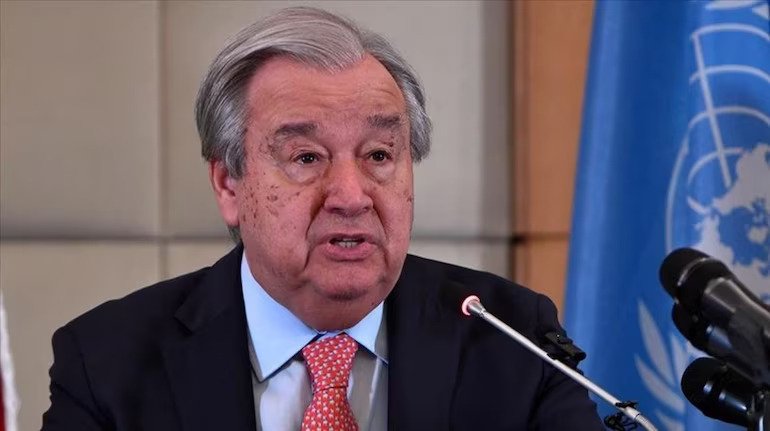
United Nations Secretary-General António Guterres is set to place multipolarity and reform of global institutions at the centre of his message at the BRICS Summit in New Delhi, as emerging powers push for a stronger voice in international decision-making. Guterres is scheduled to attend the 18th BRICS Summit on September 12 and 13 and is expected to meet Prime Minister Narendra Modi during his visit.
The UN chief’s intervention comes as the global system faces growing pressure to adapt to changes in economic weight, population, strategic influence and geopolitical power. Institutions created largely in the aftermath of the Second World War continue to shape decisions on security, finance and development, even as many countries argue that their representation no longer matches today’s distribution of power.
Guterres is expected to argue that the world of 2026 is fundamentally different from the one that existed in 1945. His message is likely to connect the rise of a more multipolar international system with the need to make multilateral institutions more representative, effective and credible.
What Guterres is expected to tell BRICS leaders
According to the UN Secretary-General’s spokesperson, Guterres is expected to emphasise that today’s economic, demographic and geopolitical realities are no longer those of 1945.
That observation goes to the heart of the debate over international Governance. The United Nations was created at the end of the Second World War, and its most powerful security institution, the UN Security Council, still reflects the balance of power that emerged at that time.
Guterres is also expected to argue that multipolarity can bring greater balance to global systems. But his broader message is likely to contain an important qualification: a multipolar world does not automatically produce a fairer or more stable international system.
Without effective institutions capable of managing competing interests, a more fragmented world can increase strategic competition. Reform, therefore, is being presented not simply as a demand from emerging powers but as a way to make international cooperation more resilient.
Why Security Council reform remains central
The UN Security Council has 15 members, including five permanent members with veto power: China, France, Russia, the United Kingdom and the United States. The remaining 10 seats are elected by the General Assembly for two-year terms.
Critics of the current structure argue that the Council does not adequately represent the geopolitical and economic realities of the 21st century. Africa, in particular, has no permanent seat despite being central to many of the conflicts, development challenges and peacekeeping operations handled by the UN.
Countries such as India, Brazil, Japan and Germany have also long advocated changes that would provide a larger role for major states currently excluded from permanent membership.
The reform question is not simply about adding countries. It also involves difficult negotiations over the number of permanent and elected members, veto rights, regional representation and the relationship between the Security Council and the wider UN system.
India’s long campaign for a permanent UN seat
For India, Guterres’ message carries particular significance because Security Council reform has been a long-standing diplomatic priority.
New Delhi argues that its growing economic weight, large population, role in peacekeeping and expanding international influence should be reflected in the architecture of global governance.
India is also one of the world’s most populous countries and has become an increasingly important participant in discussions on development, technology, climate action, energy and global security. Yet it remains outside the permanent membership of the Security Council.
That mismatch has strengthened India’s argument that institutional reform cannot be postponed indefinitely without damaging the credibility of the multilateral system.
Guterres has repeatedly supported the principle that global institutions should better reflect contemporary realities. His appearance at a BRICS gathering gives that argument a particularly relevant platform because the grouping has become one of the most visible forums for emerging and developing economies seeking greater influence.
BRICS and the rise of a multipolar world
The broader debate over multipolarity is closely connected to the evolution of BRICS itself.
The grouping began as a forum centred on Brazil, Russia, India and China, with South Africa joining later. Its membership has since expanded, while additional partner countries and outreach participants have increased the grouping’s diplomatic reach.
BRICS has increasingly presented itself as a platform through which countries outside the traditional Western-led institutions can coordinate positions on economic development, global finance, trade, technology and international governance.
That does not mean every BRICS member shares the same position on every geopolitical issue. The grouping contains countries with very different political systems, economic structures, strategic interests and relationships with the United States and Europe.
Its importance instead comes from the broader trend it represents: an international system in which more centres of economic and political power are seeking a stronger role.
Why Guterres is stressing reform instead of simply defending the status quo
The Secretary-General’s expected message reflects a difficult reality for the UN. The organisation remains the world’s most universal multilateral forum, but its institutions have faced criticism over representation, decision-making and the ability to respond quickly to major crises.
Guterres has previously warned that multipolarity without strong multilateral institutions could lead to greater geopolitical rivalry and fragmentation. The challenge, therefore, is to ensure that a more distributed balance of power is accompanied by stronger mechanisms for cooperation.
This distinction matters. Multipolarity describes how power is distributed; multilateralism describes how countries cooperate within international institutions. A world can become more multipolar without necessarily becoming more cooperative.
The UN’s argument is that the second must evolve alongside the first.
Bretton Woods institutions are also in focus
Guterres is expected to go beyond the Security Council and call for changes to the broader international financial architecture, including the Bretton Woods institutions.
The Bretton Woods system established the International Monetary Fund and the World Bank framework in the 1940s. These institutions have played central roles in global economic governance, financial stability and development for decades.
But developing countries have increasingly argued that their growing share of the world economy is not adequately reflected in the distribution of voting power and influence within international financial institutions.
That criticism has become more prominent as emerging economies have expanded their economic output, trade and reserves while facing challenges such as debt pressures, climate financing gaps and unequal access to capital.
For BRICS countries, financial reform is therefore closely tied to the wider question of whether global institutions still reflect the economic balance of the modern world.
India’s fourth BRICS chairship
India is hosting the 18th BRICS Summit as chair of the grouping in 2026. The country assumed the chairship on January 1, marking its fourth time in the role after previous chairships in 2012, 2016 and 2021.
The 2026 chairship has been built around the theme “Building for Resilience, Innovation, Cooperation and Sustainability.” That agenda gives India space to connect the summit’s traditional economic focus with newer discussions on technology, climate resilience, global growth and geopolitical uncertainty.
Guterres’ expected focus on institutional reform fits naturally within that framework because the question of resilience extends beyond national economies. International organisations themselves face pressure to become more representative and capable of responding to fast-changing global challenges.
What the 18th BRICS Summit will discuss
The summit will bring together leaders from BRICS member countries, partner states and other invited participants. Discussions are expected to cover a wide range of issues, including economic cooperation, development and the effects of current geopolitical crises.
The West Asia crisis is expected to be among the major issues shaping the discussions. The conflict has generated economic consequences extending well beyond the immediate region, affecting energy markets, Shipping, inflation and international diplomacy.
That makes the summit significant not only as an economic gathering but also as a venue for discussing how emerging powers respond to international crises that have consequences for the wider Global Economy.
Guterres and Modi set for bilateral talks
During his visit, Guterres is expected to hold talks with Prime Minister Narendra Modi as well as other leaders and officials attending the summit.
The meeting with Modi is likely to cover broader international developments and the future of multilateral cooperation, areas where India has increasingly sought to position itself as a bridge between developed economies and the Global South.
The two leaders also met during Guterres’ previous India visit in February 2026, when the UN chief attended the India AI Impact Summit in New Delhi.
That earlier visit focused heavily on inclusive global governance of artificial intelligence and the need to ensure that developing countries are not excluded from the next phase of technological development.
The BRICS meeting shifts the emphasis from AI governance to the broader architecture of international power, but the underlying principle is similar: decisions with global consequences should involve a wider group of countries.
Guterres’ India visit adds another layer to his multilateralism agenda
The UN chief’s February appearance in New Delhi offered an indication of how he views India’s role in the changing international system.
At the AI Impact Summit, Guterres argued that the future of artificial intelligence should not be determined by a small group of powerful countries or technology companies. He called for wider participation and stronger international cooperation to ensure that AI benefits developing economies as well.
His upcoming BRICS visit carries the same broader theme into traditional diplomacy. The issue is no longer simply who controls emerging technology, but also who has a meaningful voice in the institutions that govern security, finance and international cooperation.
Why Security Council reform is so difficult
Despite broad support in principle for reform, changing the Security Council remains one of the most difficult issues in the UN system.
Any major expansion of permanent membership involves competing regional claims. Countries within the same region may support greater representation while disagreeing over which state should receive a permanent seat.
The question of veto power is even more complicated. The existing permanent members have significant influence over any reform proposal because substantial changes to the UN Charter require a difficult ratification process.
As a result, decades of demands for reform have produced political momentum without an agreement on the final structure.
This is why Guterres’ expected remarks matter symbolically even if they do not immediately produce a new Security Council formula. Repeated high-level support keeps institutional reform at the centre of international diplomacy and strengthens pressure for negotiations.
Could BRICS become a stronger voice for global reform?
BRICS has increasingly become one of the forums through which developing and emerging economies articulate dissatisfaction with the existing global financial and political order.
The grouping’s growing economic and demographic weight gives it greater visibility in debates about reform. At the same time, differences among members mean it is unlikely to function as a unified geopolitical bloc on every issue.
Its strongest potential may therefore lie in collective pressure for greater representation rather than in replacing the existing international system.
That distinction is important. Guterres is advocating reform of multilateral institutions, not the abandonment of the United Nations. The objective is to make the existing architecture more representative while preserving a universal framework for cooperation.
The 1945 problem in a 2026 world
The central argument behind the reform debate can be summed up by a simple comparison: the institutions built after 1945 were designed for a very different global balance of power from the one that exists in 2026.
Population patterns have changed. Emerging economies have expanded dramatically. New centres of technological and financial power have appeared. Global challenges such as climate change, artificial intelligence, cyber risks, pandemics and supply-chain disruptions cut across national borders in ways that could not have been fully anticipated in the post-war era.
Yet the fundamental structures for global security and finance have evolved only gradually.
That gap between institutional design and contemporary reality explains why reform has become one of the most persistent themes in international diplomacy.
What Guterres’ BRICS message could mean
Guterres’ presence at the BRICS Summit gives the reform debate an unusual setting. Instead of raising the issue only within UN forums, the Secretary-General will be addressing a group that has become closely associated with demands for a more representative international order.
His message is likely to reinforce the idea that the rise of new powers does not have to result in the collapse of existing institutions. Instead, international organisations can adapt by expanding representation and giving emerging economies a greater role in decision-making.
For India, that argument aligns closely with its long-standing campaign for permanent membership of the Security Council. For BRICS more broadly, it supports the group’s emphasis on a greater voice for the Global South. For the UN, it offers a path toward maintaining relevance as the distribution of global power changes.
Guterres approaches the end of his UN tenure
The timing also matters for Guterres personally. His second five-year term as UN Secretary-General ends in December 2026, meaning the BRICS Summit comes during the final months of his tenure.
Institutional reform has been a recurring theme of his leadership, particularly as conflicts, geopolitical rivalries and global inequality have challenged traditional models of multilateral cooperation.
His final year therefore offers an opportunity to reinforce one of his central arguments: the international system cannot remain effective if major parts of the world feel excluded from its most important institutions.
A bigger test for the global order
The 18th BRICS Summit is likely to generate attention well beyond its economic agenda because it comes at a moment when questions about the future structure of global power are becoming harder to ignore.
Guterres’ call for Security Council and financial-system reform does not by itself guarantee institutional change. But his intervention places the United Nations behind a broader argument that global governance must evolve with the world it is supposed to represent.
For India, the summit provides another platform to press its case for a permanent Security Council seat. For BRICS, it offers a chance to highlight the growing influence of emerging economies. And for the UN, it is an opportunity to argue that multipolarity should produce stronger cooperation rather than deeper fragmentation.
The key question is whether the international system can adapt before the gap between global power and institutional representation becomes too wide to manage. In New Delhi, Guterres is expected to make clear that reform is no longer simply a long-term aspiration. It is increasingly tied to the credibility and effectiveness of multilateralism itself.
For breaking news and live news updates, like us on Facebook or follow us on Twitter and Instagram. Read more on Latest World on thefoxdaily.com.





COMMENTS 0