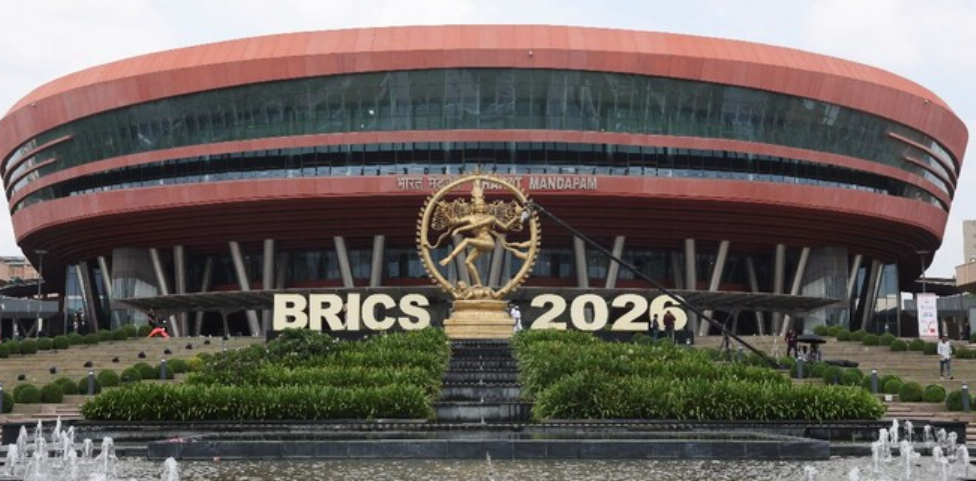
United Nations Secretary-General Antonio Guterres has described the consensus reached on the BRICS New Delhi Declaration as “reassuring”, saying it demonstrates that major powers still see multilateralism as an important way to address global crises.
Guterres made the remarks at a press conference on Wednesday, days after BRICS countries adopted the joint declaration by consensus during the grouping’s summit in New Delhi under India‘s chairship.
His comments came against the backdrop of continuing divisions within the UN Security Council, where disagreements among major powers have complicated efforts to reach common positions on several international crises.
Responding to a question from PTI about the consensus achieved by BRICS despite geopolitical differences among its members, Guterres said the declaration represented a strong commitment to both multilateralism and the United Nations.
“What is important is to say that the common declaration that was produced is a common declaration with a strong commitment of all of them to multilateralism and by all of them to the United Nations,” Guterres said.
He added that it was reassuring that a large number of important global powers continued to believe that multilateralism was the appropriate way to address international crises and that the UN should remain at the centre of those efforts.
Why the BRICS declaration matters to the UN
Guterres’ comments highlight an important distinction between geopolitical disagreement and the ability of countries to find areas of common ground through multilateral institutions.
The BRICS grouping includes countries with different political systems, strategic interests and relationships with the United States and other major powers. Its members have also held differing positions on some of the world’s most contentious conflicts.
Reaching agreement on a joint declaration under those circumstances gives the document significance beyond the individual issues covered in it. For the UN secretary-general, the consensus also demonstrates that countries with competing interests can still use multilateral diplomacy to establish common positions.
The issue is particularly relevant to the United Nations because the Security Council has faced repeated disagreements over major geopolitical crises. Its five permanent members have significant differences on conflicts and international security issues, sometimes making consensus difficult.
Against that background, the BRICS declaration provided Guterres with an example of countries overcoming differences sufficiently to produce a common statement.
BRICS adopted the declaration by consensus
The BRICS grouping adopted the New Delhi Declaration by consensus on September 12 during the summit hosted by India.
The agreement came after negotiations involving differences between Iran and the United Arab Emirates over the West Asia conflict. The divisions were addressed through a series of back-channel discussions before the final declaration was adopted.
The consensus was significant because the grouping had to accommodate differing national positions while producing a document acceptable to all participating members.
Rather than requiring countries to abandon their individual foreign-policy positions, multilateral declarations typically seek areas where governments can agree on broader principles and shared concerns.
For Guterres, the ability to reach such an agreement was an indication that multilateral diplomacy remains relevant despite the increasingly fragmented international environment.
Guterres links BRICS consensus to a divided Security Council
The UN chief’s remarks were made in response to a question specifically comparing the BRICS consensus with the difficulties faced by the UN Security Council.
The Security Council remains one of the most important bodies in the international system for dealing with questions of peace and security. However, disagreements among its members have repeatedly complicated efforts to develop common responses to major crises.
Guterres noted that not all Security Council members were present at the BRICS meeting. The comparison therefore does not mean that the BRICS format and the Security Council are identical or that consensus in one automatically resolves disagreements in the other.
Instead, his comments focused on the broader principle that countries with significant differences can still participate in multilateral processes and reach areas of agreement.
That principle has become increasingly important as geopolitical competition has intensified and international institutions have faced pressure to respond to simultaneous conflicts, economic challenges and other global emergencies.
Guterres attended the BRICS summit in New Delhi
Guterres was personally present at the BRICS summit in New Delhi on September 12 and 13.
He addressed the summit’s Open Session, which was held under the theme “Resilience, Innovation, Cooperation and Sustainability: Shaping the Future for Inclusive Global Growth.”
His participation gave the UN secretary-general an opportunity to engage directly with leaders and representatives from the BRICS grouping while India held the chairship.
During his visit, Guterres also met Prime Minister Narendra Modi.
His presence at the summit also underscored the connection between BRICS discussions and the wider multilateral system in which the United Nations remains a central institution.
India’s role in building consensus
The declaration was adopted during India’s chairship of BRICS, placing New Delhi at the centre of the diplomatic effort to bring members together around a common document.
India has repeatedly presented itself as a country that seeks to maintain dialogue across different geopolitical groupings. Hosting the BRICS summit provided another platform for that approach, particularly as members faced disagreements over sensitive international issues.
The adoption of the declaration by consensus allowed India to conclude the summit with a common statement despite differences among participating countries.
For the United Nations, such diplomatic processes can complement wider multilateral efforts by providing additional channels for dialogue among countries that do not always share the same strategic priorities.
West Asia differences tested the negotiations
One of the difficult issues surrounding the declaration was the conflict in West Asia.
Iran and the United Arab Emirates have different perspectives and interests in relation to the regional conflict, creating a potential obstacle to a common BRICS position.
According to the supplied account, a series of back-channel negotiations helped overcome those differences and allowed the declaration to be adopted.
The episode illustrates the practical challenge of producing multilateral statements when participating governments have different relationships with the parties involved in a conflict.
Consensus does not necessarily mean that all participating countries hold identical views on every issue. Instead, it can reflect an agreement on language and broader principles that each member is prepared to support.
Why multilateralism remains central to Guterres’ message
Guterres has consistently emphasised the importance of international cooperation in dealing with crises that cross national borders.
Issues such as armed conflicts, Climate Change, economic instability, humanitarian emergencies and technological risks often involve multiple countries and cannot be addressed entirely through unilateral action.
His comments on the BRICS declaration therefore fit into a wider argument for preserving institutions and diplomatic mechanisms that allow governments to coordinate their responses.
By pointing to the consensus achieved in New Delhi, Guterres highlighted the continued ability of major powers to find common ground despite significant political differences.
His emphasis on the UN’s role also reflects the organisation’s position as the central global institution for multilateral cooperation, particularly on international peace, security and development.
BRICS and the changing global order
The importance of the BRICS grouping has grown as its membership and international influence have expanded. Its members represent major emerging economies and include countries with substantial political, economic and strategic weight.
The grouping does not function as a single political bloc in the same way as a formal alliance. Its members maintain independent foreign policies and can disagree sharply on regional and international questions.
That diversity makes consensus more complicated but also makes successful joint declarations diplomatically significant.
The New Delhi Declaration demonstrates that BRICS members can produce a common position even when their interests are not identical. At the same time, the declaration should not be interpreted as evidence that all differences among members have disappeared.
The negotiations surrounding the document show that significant disagreements can remain even when countries ultimately agree on a joint statement.
Guterres’ second term ends in December 2026
Guterres’ comments came during the final months of his tenure as UN secretary-general. His second five-year term is scheduled to end in December 2026.
Throughout his tenure, strengthening international cooperation and preserving the relevance of multilateral institutions have remained central themes of his public statements.
His assessment of the BRICS declaration therefore comes at a time when the future effectiveness of multilateral diplomacy is being closely debated.
With conflicts producing divisions among major powers and the Security Council frequently struggling to reach agreement, examples of consensus among large groups of countries have taken on additional importance.
Guterres had earlier visited India for the AI summit
The New Delhi BRICS summit was not Guterres’ first visit to India in 2026.
He had travelled to New Delhi in February to attend the India-AI Impact Summit 2026. His participation reflected another area where international cooperation is becoming increasingly important as countries consider the economic, technological and social implications of Artificial Intelligence.
The two visits also illustrate the breadth of issues covered by contemporary multilateral diplomacy, from global economic development and emerging technology to geopolitical conflicts and international security.
A signal that diplomatic consensus remains possible
Guterres’ response to the New Delhi Declaration ultimately focused on the significance of countries finding common ground despite a difficult geopolitical environment.
The BRICS consensus does not remove the disagreements that exist among its members, nor does it resolve the divisions currently affecting the UN Security Council. But it provides an example of governments with different interests agreeing on a shared declaration through negotiation.
For Guterres, that is the element worth highlighting. At a time when international institutions face competing pressures and major powers often disagree over how to respond to crises, the ability to reach a common position remains important to the functioning of the multilateral system.
The New Delhi Declaration therefore carries significance not only for BRICS but also for the wider debate over the future of global cooperation. Guterres’ message was that consensus remains possible and that the United Nations should continue to occupy a central place in efforts to address the world’s most difficult crises.
For breaking news and live news updates, like us on Facebook or follow us on Twitter and Instagram. Read more on Latest World on thefoxdaily.com.






COMMENTS 0