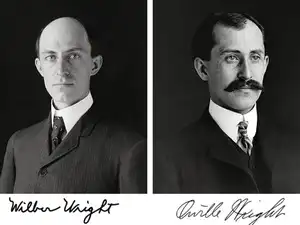
Long before Wilbur and Orville Wright became known as the pioneers of powered flight, the brothers were running a small printing business from a second-floor office in Dayton, Ohio. Their company, Wright & Wright, Job Printers, operated from the historic Hoover Block during the early 1890s, marking an important but often overlooked chapter in the lives of the men who would eventually change the history of aviation.
The brothers initially built their careers around printing, producing newspapers, advertisements and other printed materials before turning their attention to bicycles and, eventually, flying machines. Their printing operation remained at the Hoover Block until 1899, when their business interests had already begun moving in a new direction.
Today, the building is preserved as part of Dayton’s aviation heritage. The National Park Service has transformed the historic site into a museum, allowing visitors to explore the early working lives of the Wright brothers and understand how their journey towards flight began far from an aircraft workshop.
Hoover Block: Where the Wright Brothers Started Their Printing Business
The Hoover Block in Dayton, Ohio, holds a special place in the history of the Wright brothers because it was home to their early printing operation. During the early 1890s, Wilbur and Orville established Wright & Wright, Job Printers, in a second-floor office inside the building.
At the time, printing offered the brothers an opportunity to establish an independent business and develop practical skills. Their work involved producing printed material for customers, including newspapers, advertisements and commercial publications.
The printing business was a significant part of their early professional lives, although it is often overshadowed by their later achievements in aviation. The brothers were not initially working towards becoming aircraft inventors. They were young entrepreneurs exploring opportunities in a growing American economy.
Their office at Hoover Block reflected that ambition. It provided a base from which they could operate their printing enterprise, serve customers and develop the technical and commercial experience that would later prove useful in other ventures.
How Wilbur and Orville Wright Entered the Printing Business
Wilbur and Orville Wright developed an interest in printing during a period when newspapers and printed publications were important parts of everyday communication. The brothers recognised an opportunity to use printing equipment and their practical abilities to establish a business of their own.
They became involved in designing and producing printed material, gradually developing experience in typography, machinery and the operation of a small commercial enterprise.
Printing required attention to detail, mechanical understanding and the ability to solve practical problems. These were skills that would remain relevant as the brothers explored new technologies in later years.
Their work also reflected a characteristic of the Wright brothers’ approach to innovation: they were willing to experiment, learn through practical experience and build their knowledge by working directly with machines and equipment.
Although there is no direct evidence that their printing work alone led to their later aviation achievements, it formed part of the technical and entrepreneurial background that shaped their early careers.
From Printing Presses to Bicycle Manufacturing
The Wright brothers’ interests eventually expanded beyond printing. During the 1890s, bicycles became increasingly popular across the United States, creating opportunities for businesses involved in selling, repairing and manufacturing them.
Wilbur and Orville recognised the potential of the bicycle industry and established a bicycle business in Dayton. Their work included repairing bicycles, selling them and eventually producing their own models.
The transition from printing to bicycles was an important development because it brought the brothers into more direct contact with mechanical design and engineering. Bicycle construction required an understanding of balance, weight distribution, moving parts and structural stability.
These practical lessons became particularly valuable when the brothers began investigating the possibility of controlled flight. A bicycle had to remain balanced while moving, and its rider needed to control its direction. The Wright brothers would later confront related challenges when attempting to keep an aircraft stable and steerable in the air.
Their bicycle business also provided a source of income that helped support their experiments. Rather than depending entirely on outside financial backing, the brothers used their commercial activities to fund their growing interest in aviation.
Why the Wright Brothers’ Printing Experience Matters to Aviation History
The story of the Wright brothers is often told through their experiments with gliders, aircraft engines and the development of the first successful powered aeroplane. However, their earlier business activities help explain how they developed the practical abilities and financial independence that supported those achievements.
Printing exposed them to machinery, production processes and the challenges of running a business. Their later bicycle work strengthened their mechanical knowledge and encouraged them to approach technical problems through experimentation.
The brothers did not emerge as aviation pioneers overnight. Their progress involved years of learning, testing ideas and adapting existing knowledge to new challenges.
Their printing and bicycle businesses also demonstrate that major technological breakthroughs can emerge from unexpected beginnings. Before they became associated with aircraft, Wilbur and Orville were entrepreneurs working in industries that had little obvious connection to powered flight.
From Dayton to the First Successful Powered Flight
The Wright brothers’ growing interest in aviation developed during the late 1890s, when they began studying the problems involved in human flight. They examined the work of earlier aviation experimenters and focused on an issue they believed was central to making an aircraft successful: control.
Rather than concentrating only on building a powerful engine, they investigated how a pilot could maintain balance and change an aircraft’s direction while flying. Their experiments with gliders helped them develop the principles of three-axis control, which became fundamental to their successful flying machines.
In 1903, their work reached a historic milestone at Kill Devil Hills near Kitty Hawk, North Carolina. On December 17, Orville Wright piloted the Wright Flyer during the first successful controlled, sustained flight of a powered, heavier-than-air aircraft.
The flight lasted 12 seconds and covered approximately 120 feet. Wilbur and Orville conducted four flights that day, with the final flight lasting 59 seconds and covering 852 feet.
The achievement marked a turning point in transportation and engineering. It demonstrated that a powered aircraft could be controlled in flight, opening the way for further developments in aviation.
How the Hoover Block Became a Wright Brothers Museum
The historic Hoover Block eventually became an important part of efforts to preserve the early history of the Wright brothers. Its connection to their printing business gives the building significance beyond its architecture because it represents a period when the future aviation pioneers were still developing their professional and technical interests.
The National Park Service later incorporated the building into the preservation of Dayton’s aviation heritage, turning the historic site into a museum where visitors can learn about the brothers’ early business activities and their journey towards flight.
The museum helps place the Wright brothers’ achievements in a broader historical context. Instead of focusing exclusively on the 1903 flight, it allows visitors to explore the years of work, business experience and experimentation that preceded it.
Preserving the Hoover Block also protects an important part of Dayton’s local history. The city played a central role in the Wright brothers’ development, serving as the place where they established businesses, developed mechanical skills and pursued many of their early experiments.
Why Dayton Remains Central to the Wright Brothers’ Legacy
Dayton’s connection to the Wright brothers extends far beyond the Hoover Block. The city was their home and the centre of much of their early commercial and experimental work.
The brothers’ printing operation, bicycle business and aviation experiments were closely connected to the city’s industrial and entrepreneurial environment. Their achievements eventually brought international attention to Dayton and established the city as an important location in the history of flight.
Today, historic sites associated with the brothers help visitors understand how their work developed over time. The Hoover Block offers a particularly interesting perspective because it preserves evidence of a stage in their lives that is less widely known than their aviation experiments.
The building’s transformation into a museum also reflects the importance of preserving the places where major technological developments began. Such sites provide a tangible connection to the people behind historic achievements and help explain the circumstances in which their ideas took shape.
From Job Printers to Aviation Pioneers: An Unusual Journey
The story of Wright & Wright, Job Printers, is a reminder that the Wright brothers’ path to aviation began with ordinary business ventures rather than an immediate ambition to build an aeroplane.
Their second-floor office in Dayton’s Hoover Block was part of a period when they were learning how to operate a business, work with machinery and turn practical ideas into commercial products. Their subsequent move into bicycles gave them further mechanical experience and helped finance their aviation experiments.
Those early years provide a more complete picture of how Wilbur and Orville developed the skills and independence that eventually supported their historic achievement in 1903.
The Hoover Block’s preservation as a museum ensures that this lesser-known chapter remains part of their story. For visitors, it offers an opportunity to look beyond the famous first flight and discover where the journey of two of aviation’s most influential pioneers began: not in an aircraft factory, but in a small printing office in downtown Dayton.
For breaking news and live news updates, like us on Facebook or follow us on Twitter and Instagram. Read more on Latest World on thefoxdaily.com.



COMMENTS 0