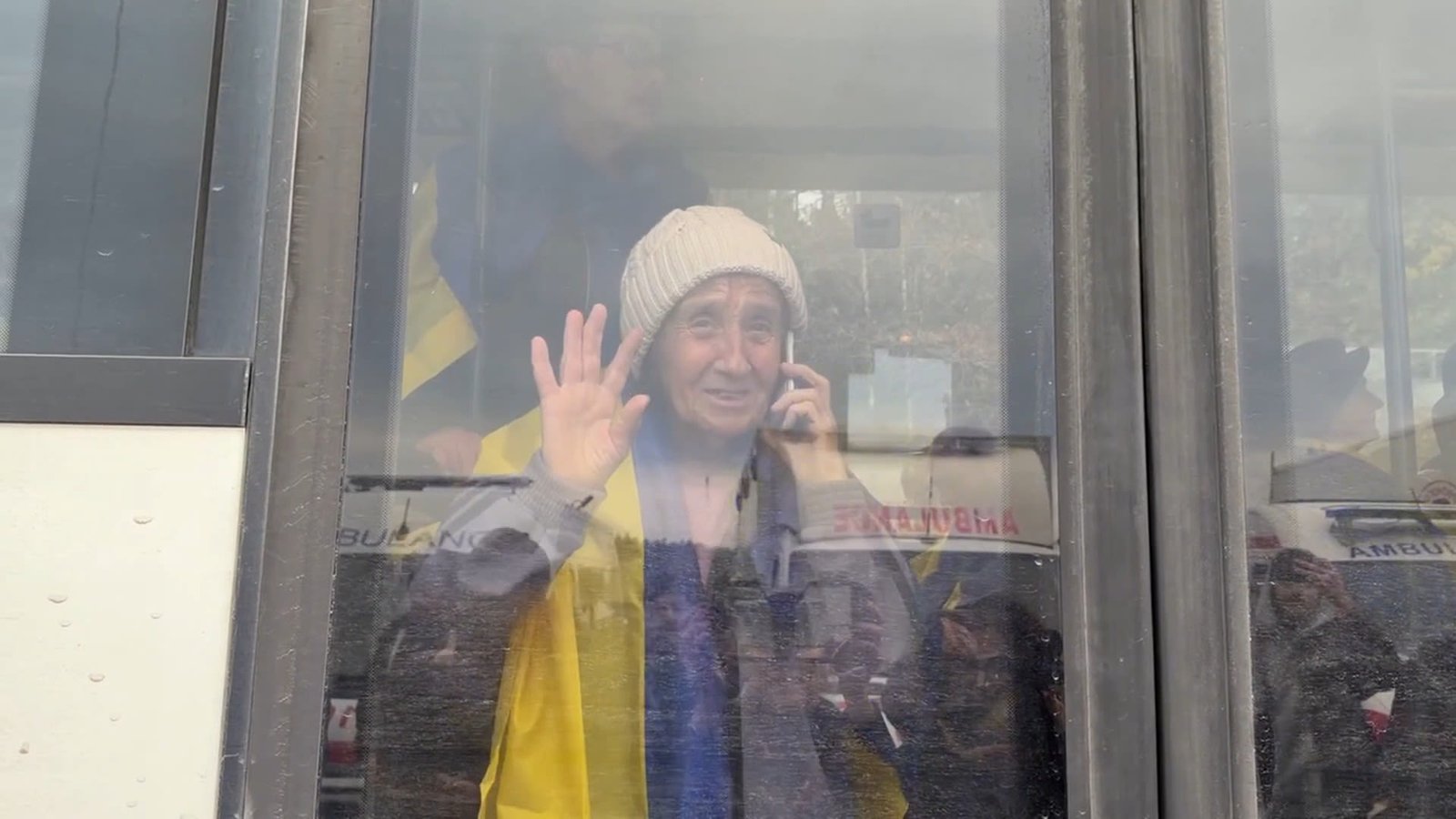
After 1,711 days apart, Dmytro and his wife Larisa were finally reunited as hundreds of Ukrainian civilians evacuated from the Russian-occupied town of Oleshky returned to Ukrainian-controlled territory under a temporary ceasefire. Their emotional meeting near the Ukraine-Belarus border marked the end of years of separation, hardship and uncertainty.
The humanitarian evacuation was made possible through a ceasefire called for by Pope Leo XIV, with US First Lady Melania Trump helping to facilitate negotiations. Hundreds of people, accompanied by pets, crossed back into Ukraine after enduring severe shortages of food, medicine and other essential supplies under occupation.
For Dmytro, a Ukrainian soldier, the reunion was especially emotional. He had been counting the days since he last saw Larisa. When she finally arrived by bus on Saturday afternoon, he repeatedly kissed her and held her tightly.
Larisa, 54, had lost approximately one-third of her body weight during the occupation. Despite her physical condition, she expressed happiness at returning home and spoke about other Ukrainians who continue to suffer because of the war.
“It’s hard for everyone in the country; there are so many people in the same situation as me. There are people in different situations, and some are even worse off. We’re waiting for all this to end, for peace to come, and for victory,” Larisa told CNN.
Melania Trump Helps Facilitate Humanitarian Evacuation
Ukraine’s President Volodymyr Zelensky announced the arrival of the evacuees in a Telegram post and thanked Melania Trump for her role in the mediation effort.
Zelensky also acknowledged journalists, political leaders, civic organisations and individuals who helped draw international attention to the Humanitarian Crisis in Oleshky. He said global attention had helped save people living in the Russian-occupied territory.
Melania Trump responded to the evacuation on X, writing that “Oleshky proves we can raise humanity above war.”
The operation involved cooperation between Ukrainian and Russian representatives, with Ukraine’s human rights commissioner Dmytro Lubinets travelling to Oleshky to personally escort the evacuees.
Lubinets’ visit was particularly significant because he became the first high-profile Ukrainian official to openly travel to Russian-controlled occupied territory since the beginning of the war, according to the supplied report.
Speaking to CNN after crossing the border, Lubinets described the operation as extremely difficult but said it could provide a model for future humanitarian negotiations.
“Now we have a unique positive experience how to negotiate with the Russian side with the coordination role of Melania Trump,” he said.
He added that several other Ukrainian communities were facing similar shortages of food and medicine, and expressed hope that the experience could help arrange further evacuations. He also said the process would depend on cooperation from both sides.
167 More People Evacuated From Kherson Region
The ceasefire also created an opportunity for additional evacuations from areas affected by fighting. On Sunday, the Ukrainian Army announced that it had evacuated 167 people from parts of the Kherson region that had been subjected to daily Russian shelling.
Among those evacuated were 22 children and 21 people with limited mobility who required additional assistance and care.
The operation highlighted the wider humanitarian importance of temporary arrangements that allow civilians to leave frontline communities. However, the situation remains uncertain for residents who are still unable or unwilling to leave occupied areas.
Malnutrition and Medicine Shortages Left Oleshky Residents in Crisis
For Larisa and other residents who remained in Oleshky, the years under occupation brought increasingly difficult living conditions. The town’s humanitarian situation deteriorated as fighting disrupted supplies and access to basic services.
Dmytro’s military service made Larisa particularly vulnerable after Russian forces took control of their hometown in southern Ukraine. The couple had managed to get their daughter out earlier, but Larisa feared that attempting to leave could result in her being stopped at a Russian military checkpoint.
She was concerned about undergoing so-called filtration, a process involving questioning of Ukrainians seeking to leave occupied areas for Ukrainian-controlled territory. The process has been described as humiliating and, in some cases, violent.
Larisa therefore remained in Oleshky, hoping that conditions would improve. Instead, the town experienced further destruction and worsening shortages.
2023 Nova Kakhovka Dam Collapse Worsened the Situation
Oleshky was severely affected by the major flooding in 2023 following the collapse of the nearby Nova Kakhovka Dam. The dam’s destruction caused widespread flooding across parts of southern Ukraine, with Ukrainian authorities attributing it to a Russian explosion.
Further damage from prolonged fighting added to the town’s difficulties. By September, Ukrainian authorities reported that Oleshky had run out of food and other essential supplies, with residents facing a lack of electricity, gas, medicine and basic services.
Reports from that period described people surviving on grass and weeds as food became increasingly difficult to obtain.
Residents who returned to Ukrainian-controlled territory during the latest evacuation told CNN that food deliveries had not reached Oleshky since the summer. One woman said she had gone more than a year without bread and had survived largely on vegetables, including tomatoes and cucumbers, that she had planted earlier.
Doctors Warn of Serious Health Risks From Prolonged Hunger
Medical teams were waiting near the border to provide immediate assistance to the returning civilians. Andriy Zhydenko, director of Chernihiv Regional Hospital, arrived with hospital staff to assess the evacuees and arrange medical care.
He said prolonged malnutrition would be one of the main concerns. People who have experienced severe food shortages cannot necessarily return to normal eating patterns immediately. Medical supervision is important because consuming large quantities of food too quickly after prolonged starvation can create serious health risks.
Zhydenko said the evacuees included people with injuries, stroke survivors and individuals with limited mobility who required special attention.
“All of my staff wanted to come here. People have suffered greatly there. There is no humanity,” he told CNN.
Another evacuee, Oleksandr, described his return as an extraordinary relief after living through severe deprivation.
“It was like I’d escaped from hell,” he said.
He explained that he had rarely gone outside because of the conditions and that residents had been unable to obtain food. Some survived by eating canned goods and pickles left behind in other apartments.
Not Everyone Chose to Return to Ukraine
Although hundreds of residents took part in the evacuation, not everyone chose to leave Oleshky. Some decided to remain in the occupied town despite the temporary ceasefire being scheduled to expire on Sunday.
Both Ukrainian and Russian authorities said humanitarian assistance had been provided to those who stayed.
Other residents chose to travel to Russia instead of returning to Ukrainian-controlled territory. Russia’s human rights commissioner, Yana Lantratova, said on Saturday that those evacuees had been received at a temporary accommodation centre in Simferopol, Crimea.
The different choices reflected the difficult circumstances facing civilians who had spent years living under occupation and had different personal, family and security considerations.
Families Reunited After Years of Separation
The evacuation also brought together families who had been separated since the early stages of the war. Among them were Zhanna Ptakhova and her daughters, Elizaveta and Daria Paliy, who had managed to leave Oleshky when evacuation routes were still accessible.
However, Ptakhova’s husband and the girls’ father, Mykhailo Paliy, had remained behind to look after the family home. He had expected to return to normal family life once it became safe, but the prolonged occupation prevented that from happening.
He survived by adapting the house to conditions without electricity, gas or heating. According to Ptakhova, he built a stove, raised chickens and planted a garden to provide food for himself.
“He took a house that had been adapted for modern civilian life and turned it into a home suited for a primitive lifestyle; he built a stove, raised chickens to feed himself, planted a garden, and through his own hard work, he survived there,” Ptakhova told CNN.
The family was finally reunited after three years apart. Mykhailo said he immediately recognised his daughters among the returning evacuees.
“I spotted my girls right away amidst everyone else, even from the bus,” he said.
How the Oleshky Evacuees Reached Ukraine
The journey out of Oleshky was complicated by extensive damage and dangerous conditions along the available routes. Access roads had been heavily mined and were littered with debris from drones and military vehicles. Direct evacuation across the Dnipro River into Ukrainian-controlled territory was not possible.
As a result, the evacuation required a longer route through Russian-controlled territory and neighbouring Belarus.
According to Russian and Ukrainian officials, a two-day demining operation was completed on Thursday. Residents who wanted to leave gathered on Friday before beginning their journey through occupied Crimea towards Anapa in Russia’s Krasnodar region.
From Anapa airport, the evacuees travelled by plane to Gomel in Belarus. They then continued by bus towards the Ukrainian border, where relatives, officials and medical teams waited for their arrival.
After crossing into Ukraine, the convoy of buses set off again, carrying people towards safety and reunions with loved ones. Strangers lined the roads for miles, waving Ukrainian flags as the evacuees returned.
Thousands of Oleshky Residents Remain Affected by the War
Oleshky had a prewar population of approximately 24,000 people. According to the Institute for the Study of War (ISW), around 40% of its residents managed to flee to Ukrainian-controlled territory during the earlier stages of the fighting, when evacuation was still possible.
Thousands more escaped in the years that followed, but many residents remained in the occupied town. Some were unable to leave because of dangerous routes, while others chose to stay for personal or family reasons.
The latest evacuation has brought relief to hundreds of civilians, but it also highlights the continuing humanitarian challenges in communities under Russian occupation.
A Humanitarian Breakthrough Amid the Ongoing War
The return of the Oleshky evacuees represents a significant humanitarian development, particularly for families who had spent years separated by the conflict. The reunion of Dmytro and Larisa after 1,711 days illustrates the personal cost of occupation, displacement and prolonged uncertainty.
The operation also demonstrated how temporary ceasefires and negotiations can create opportunities to move civilians away from dangerous conditions. Ukraine’s officials have expressed interest in using the experience to help other communities facing shortages of food, medicine and essential services.
However, the ceasefire was temporary, and thousands of Ukrainians continue to face the consequences of the war. For those who returned from Oleshky, the journey home has ended, but the wider humanitarian crisis remains unresolved.
For breaking news and live news updates, like us on Facebook or follow us on Twitter and Instagram. Read more on Latest World on thefoxdaily.com.





COMMENTS 0