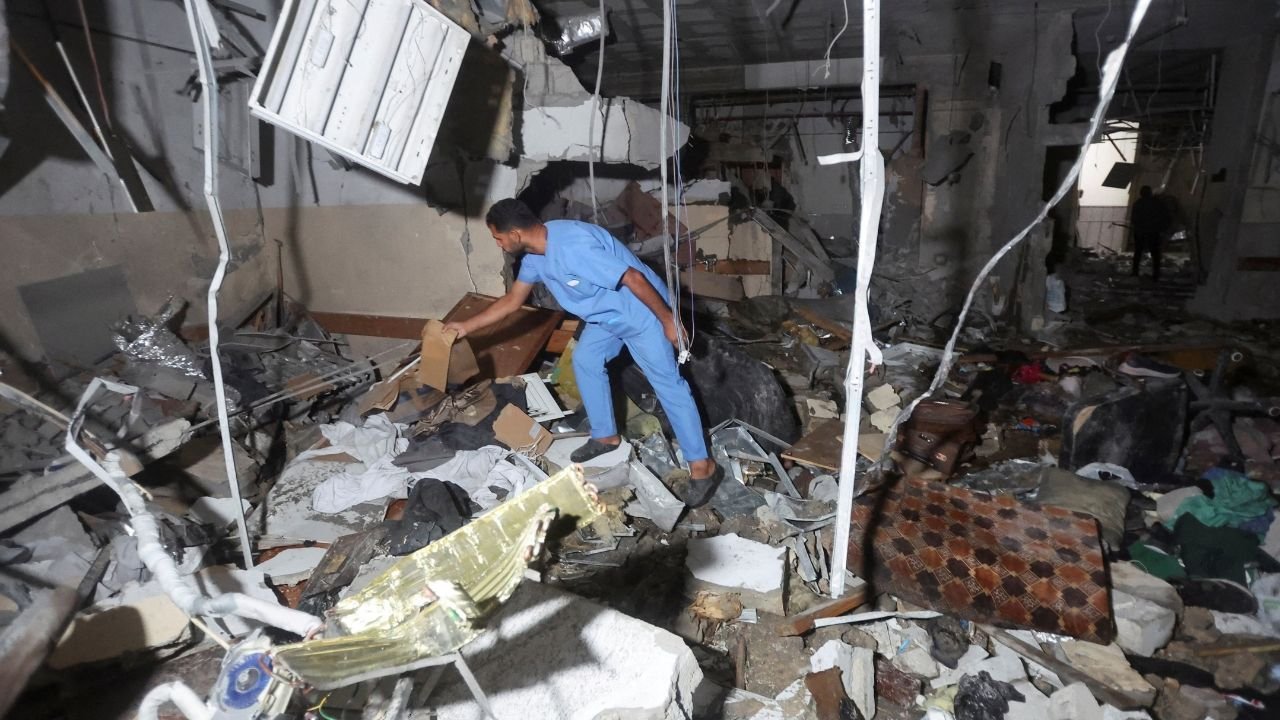
An Israeli airstrike hit Nasser Hospital in southern Gaza early Thursday, November 12, killing at least six people, including a surgeon and a 13-year-old boy, according to Palestinian health officials. The attack damaged the hospital’s surgical department and left debris scattered across medical wards, raising fresh concerns about the safety of patients and healthcare workers despite the US-backed ceasefire between Israel and Hamas.
The Israeli military said it targeted a senior Hamas commander and other militants whom it accused of operating from within the hospital complex. It later identified the intended target as Muhammad Abu Ismail, whom it described as the commander of Hamas’ Khan Younis Brigade. However, the military had not confirmed whether he was killed in the strike.
Palestinian officials said medical personnel and patients were among those killed. The dead included surgeon Dr. Rizk Abu Shaira, who had continued working at the hospital throughout the conflict, and 13-year-old patient Jihad Naeem Muhammad Abu Tilikh.
The incident has intensified criticism of continued attacks on Gaza’s healthcare facilities, many of which have been damaged or rendered inoperable during the war that began in October 2023.
What Happened at Nasser Hospital?
The strike hit the surgical building at Nasser Hospital in Khan Younis shortly after midnight on Thursday. The attack caused extensive damage to parts of the medical complex, including surgical wards and areas used to provide treatment to patients.
Gaza’s Health Ministry and Civil Defence authorities reported that at least six people were killed and around 20 others injured. The initial reports described damage to the surgery department, with ceilings shattered, furniture and rubble scattered across rooms, and electrical wires left hanging from damaged sections of the building.
People inside the hospital had to navigate debris-covered corridors as emergency workers and medical staff attempted to assist the wounded. The damage also disrupted medical services, including surgical operations and other treatment facilities.
Nasser Hospital is located in Khan Younis and is among the relatively few medical facilities in Gaza that continue to provide significant healthcare services. Its importance has increased as repeated attacks, shortages of supplies and damage to infrastructure have weakened the territory’s medical system.
The strike occurred despite a ceasefire agreement that took effect in October 2025. Both Israel and Hamas have accused each other of violating the arrangement, while diplomatic efforts to advance the next stage of the agreement have faced difficulties.
Surgeon Rizk Abu Shaira Among Those Killed
Dr. Rizk Abu Shaira, a Palestinian surgeon working at Nasser Hospital, was among the six people killed in the attack, according to Gaza’s Health Ministry.
Abu Shaira had continued providing medical care during the war and was remembered by colleagues and hospital officials for remaining at his post even under extremely difficult conditions. He had also appeared in the 2026 documentary American Doctor, which followed three American doctors who travelled to Gaza to assist with medical treatment.
British surgeon Dr. Goher Rahbour, who had worked alongside Abu Shaira earlier on Wednesday, said they had spent time together in the operating theatre and had been laughing and joking in the hours before the attack.
Rahbour described his colleague as a lovely and affable person. The two surgeons had worked together on medical cases during Rahbour’s visit to Gaza, making the news of Abu Shaira’s death particularly difficult for the visiting medical team.
Dr. Mohammed Zaqout, director general of Gaza’s Health Ministry, paid tribute to the surgeon during a gathering of mourners. He said Abu Shaira had remained at the hospital throughout the war and had not abandoned his responsibilities for even a day.
Abu Shaira’s death has become a symbol of the risks faced by healthcare workers who continue treating patients in Gaza despite repeated attacks, damaged facilities and shortages of essential medical equipment.
13-Year-Old Patient Also Killed in the Strike
Among the victims was 13-year-old Jihad Naeem Muhammad Abu Tilikh, whose death was confirmed by Nasser Hospital.
The killing of a child receiving or connected to medical care at the hospital has added to concerns about the impact of the strike on civilians. Patients inside medical facilities are particularly vulnerable because they may be unable to move quickly or evacuate without assistance.
Another victim was identified as Khaled Abu Anza, a 53-year-old man who was at the hospital for physical therapy after undergoing surgery. His sister, Tahani Ibrahim Abu Anza, said he had gone to the medical complex to receive treatment rather than participate in any fighting.
She said she believed her brother had been targeted, although she did not directly identify him as a Hamas member. Her account highlighted the uncertainty surrounding the circumstances of individual victims and the competing explanations being offered after the attack.
Palestinian health authorities have not presented evidence establishing that the patients and medical workers killed were involved in military activity.
British Doctors Say They Received No Warning Before the Attack
Two British surgeons who were inside Nasser Hospital when the missile struck described the impact and the damage caused by the explosion.
Dr. Goher Rahbour, a consultant general and colorectal surgeon, and Dr. Stephan Verborg, a limb reconstruction surgeon, had travelled to Gaza earlier in November to assist with medical care. Both were working through IDEALS, a UK-based charity that provides humanitarian support to communities affected by conflict and natural disasters.
Verborg said he was approximately 15 to 20 metres from the point of impact when the explosion occurred. He described hearing the blast and feeling the entire hospital shake.
He also recalled the smell of smoke and the dust that filled the area immediately after the missile struck. His account illustrated how close medical personnel were to the explosion while carrying out their work.
Both doctors said they were unaware of any warning from the Israeli military before the strike. They also said they had not observed indications of a Hamas presence inside the hospital during their work there.
Their accounts contrast with the Israeli military’s claim that Hamas had established a military presence within the medical complex. The competing statements have made the circumstances surrounding the alleged military activity a central issue in the aftermath of the attack.
Israel Says It Targeted Hamas Khan Younis Brigade Commander
The Israel Defense Forces and Israel Security Agency said the operation targeted a senior Hamas member and additional militants who were allegedly using Nasser Hospital for military activities.
In a subsequent statement, Israeli authorities identified the senior target as Muhammad Abu Ismail, whom they described as the commander of Hamas’ Khan Younis Brigade. The military alleged that he was responsible for directing attacks against Israeli forces and civilians and had also been involved in holding hostages in Gaza.
Israeli authorities further claimed that Hamas had established a presence inside the hospital complex and was using it as a command centre. According to their statement, the group stored weapons there and conducted interrogations and torture within the medical facility.
The IDF and Shin Bet said they had taken measures to reduce the risk to civilians, including using precision munitions and aerial surveillance. They also released images that they said showed weapons allegedly found inside the complex.
However, the military’s claims about the hospital’s use were not independently established in the immediate aftermath of the attack. The Israeli authorities also said they were examining reports that medical workers, including Abu Shaira, and patients had been killed.
The military’s statement did not establish whether Abu Ismail died. Reports identifying a Hamas commander with the same name as a victim of the strike also circulated, but the Israeli military had not confirmed his death at the time of the initial reports.
Hamas Rejects Israeli Allegations About the Hospital
Hamas condemned Israel’s claims that the hospital was being used for military operations, describing them as false allegations. The group called the strike a war crime and accused Israel of continuing attacks on Gaza despite the ceasefire.
The dispute reflects a longstanding disagreement over Israel’s military operations around medical facilities in Gaza. Israeli authorities have repeatedly accused Hamas of using hospitals and other civilian infrastructure for military purposes, while Hamas has denied those allegations.
These competing claims are particularly significant because hospitals receive special protection under international humanitarian law. Medical facilities, patients and healthcare workers must be respected and protected during armed conflict.
That protection is not absolute in every circumstance. A hospital can lose its special protection if it is used outside its humanitarian function to commit acts harmful to an enemy, subject to legal requirements that include warnings where appropriate and consideration of civilian harm.
Even when a hospital is alleged to be used for military purposes, the presence of fighters does not remove the obligation to distinguish between military targets and civilians. Any attack must comply with the principles of distinction, proportionality and precautions under international humanitarian law.
The circumstances of the Nasser Hospital strike, including the alleged military use of the complex, the precautions taken and the civilian casualties, remain important questions requiring independent examination.
Nasser Hospital Has Been Hit Before
The latest attack is not the first time Nasser Hospital has been struck during the war. In August 2025, an Israeli attack on the medical complex killed at least 20 people, including journalists and healthcare workers.
That incident involved two successive strikes. The first hit an area where journalists were working, and another explosion followed as emergency responders and other journalists arrived at the scene. The deaths triggered widespread international criticism and renewed scrutiny of military operations around hospitals and civilian infrastructure.
The earlier attack demonstrated the dangers faced by journalists, medical personnel and rescue workers operating in Gaza. It also intensified calls for investigations into strikes that result in civilian deaths at medical facilities.
The repeated targeting of locations associated with healthcare has placed additional pressure on an already weakened medical system. Hospitals that remain operational must often treat large numbers of patients while dealing with shortages of medicine, equipment, electricity and trained personnel.
Gaza’s Healthcare System Faces Severe Damage
Nasser Hospital is among the limited number of facilities still providing substantial medical services in Gaza. The World Health Organization has reported extensive damage to the territory’s healthcare infrastructure, with hospitals operating under severe constraints.
According to WHO figures cited in the supplied reporting, only two of Gaza’s 37 hospitals were considered fully functioning, while 18 were partially functioning and 17 were nonfunctioning.
The distinction matters because a hospital classified as partially functioning may still provide essential treatment, but it may lack the capacity, equipment or staffing needed to deliver a full range of medical services.
Damage to surgical facilities can have consequences beyond the immediate casualties of an attack. Patients requiring emergency operations, cancer treatment, rehabilitation, intensive care or specialist procedures may have fewer places to receive treatment.
Medical staff also face difficult decisions when facilities are damaged. Patients may need to be transferred to other hospitals, but transportation can be dangerous and alternative facilities may already be overwhelmed.
The destruction and disruption of healthcare infrastructure therefore affect not only people injured during military operations but also patients with chronic illnesses, pregnant women, children and people recovering from previous injuries.
Medical Aid Organisations Condemn the Latest Attack
Medical Aid for Palestinians, an organisation that supports several departments at Nasser Hospital, condemned the overnight strike.
The organisation said the attack demonstrated that the ceasefire had not brought an end to the dangers facing Gaza’s healthcare system. It warned that continued attacks were undermining the ability of medical facilities to provide essential treatment.
Humanitarian organisations have repeatedly called for medical facilities and healthcare workers to be protected. They have also highlighted the need for reliable access to medicines, medical equipment, fuel and other essential supplies.
For doctors working in Gaza, the latest strike adds to an already difficult environment in which providing routine medical care can involve significant risks. The deaths of local medical personnel also create additional pressure on a system that has lost many experienced healthcare workers during the conflict.
Ceasefire Under Pressure as Palestinian Death Toll Rises
The attack has raised further questions about the effectiveness of the ceasefire agreement that came into effect in October 2025 with US backing.
Despite the truce, Israeli strikes and gunfire have continued in Gaza. The Palestinian Health Ministry says more than 1,600 people have been killed since the ceasefire began. Israel has reported the deaths of four of its soldiers during the same period, according to the figures provided in the latest reporting.
Both Israel and Hamas have accused the other side of violating the agreement. Disagreements over security arrangements, the future of Hamas, Israeli military positions and the next stage of the proposed peace framework have complicated efforts to move forward.
The overall death toll in Gaza has also continued to rise. Palestinian health authorities report that more than 74,600 people have been killed since Israel launched its military offensive following the Hamas-led October 7, 2023, attack on southern Israel.
Approximately 1,200 people were killed in the October 7 attack, according to Israeli figures, while around 250 people were taken hostage. The subsequent Israeli military campaign has devastated large parts of Gaza and displaced much of its population.
Heavy Rain and Winter Conditions Add to Gaza’s Humanitarian Crisis
The latest hospital strike comes as Palestinians face worsening humanitarian conditions with the arrival of colder weather and heavy seasonal rainfall.
Many people remain displaced from their homes, with families living in temporary shelters and damaged buildings. Heavy rain can flood makeshift accommodation, destroy limited belongings and increase the risk of illness among people who lack adequate protection from the elements.
The combination of damaged infrastructure, limited medical services and inadequate shelter has made the humanitarian situation particularly difficult for children, older people and those with existing health conditions.
Humanitarian organisations have called for greater access to essential supplies, including medicines, food, clean water, shelter materials and equipment needed to restore healthcare services.
The latest attack on Nasser Hospital has added another layer of uncertainty for patients and medical workers who depend on the facility. With the ceasefire still facing serious challenges, the prospects for restoring Gaza’s healthcare system remain closely tied to whether attacks decrease and humanitarian access improves.
What Happens Next After the Nasser Hospital Strike?
The immediate priority following the attack is treating those injured, assessing the damage to the surgical department and determining which hospital services can continue operating safely.
Gaza’s Health Ministry has condemned the strike and highlighted the deaths of medical personnel and patients. Israel, meanwhile, has said it was targeting a senior Hamas commander and other militants allegedly operating from the hospital complex.
Important questions remain about the military target, the circumstances surrounding the deaths of civilians and the evidence supporting the allegation that Hamas used the medical facility for military purposes.
The incident is also likely to intensify international calls for the protection of hospitals and medical workers under international humanitarian law. Any assessment of the attack will need to consider the military claims, the accounts of witnesses, the civilian casualties and the obligations governing attacks on medical facilities.
For patients and healthcare workers in southern Gaza, the consequences are immediate. The deaths of six people, including a surgeon and a child, and the damage to one of the territory’s remaining major hospitals have further weakened an already devastated healthcare system.
As the ceasefire continues to face repeated challenges, the Nasser Hospital strike has underscored the gap between the announcement of a truce and the reality experienced by civilians who remain exposed to violence and severe humanitarian hardship.
For breaking news and live news updates, like us on Facebook or follow us on Twitter and Instagram. Read more on Latest World on thefoxdaily.com.




COMMENTS 0