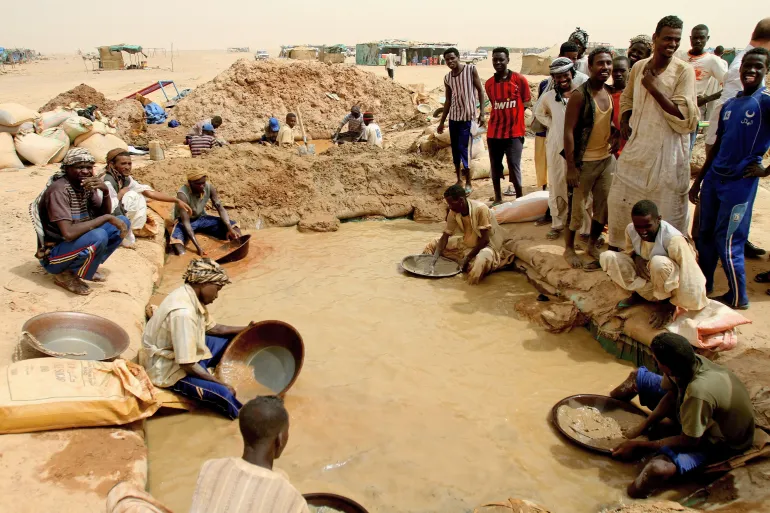
At least 67 informal miners have been killed in a gold mine collapse in Sudan’s West Kordofan province, according to survivors and the Sudan Doctors Network, in another deadly disaster highlighting the risks faced by workers in the country’s largely unregulated small-scale mining sector.
The collapse occurred at the al-Zara gold mine near Nuhud, an area controlled by the paramilitary Rapid Support Forces (RSF), which has been fighting Sudan’s military in a devastating conflict that began in April 2023.
The reported death toll remained uncertain as rescue workers searched through collapsed earth and rock. A local administration official told The Associated Press that 82 bodies had been recovered and that dozens of people were still missing. Other accounts put the number of dead or missing at lower levels.
The conflicting figures reflect the difficulty of conducting rescue and recovery operations in a remote mining area amid an ongoing war. Survivors said heavy machinery was scarce, while the Sudan Doctors Network warned that the number of fatalities could increase as rescuers reached deeper sections of the mine.
Beyond the immediate tragedy, the collapse has exposed two longstanding problems in Sudan: dangerous conditions in informal gold mines and the severe limitations facing emergency response teams in territories affected by armed conflict.
What happened at the al-Zara gold mine?
The collapse took place at the al-Zara mine, a large informal mining site near Nuhud in West Kordofan. Survivors described the collapse as massive, with interconnected underground shafts becoming affected after an initial section gave way.
A local official said the collapse began in one shaft before spreading to other connected shafts. The mine reportedly extends across more than a kilometre and sits in an area of fragile, sandy soil, conditions that can make underground excavation particularly hazardous.
Survivors also described the difficulty of reaching miners trapped beneath the rubble. Khairal-Sayed Gabara said workers did not have sufficient machinery to remove soil and stones from depths exceeding 30 metres.
Another survivor, Al-Amin Suliman, said dozens of people had been working at the site and that bodies had been recovered by Wednesday morning, while others remained trapped underground.
The lack of heavy equipment has become one of the central obstacles to the rescue operation. According to the local administration official, only one privately owned forklift was available to assist with the recovery effort.
Death toll remains unclear as rescue continues
Different organisations and witnesses have reported different casualty figures, making it difficult to establish a final toll while recovery operations remain underway.
The Sudan Doctors Network initially reported at least 67 deaths and warned that the number could rise. The Kordofan Observatory, a monitoring group, reported that at least 70 miners were either dead or missing.
A local administration official later told the Associated Press that 82 bodies had been recovered, while dozens remained unaccounted for.
The discrepancies are not unusual in a disaster occurring in a remote conflict-affected area. Access to the site is limited, communications are unreliable and authorities lack the logistical capacity normally available during major industrial accidents.
The timing of the collapse has also been reported differently. Survivors reached by phone and the Sudan Doctors Network described the incident as occurring on Tuesday evening, while a local official said the collapse began on Sunday. These differences underline the difficulty of independently verifying events in an area where information is emerging through survivors, local officials and monitoring groups.
Until the recovery operation is completed and authorities can reconcile the lists of workers present at the mine with recovered bodies, the final death toll may remain uncertain.
Why are Sudan’s gold mines so dangerous?
Sudan is one of Africa‘s significant gold-producing countries, but much of its mining sector operates through small-scale and informal activities where safety standards are difficult to enforce.
Thousands of small mining sites operate across the country, with workers often digging underground shafts using limited equipment. Where geological assessments, structural reinforcement, ventilation systems and other safety measures are absent or inadequate, mine collapses can become deadly.
The al-Zara disaster is not an isolated event.
A mine collapse in Sudan in 2023 killed 14 miners, while another collapse in 2021 killed 38 people. Repeated accidents have highlighted the dangers of informal mining even before the country’s current war further weakened state institutions and emergency services.
In a functioning mining industry, underground operations typically depend on geological assessments, engineered supports, inspection systems, worker training and emergency plans. Informal mines may operate outside such systems, increasing the risk that unstable shafts will fail without warning.
The problem becomes even more serious when rescue equipment is unavailable. A collapse is not necessarily fatal for everyone underground, but survivors can quickly run out of air or become trapped by secondary collapses if rescue teams cannot remove debris rapidly.
War has made rescue operations even harder
The al-Zara mine is located in West Kordofan, a region caught up in Sudan’s wider conflict between the Rapid Support Forces and the Sudanese military.
The war began in April 2023 after tensions between the two forces erupted into full-scale fighting. Since then, fighting has spread across large parts of Sudan, destroying infrastructure and severely disrupting Healthcare, transportation and other public services.
West Kordofan is strategically important because of its location and natural resources. The wider Kordofan region has experienced fighting and displacement as the rival forces compete for territory and access routes.
In such an environment, an industrial or mining accident becomes much more difficult to manage than it would be under normal circumstances.
Heavy rescue equipment has to reach the site. Medical teams need safe access. Roads must remain usable. Communications have to function. Authorities also need enough personnel to coordinate recovery efforts.
The reported availability of only one privately owned forklift illustrates how limited those capabilities can be in a conflict zone.
Gold has become intertwined with Sudan’s war economy
The mine collapse also draws attention to the wider role of gold in Sudan’s conflict.
Gold has long been economically important to Sudan. The country’s extensive gold deposits have attracted both industrial and artisanal miners, while the sector has also become a major source of revenue and influence for armed groups and networks operating outside formal state structures.
United Nations-commissioned experts have reported that substantial quantities of Sudanese gold have been smuggled out of the country, with gold revenues helping finance the RSF. The paramilitary force controls areas of Darfur and Kordofan where gold production takes place.
This does not mean that every informal miner working in an RSF-controlled area is directly connected to the paramilitary group. Many are ordinary workers seeking income in an economy devastated by war.
However, control over gold-producing territory can provide armed groups with access to valuable resources and informal taxation or trading networks. That makes mining areas economically important as well as potentially dangerous.
Informal miners face risks beyond mine collapses
For miners working outside tightly regulated industrial operations, the danger extends beyond unstable shafts.
Informal workers can face exposure to hazardous substances, accidents involving rudimentary machinery, inadequate ventilation and difficult working conditions. Limited access to healthcare can make even survivable injuries potentially life-threatening.
War adds another layer of vulnerability. Workers may have limited alternatives for earning money and may continue mining despite dangerous conditions because gold provides one of the few available sources of income.
At the same time, the collapse of public institutions makes it harder to enforce safety rules or conduct regular inspections.
This creates a cycle in which economic desperation pushes workers toward informal mining, while weak regulation leaves them exposed to hazards that a better-equipped mining industry would normally be expected to control.
The human cost is larger than the official death toll
The immediate victims of the al-Zara collapse are the miners who died or remain trapped underground. But disasters of this kind also affect families and communities that depend on mining income.
In many small-scale mining communities, individual miners support entire households. The loss of dozens of workers therefore removes income from families already facing the consequences of war, Inflation, displacement and shortages of basic necessities.
Families also face uncertainty when bodies cannot immediately be recovered. The difference between a confirmed death and a missing worker becomes particularly significant when rescue operations are slow.
For communities living in remote areas, the absence of functioning emergency services can intensify that uncertainty.
Sudan’s wider humanitarian crisis makes the disaster more serious
The mine collapse occurred against the backdrop of one of the world’s largest humanitarian crises.
Sudan’s war has displaced millions of people and disrupted food production, healthcare and essential infrastructure. Aid agencies have repeatedly warned of severe hunger and famine conditions in parts of the country.
The conflict has also produced a very high death toll. Data from the Armed Conflict Location & Event Data group has put the number of people killed since the war began at at least 59,000, while humanitarian organisations have warned that the actual figure could be considerably higher because many deaths are never recorded.
That uncertainty is reflected in the mine disaster as well. Establishing the exact number of people underground at the time of a collapse can be difficult when workers are informal, records are incomplete and the authorities responsible for the area have limited resources.
Why the al-Zara collapse matters beyond West Kordofan
The tragedy highlights a problem that extends across Sudan’s mining economy.
Gold remains valuable enough to attract workers even during wartime. But the same conflict that increases reliance on informal economic activity also weakens the institutions capable of regulating it.
That combination creates significant safety risks.
The al-Zara mine collapse demonstrates how three separate vulnerabilities can reinforce each other: unsafe informal mining, weak emergency capacity and armed conflict.
Even if rescue teams manage to recover everyone trapped underground, the underlying conditions that produced the disaster will remain. Thousands of informal miners continue to work in environments where safety enforcement can be limited and emergency response may be severely constrained.
What happens next?
The immediate priority is recovering miners who remain trapped and identifying the victims. Rescue teams will need heavy machinery capable of moving large quantities of soil and rock without triggering further collapses.
Authorities will also need to establish how many workers were present when the shaft failed and determine the precise cause of the collapse.
Those questions are difficult to answer while the site remains unstable and access is restricted. They are nevertheless important because understanding whether the collapse was linked to unstable ground, excavation practices, inadequate supports or another factor could help prevent similar disasters.
Longer term, the tragedy raises difficult questions about how Sudan can regulate informal mining while its institutions remain weakened by war.
Formalising mining sites, improving safety inspections, providing appropriate protective equipment and establishing realistic emergency-response capacity could reduce the risks. But implementing such measures in an RSF-controlled conflict zone presents challenges that go far beyond mining regulation.
A disaster exposing Sudan’s wartime vulnerabilities
The deaths at the al-Zara gold mine are not simply the result of one section of earth collapsing underground. They expose the vulnerabilities of an informal workforce operating inside a country where war has weakened the systems designed to protect workers and respond to emergencies.
The precise death toll remains uncertain, with different sources reporting different numbers as rescue and recovery operations continue. What is clear is that dozens of miners have died and others may still be trapped.
The disaster also shows why Sudan’s gold sector cannot be viewed only through production and revenue figures. Behind the country’s gold output are workers operating in difficult conditions, often with little protection and few alternatives.
In West Kordofan, those risks are compounded by armed conflict and limited rescue capacity. Until safer mining practices and effective emergency systems can be established, deadly collapses like the one at al-Zara will remain an ever-present danger for Sudan’s informal miners.
For breaking news and live news updates, like us on Facebook or follow us on Twitter and Instagram. Read more on Latest World on thefoxdaily.com.




COMMENTS 0