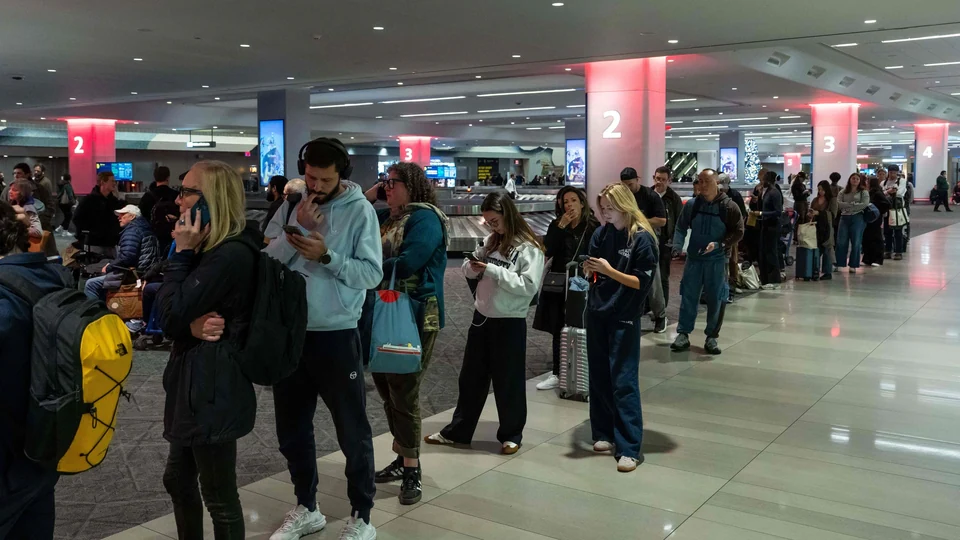
Airports across the United States descended into confusion on Friday after the Federal Aviation Administration (FAA) temporarily halted all departing flights following a communications system outage. The unprecedented disruption left passengers stranded, disrupted connecting journeys and forced travellers to reconsider plans with little information about when services would resume.
The nationwide ground stop was lifted after approximately four hours, but the end of the restriction did not mean an immediate return to normal operations. Airlines and airports faced the difficult task of clearing backlogs, repositioning aircraft and accommodating passengers whose journeys had been interrupted.
US Transportation Secretary Sean Duffy attributed the disruption to an overload involving an ageing air traffic control communications system. The failure reportedly caused faulty information to reach regional air traffic control centres, prompting authorities to stop departing flights as a precaution.
The incident affected thousands of flights and exposed the vulnerability of critical aviation infrastructure that still depends on older communications technology. For passengers, however, the immediate concern was more personal: missed connections, cancelled trips and uncertainty about getting home.
Passengers Describe Panic, Missed Plans and Lack of Information
The sudden announcement left passengers at airports across the country struggling to understand what had happened. Many said they received little information about the cause of the disruption or how long they would have to wait.
At New York’s LaGuardia Airport, 61-year-old Janice Llewellyn feared she would miss her daughter’s wedding in Toronto. Her husband had travelled from England to attend the family event, making the disruption particularly distressing.
“I may lose my mind,” she said while describing the possibility of missing the wedding. Speaking to AFP, she expressed frustration over the lack of alternative flights and said she wished she could get another flight immediately.
Other passengers described the experience as frightening and confusing. One woman told the BBC that her first thought was “doomsday” when she heard about the nationwide shutdown. Another passenger said he was shocked by the announcement.
Some travellers initially connected the disruption to the technology problems that had affected Microsoft services earlier in the week. However, officials later said there was no evidence linking the aviation outage to that incident.
At Las Vegas airport, passengers faced long queues at rental car counters as they tried to find alternative ways to reach their destinations. Conflicting explanations from airline staff added to the uncertainty, with some travellers being told their delays were related to weather conditions while others heard that the ground stop could last eight or even 24 hours.
For passengers with important personal commitments, the disruption was more than an inconvenience. Riley Alexis Holmes, who was travelling to Oregon for her brother’s musical closing night, said her flight was cancelled after being delayed for around two hours.
“I called my mom and cried, and I’m just like sitting here waiting for information,” she told Business Insider.
Kieran Cullen, 27, was also left stranded after travelling for more than 24 hours following the end of his overseas deployment. He was trying to reach Jacksonville, Florida, when his flight was cancelled after hours of waiting.
Cullen said announcements mentioned rotating blackouts on communication frequencies but provided little detail about the problem. After such a long journey, the cancellation left him frustrated and uncertain about when he would reach his destination.
Tiara Johnson described a similar experience, saying she felt stuck after arriving at the airport expecting to travel as planned. Other passengers told NBC News that they had never experienced such a widespread disruption during their years of flying.
What Caused the Nationwide FAA Ground Stop?
Transportation Secretary Sean Duffy blamed the disruption on an ageing air traffic control communications network that became overloaded with data. He said the system’s switches and routers began delivering inconsistent information to air traffic control facilities across the country.
According to Duffy, instability affected radar information and communications at regional centres and Terminal Radar Approach Control facilities, commonly known as TRACONs. These facilities help controllers manage aircraft approaching and departing airports.
The problem created inconsistencies in the information used by air traffic controllers to coordinate aircraft movements. Authorities decided to halt departures as a precaution rather than risk operating with unreliable communications data.
Duffy described the infrastructure as extremely old, pointing to its reliance on legacy technology and analogue telecommunications. He said the system used older switches, routers and copper-based connections that had become vulnerable to overload.
The FAA’s decision was therefore a safety measure rather than a response to an aircraft accident. The agency temporarily restricted departures while technicians investigated the communications failure and worked to restore normal functionality.
Officials Rule Out Evidence of a Cyberattack
The nationwide ground stop immediately raised questions about whether the outage could have been caused by a cyberattack or another form of hostile interference. However, Homeland Security Secretary Markwayne Mullin said officials had found no evidence of such activity.
Mullin stressed that investigators had not identified signs of a cyberattack or an artificial intelligence-related attack. He also rejected suggestions that the disruption was connected to the Microsoft service outage reported earlier in the week.
President Donald Trump’s administration said there was no evidence that the incident involved foul play. Officials nevertheless indicated that the cause was being examined rather than presenting the absence of evidence as a final determination of every possible technical cause.
Mullin sought to reassure travellers that the situation was different from a national security emergency. He said aircraft already in the air were being handled safely and that the public did not need to fear for the safety of passengers.
The statements helped address immediate concerns about a possible deliberate attack, although the incident renewed questions about the reliability of the technology supporting the country’s aviation system.
FAA Lifts Ground Stop After Around Four Hours
The FAA eventually cancelled the nationwide ground stop after approximately four hours, allowing airlines to resume departures. The restriction had been imposed on Friday afternoon and was lifted at around 8:15 pm Eastern Time.
However, reopening the airspace did not immediately restore normal flight schedules. By the time departures were allowed to resume, aircraft and crews had been displaced from their planned positions, while passengers were waiting for updated travel arrangements.
Duffy warned that the recovery process would take time. Airlines needed to determine which aircraft were available, whether pilots and cabin crew were within their permitted duty limits and how to reorganise disrupted schedules.
The impact extended beyond cancelled departures. Arriving flights, connecting journeys and international travel were also affected as airlines adjusted operations to deal with the backlog.
According to flight-tracking data cited during the disruption, thousands of flights were cancelled and many more delayed. The Associated Press reported that at least 600 flights were diverted, while other services faced lengthy interruptions. The total number of affected flights continued to change as airlines updated their schedules.
Why the US Air Traffic Control System Is Under Scrutiny
The outage has renewed concerns about the condition of the technology used to manage air traffic in the United States. Although the country operates one of the world’s busiest aviation networks, parts of its air traffic control infrastructure still depend on older communications equipment.
Air traffic controllers rely on dependable radar information and communication links to coordinate aircraft movements. Even when aircraft remain capable of flying safely, inconsistent information can make it difficult for controllers to maintain the separation and coordination required across busy airspace.
The nationwide ground stop demonstrated how a technical problem affecting communications facilities can quickly spread across the aviation network. A failure involving critical infrastructure does not necessarily have to affect every airport directly to disrupt flights across the country.
Modernisation has been a major focus of US Aviation policy, with authorities working to replace ageing equipment and improve communications systems. Duffy used the incident to renew calls for funding to upgrade the country’s air traffic control infrastructure.
The challenge is not limited to replacing old hardware. Modern systems must also be reliable, secure and capable of handling the enormous volume of information required to manage commercial, cargo and other aircraft movements.
What Passengers Should Expect After the FAA Disruption
Even after the ground stop was lifted, passengers were advised to check directly with their airlines for updated departure times and cancellation information. The recovery process depended on the availability of aircraft and crews as well as the ability of airports to manage the backlog.
Travellers with connecting flights faced additional uncertainty because delays on one part of a journey could affect later bookings. Passengers whose flights were cancelled also needed to contact airlines to arrange alternative travel.
The incident highlighted the importance of checking flight status before leaving for the airport during major disruptions. Travellers should rely on official airline updates rather than assume that flights will operate according to their original schedules once a ground stop ends.
For the aviation industry, the immediate priority was restoring normal operations while ensuring that safety procedures remained in place. For passengers, the disruption served as a reminder of how quickly a technical failure can affect travel plans across an entire country.
The FAA’s nationwide ground stop was lifted, but its consequences extended well beyond the hours when departures were suspended. The incident has placed renewed attention on ageing air traffic control technology and the need for a more resilient communications network to prevent a similar disruption in the future.
For breaking news and live news updates, like us on Facebook or follow us on Twitter and Instagram. Read more on Latest World on thefoxdaily.com.


COMMENTS 0