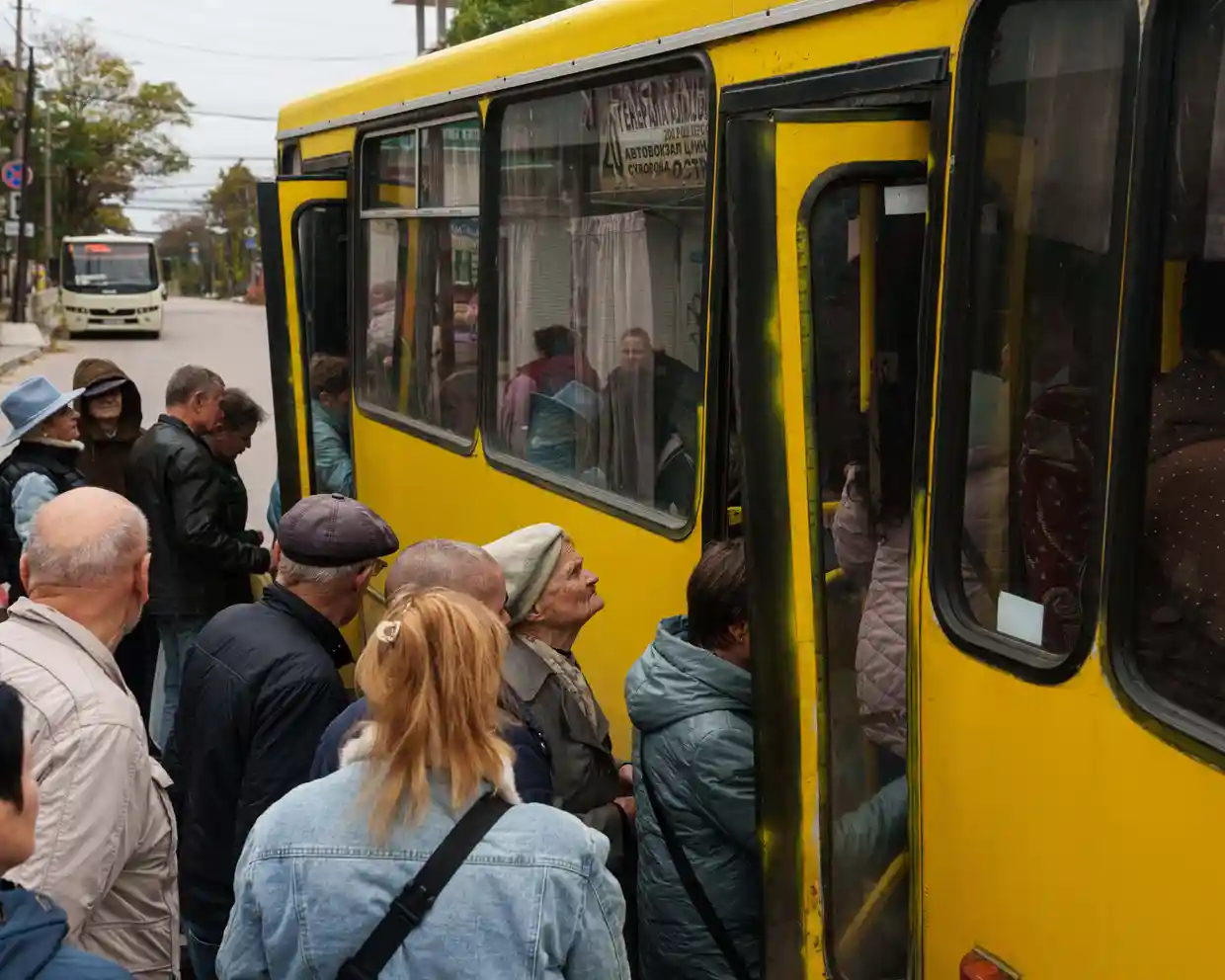
A temporary ceasefire in Russian-occupied Oleshky in southern Ukraine appeared to be holding after both Russian and Ukrainian forces reportedly halted drone attacks around the city, creating a brief window for a planned humanitarian evacuation of civilians trapped by the fighting.
The local truce began at 3 a.m. on Tuesday in Oleshky, a city on the Dnipro River opposite Kherson. Ukrainian forces recaptured Kherson in autumn 2022, but Oleshky has remained under Russian control. The latest pause in hostilities offers a rare period of relative calm along a frontline that residents and observers say has experienced years of sustained violence.
The ceasefire is expected to remain in place until 11 p.m. on Sunday, according to Ukrainian officials. An evacuation involving an estimated 1,500 to 2,000 residents is expected to begin later in the week, with buses reportedly planned to transport civilians to Russian-occupied Crimea and Russia.
The development comes as diplomatic efforts to end the war continue. Finland’s President Alexander Stubb and Norway’s Prime Minister Jonas Gahr Støre have held what they described as a “frank and substantive” telephone conversation with Russian President Vladimir Putin. The leaders said their discussion was connected to preparations for expected talks involving Russia, Ukraine and the United States in Abu Dhabi next month.
Oleshky Ceasefire Creates a Window for Civilian Evacuation
The temporary truce has brought an unusual pause to the fighting around Oleshky, where civilians have reportedly endured a prolonged blockade, shortages of essential supplies and the threat of attacks. The city lies across the Dnipro River from Kherson, placing it close to a frontline that has remained dangerous since Ukrainian forces regained control of Kherson in 2022.
According to the account of conditions in the city, between 1,500 and 2,000 people remain trapped under severe restrictions. Food supplies have reportedly dwindled to critical levels, with the last delivery to local shops arriving in May. Some residents have allegedly resorted to eating weeds to survive.
Ukrainian military personnel have reportedly used drones to deliver food to people in the city. However, local accounts claim that Russian security forces detain residents who collect the supplies, adding another obstacle for civilians attempting to obtain basic necessities.
The reported Humanitarian Crisis has developed alongside the continuing military use of the surrounding area. Russian forces have allegedly mined roads and used damaged buildings to coordinate attacks against Kherson. Residents attempting to flee have described travelling past bodies on the streets and the burned-out remains of vehicles.
For people still living in Oleshky, the temporary cessation of drone attacks could provide an opportunity to leave an area where access to food, safe transport and medical assistance has become increasingly difficult. However, the success of the planned evacuation will depend on whether the truce holds, whether transport can reach civilians safely and whether residents can travel without being exposed to further danger.
A pause in attacks does not, by itself, guarantee safe passage. The arrangements for evacuation, the treatment of civilians and the destination to which they are transported will remain important factors in determining the humanitarian consequences of the operation.
Melania Trump’s Request and International Calls for a Humanitarian Pause
The White House has said that US First Lady Melania Trump requested the humanitarian mission. The evacuation is expected to begin on Thursday or Friday, although the precise arrangements and the number of people who will be able to leave remain uncertain.
Calls for a ceasefire have also come from Pope Leo XIV, the United Nations, European Union officials and the Council of Europe. Their appeals reflect concern about the situation facing civilians in Oleshky and the need to establish conditions under which people can receive assistance or escape the fighting.
The planned operation is taking place against the backdrop of wider diplomatic activity surrounding the war. With further discussions involving Russia, Ukraine and the United States expected in Abu Dhabi next month, the temporary truce could provide an opportunity for humanitarian cooperation even as the broader conflict remains unresolved.
However, the circumstances surrounding the evacuation have also generated competing political interpretations. Ukrainian observers have alleged that the Kremlin is preparing a propaganda operation intended to blame Kyiv for Oleshky’s destruction. According to these accounts, media outlets supportive of US President Donald Trump have been invited to observe the evacuation.
The planned transportation of residents to Russian-occupied Crimea and Russia is another sensitive aspect of the operation. Any assessment of the evacuation will need to distinguish between the immediate humanitarian benefit of getting civilians out of danger and the wider questions surrounding the conditions of their departure, their freedom of movement and their eventual destination.
The suggestion that the ceasefire is intended to improve Moscow’s position with Washington ahead of upcoming talks and US midterm elections remains an interpretation attributed to Ukrainian observers, rather than an independently established explanation for Russia’s decision to permit the pause.
Stubb and Støre Hold a Rare Direct Call With Putin
While the Oleshky truce has focused attention on the humanitarian situation in southern Ukraine, the telephone conversation between Stubb, Støre and Putin has highlighted renewed efforts by some European leaders to establish direct communication with Moscow.
The Finnish and Norwegian leaders described their discussion with the Russian president as “frank and substantive.” Støre subsequently indicated that substantial differences remained, suggesting that the conversation had not resolved the fundamental disagreements separating Russia from Ukraine and its European partners.
The call was linked to preparations for expected negotiations involving Russia, Ukraine and the United States in Abu Dhabi next month. Stubb and Støre said they participated as leaders of their own countries and were not speaking on behalf of Europe as a whole.
The distinction is significant because European governments have not reached a common position on how direct engagement with Putin should be conducted or who should represent the continent in discussions about ending the war.
Some European officials regard Stubb as a possible figure who could play a role in future diplomatic efforts. His conversation with Putin, alongside Støre’s participation, reflects an attempt by the two Nordic countries to maintain a direct channel of communication while negotiations over Ukraine continue to develop.
Supporters of diplomatic engagement may see direct contact as a way to communicate European concerns and test whether Moscow is prepared to discuss steps towards de-escalation. Critics, however, question whether such conversations can produce meaningful progress while Russian military operations and territorial demands remain unchanged.
The latest call therefore illustrates both the continuation of diplomatic outreach and the lack of agreement among European governments about the best way to pursue negotiations.
Denmark Questions the Independent Diplomatic Initiative
The Finnish-Norwegian initiative exposed divisions within Europe shortly after the call became public. Denmark’s Prime Minister Mette Frederiksen expressed scepticism about the decision by Stubb and Støre to contact Putin without securing broader agreement among European governments.
“I am very sceptical about this independent initiative by Norway and Finland. It was not agreed with any of us,” Frederiksen said.
Frederiksen also questioned whether Russia had demonstrated a genuine willingness to pursue peace, pointing to what she described as continuing hybrid warfare against Europe and daily attacks in Ukraine that have claimed lives.
Her comments reflect a broader disagreement over whether direct talks with the Russian president are likely to advance negotiations or risk weakening the appearance of a coordinated European position.
For governments favouring direct engagement, maintaining communication with Moscow could help Europe articulate its security concerns and ensure that European interests are represented in discussions involving Washington and Kyiv. For more sceptical governments, unilateral initiatives risk creating divisions at a time when Russia’s actions continue to undermine confidence in its willingness to compromise.
The disagreement also raises a practical question about Europe’s role in any eventual settlement. European governments have significant interests in the outcome of the war, including regional security, the protection of Ukraine and the future relationship between Russia and European states. Yet the latest exchange shows that they remain divided over how to translate those interests into a common negotiating strategy.
Putin and Zelenskyy Remain Far Apart on Territorial Demands
The differences between Moscow and Kyiv remain a central obstacle to a broader ceasefire or peace agreement. Earlier this month, Putin said he was prepared to resume peace negotiations, but his position continued to include demands that Ukraine has rejected.
These demands include the transfer of the entire eastern Donbas region to Russian control, including areas Russia has been unable to capture since 2014. Moscow has also sought additional territory in the southern Ukrainian regions of Kherson and Zaporizhzhia.
Such conditions would require Ukraine to surrender territory beyond the areas currently controlled by Russian forces. They therefore remain a major point of disagreement in any discussion about how to end the war.
Ukrainian President Volodymyr Zelenskyy has indicated that Kyiv would consider an agreement that freezes the fighting along the existing frontlines. In an interview with ABC News last week, he said Ukraine was ready to stop the war as soon as possible.
However, Zelenskyy also made clear that a halt to the fighting would not mean Ukraine legally recognising territory occupied by Russia as Russian territory. This distinction separates a possible military arrangement that stops further advances from a political settlement that formally determines sovereignty over disputed areas.
A ceasefire along current frontlines could reduce immediate casualties and create space for further negotiations. It would not automatically resolve the territorial questions that have driven the conflict, nor would it settle disagreements over security guarantees, the future status of occupied regions or the conditions required for a lasting peace.
The contrasting positions suggest that any future negotiations will face difficult choices over the relationship between stopping the fighting and resolving the underlying political dispute. Russia’s stated territorial demands and Ukraine’s position on sovereignty remain significant barriers to an agreement.
Ukraine Continues to Face Attacks Outside the Oleshky Truce
The temporary ceasefire in Oleshky does not extend to the rest of Ukraine. While the local pause has created a potential opportunity for evacuation, Russian attacks have continued elsewhere, underscoring the limited geographic scope of the arrangement.
According to the supplied reports, Russia attacked Kyiv overnight using drones and ballistic missiles, killing at least one person and injuring 15. A university campus was hit, with students among those wounded. The attacks also damaged a bridge over the Dnipro River and metro infrastructure, while 10 other regions came under fire.
The bridge remained closed to traffic following the attack, although some commuters were reportedly walking across it to reach work. Damage to transport infrastructure can disrupt daily life well beyond the immediate area struck, affecting access to workplaces, education and essential services.
The reported attacks also demonstrate the difference between a local humanitarian arrangement and a nationwide cessation of hostilities. Even if the Oleshky truce continues to hold, civilians elsewhere remain exposed to the consequences of ongoing military operations.
Zelenskyy responded by calling on Russia to stop prolonging the war and welcoming European efforts to advance a diplomatic solution. He said Stubb and Støre had briefed him on their conversation with Putin.
“Alex and Jonas clearly conveyed to the Russian leadership the need for genuine steps towards de-escalation, particularly when it comes to our energy sector and infrastructure,” Zelenskyy wrote on social media.
His statement linked the diplomatic initiative to the protection of essential infrastructure, an issue that has remained important as attacks affect transport networks, energy facilities and other systems that civilians depend on.
Can a Local Truce Lead to Wider De-escalation?
The Oleshky ceasefire represents a limited development in a conflict that continues across multiple regions of Ukraine. Its immediate significance lies in the possibility of allowing civilians to leave an area where access to food and safe movement has reportedly become extremely difficult.
If the pause holds and the evacuation proceeds, it could demonstrate that limited humanitarian arrangements remain possible even when the wider political and military disagreements are unresolved. Such an outcome would not establish that Russia and Ukraine are close to a comprehensive settlement, but it could provide a concrete benefit for people trapped in the city.
The broader diplomatic picture remains considerably more complicated. Stubb and Støre have opened a direct channel to Putin, but their call has exposed differences among European governments about how to engage with Moscow. Russia and Ukraine also continue to hold opposing positions on the territory that would be covered by a peace agreement.
For now, three separate developments will shape the next stage: whether the Oleshky ceasefire remains effective, whether the planned evacuation can take place safely, and whether upcoming talks involving Russia, Ukraine and the United States produce progress beyond statements of willingness to negotiate.
The local truce should therefore be viewed as a limited humanitarian pause rather than evidence of a broader end to the war. The conditions facing Oleshky’s residents, the continuation of attacks elsewhere in Ukraine and the unresolved territorial dispute all underline how much remains to be addressed.
For civilians awaiting evacuation, the immediate priority is safe passage and access to essential assistance. For diplomats, the challenge is to turn isolated opportunities for de-escalation into arrangements that reduce violence more broadly. Whether the current pause contributes to that wider objective will depend on what follows the evacuation and whether the parties are prepared to make substantive changes to their positions.
For breaking news and live news updates, like us on Facebook or follow us on Twitter and Instagram. Read more on Latest World on thefoxdaily.com.




COMMENTS 0