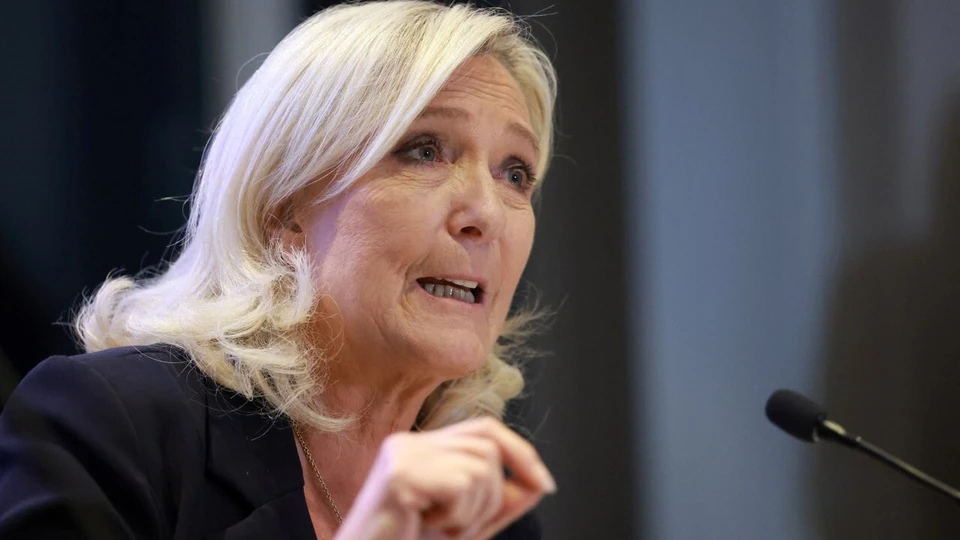
France’s political establishment is facing renewed pressure as riots, looting and protests expose deep public frustrations over security, living costs and confidence in government. Amid the turmoil, far-right leader Marine Le Pen is seeking to position herself as a candidate who can restore order and offer an alternative to the country’s established political leadership.
For more than a decade, Le Pen has built her political message around Immigration, law and order, national identity and dissatisfaction with mainstream parties. The unrest has brought these issues back to the centre of France’s political debate, giving her an opportunity to argue that the government has failed to protect citizens and maintain stability.
Her response has been carefully framed to resemble that of a national leader addressing a country in crisis. In a video address, Le Pen appeared seated at a desk in front of a bookcase, with the French tricolour flag beside her. She presented the riots as evidence of a breakdown in public confidence in President Emmanuel Macron’s authority.
“Our country is caught in a vice, held hostage between violence and powerlessness,” Le Pen said. She also pointed to the coming presidential election as an opportunity for voters to choose a different direction, centred on authority and security.
The message reflects a broader political strategy: using the unrest to shift the debate away from Le Pen’s own controversies and towards the performance of the government. Whether that strategy translates into electoral support will depend on how voters assess the causes of the unrest, the competing parties’ responses and the credibility of the alternatives on offer.
Why France’s Unrest Matters to Marine Le Pen
Le Pen’s political positioning is closely tied to the public perception of security and the state’s ability to respond to crises. When disorder spreads through urban areas and businesses are damaged or looted, concerns about policing, public safety and government authority can become more prominent in political discussions.
For National Rally, the unrest provides an opportunity to reinforce longstanding arguments that France’s institutions have failed to address problems involving crime, immigration and social cohesion. Le Pen has portrayed herself as a candidate prepared to take a tougher approach to public order than the political establishment.
Adélaïde Zulfikarpasic, a pollster at Ipsos BVA, described the image Le Pen was projecting as that of someone already occupying the country’s highest office. Her assessment was that Le Pen’s sustained focus on law and order allows her to present herself as a figure associated with stability when confidence in democratic institutions is under pressure.
That perception matters because political campaigns are not shaped only by policy proposals. They are also influenced by whether voters believe a candidate understands their concerns, can explain the problems facing the country and has a credible plan to address them.
Le Pen’s messaging attempts to connect these questions directly. By presenting public disorder as evidence of government failure, she seeks to make security a central test of the administration’s performance and her own political appeal.
However, unrest does not automatically translate into support for any single party. Voters may disagree about the causes of the violence, the appropriate response from authorities and whether tougher policing or broader social and economic reforms would be more effective.
Riots Put Pressure on Macron’s Government
The unrest has created a difficult situation for Macron’s administration, which is facing questions about its ability to maintain public order while addressing the social grievances driving protests.
What began as student-led complaints about school conditions has widened into a broader movement involving dissatisfaction with the cost of living, public spending cuts and government policy. This expansion has complicated the political response by bringing together different grievances that cannot necessarily be addressed through policing alone.
Authorities reported that more than 3,000 stores were damaged or looted nationwide over a weekend. The government also announced that affected businesses would be eligible for state assistance to help pay staff temporarily, an effort to limit the economic consequences of the violence.
The damage to shops and other commercial properties highlights the immediate costs of prolonged unrest. Businesses can face lost revenue, repair expenses and uncertainty about when normal operations can resume. Employees may also experience disruption if workplaces close or reduce activity.
For the government, the challenge is twofold: restoring security while demonstrating that it is responding to the concerns expressed by protesters. A response focused exclusively on enforcement risks leaving economic and social grievances unresolved, while a response perceived as insufficiently firm can intensify criticism over public safety.
Macron’s office said his interior minister, Laurent Nuñez, had offered his resignation, but the president declined it, citing the need for stable leadership. The episode underscored the political pressure surrounding the government’s handling of the crisis.
The government also announced curfews in shopping districts and other areas particularly affected by rioting. Such measures are intended to restrict opportunities for further disorder, although their longer-term effectiveness depends on enforcement, local conditions and the wider course of the protests.
The unrest has therefore become more than a public-order challenge. It is also a test of the administration’s ability to preserve confidence in state institutions while responding to the economic and social issues that have fuelled dissatisfaction.
Le Pen’s Law-and-Order Message and Immigration Politics
Immigration has long been a central issue in Le Pen’s political platform. She has linked questions of national identity, crime and social integration to her calls for tighter immigration policies and a stronger state response to disorder.
During the unrest, Le Pen portrayed the violence as the work of far-left radicals allied with young people from France’s banlieues, the poorer urban areas surrounding major cities. These neighbourhoods include residents from a range of backgrounds, including communities with immigrant origins.
The framing allows National Rally to connect the immediate crisis to its longstanding political themes. Images of damaged businesses, looted shops and confrontations with authorities can reinforce public concerns about security, giving greater prominence to the party’s arguments about law enforcement and immigration.
However, the presence of rioters from particular neighbourhoods does not establish that immigration is the cause of the unrest. The protests have also involved complaints about living costs, schools, public spending and dissatisfaction with government. Treating these issues as a single problem risks overlooking the different motivations behind the demonstrations.
Zulfikarpasic said the looting had drawn attention to young people from certain neighbourhoods, including some with immigrant backgrounds, and that this connected with themes central to National Rally’s rhetoric.
The political significance lies in how competing parties interpret the events. Le Pen is emphasising security and immigration, while other political voices have focused on social grievances and the government’s response. The public debate is consequently shaped not just by the events themselves, but by the explanations political leaders offer for them.
For voters, distinguishing between verified information about the unrest and claims made by political figures is essential to assessing the competing arguments. Evidence about the circumstances of individual incidents, the wider causes of the protests and the effectiveness of proposed policies can help clarify what different approaches might achieve.
Jean-Luc Mélenchon Adds Another Dimension to the Political Contest
Le Pen is not the only political figure seeking to benefit from the crisis. Far-left leader Jean-Luc Mélenchon has attracted attention through his support for protesters, putting him in direct conflict with political figures who have called for a stronger emphasis on restoring order.
His prominence has also affected the visibility of other opposition candidates. In a crowded political field, sustained attention can help a candidate shape the national conversation, while leaving rivals struggling to establish their own positions.
Raphaël Glucksmann, the socialist candidate competing with Mélenchon, criticised his approach, describing him as a “steppingstone for the far-right” because, in Glucksmann’s view, Le Pen stood to benefit from the resulting chaos.
The criticism reflects a wider strategic concern among parties opposed to both the far right and the far left: that polarisation may strengthen candidates who can present the political establishment as ineffective or divided.
Le Pen’s campaign benefits from the opportunity to portray the unrest as a failure of established governance. At the same time, Mélenchon’s support for protesters places him at the centre of debates over the legitimacy of demonstrations and the relationship between social grievances and public order.
The dynamic creates a challenge for centrist and centre-left candidates. They must respond to concerns about security without ignoring the economic and social complaints that have widened the protests. They must also distinguish their positions from those of both Le Pen and Mélenchon.
The political effects remain uncertain. Media attention and short-term public reactions do not necessarily predict how voters will behave when choosing between candidates. Electoral outcomes can also depend on turnout, campaign developments, policy credibility and how supporters of eliminated candidates vote in a second round.
How Le Pen’s Presidential Campaign Differs From Previous Contests
Le Pen has reached the final stages of previous French presidential elections with substantial support, but she has struggled to convert that position into victory in the decisive second round.
In earlier contests against Macron, voters who supported other candidates rallied behind the incumbent, producing a wider margin of defeat for Le Pen than the initial rounds suggested. The pattern illustrated a central obstacle for National Rally: attracting a substantial first-round vote is not the same as building a majority broad enough to win the presidency.
The political circumstances have changed as Macron approaches the end of his time in office. Under France’s presidential term limits, he cannot seek an immediate third consecutive term, removing the possibility of another direct contest between the two figures in the same form as before.
That change gives the next presidential race a different structure. Candidates will need to compete not only on their own platforms but also on their ability to appeal to voters who may be dissatisfied with the outgoing administration without necessarily supporting National Rally.
Le Pen is attempting to use the unrest to present herself as a source of continuity and authority rather than as a disruptive outsider. The approach marks a shift from the image that long defined her party, which was widely regarded as an anti-establishment force whose policies and governing experience raised concerns among some voters.
Her campaign’s challenge is to convince the electorate that National Rally can govern effectively across the full range of national responsibilities, not simply articulate frustration with the government’s handling of security.
National Rally’s Past Still Shapes Its Political Image
Marine Le Pen inherited the party from her father, Jean-Marie Le Pen, whose leadership was associated with a more openly confrontational far-right political identity. His repeated minimisation of the Holocaust attracted condemnation, and his daughter expelled him from the party in 2015 following renewed controversy over his views.
Marine Le Pen subsequently sought to change the party’s public image and broaden its appeal. The process included attempts to distance National Rally from some of the positions and associations that had made it unacceptable to many voters.
Economic policy was one of the areas in which the party’s earlier positions created uncertainty. During her 2017 presidential campaign, Le Pen proposed taking France out of the euro, the single currency used by many European Union member states. The proposal raised concerns among voters about the potential economic consequences of a major change to France’s monetary arrangements.
Nearly a decade later, the political conversation has shifted. Macron’s administration is facing scrutiny over France’s public finances, while Le Pen is seeking to make security and government performance central campaign issues.
Yet a shift in public attention does not eliminate questions about National Rally’s economic programme, its approach to European integration or its capacity to manage the practical demands of government. Those questions remain relevant even when public disorder dominates the headlines.
France’s Debt Crisis Complicates the Political Debate
France’s fiscal position represents a separate but significant challenge for whichever candidate ultimately seeks to lead the country. The government has run budget deficits exceeding 5% of gross domestic product for years, while public debt has approached 120% of GDP.
Persistent deficits can limit a government’s room for manoeuvre. When public borrowing remains high, policymakers face difficult choices about taxation, spending, public services and measures intended to support economic growth. Higher borrowing costs can add further pressure by increasing the expense of financing existing debt and new deficits.
These financial constraints matter because the next president would inherit responsibilities extending well beyond public security. The government would need to address the state’s finances while responding to demands for better services, economic support and protection against rising living costs.
Le Pen and National Rally have also contributed to the political difficulties surrounding fiscal reform. The party voted to remove two of Macron’s prime ministers who sought to introduce spending cuts and reduce the deficit, illustrating the obstacles facing efforts to secure support for budgetary measures.
At the same time, Le Pen has campaigned on lowering France’s retirement age to as low as 60. Such a change could increase public expenditure and add billions of euros to the annual deficit, depending on its design and implementation.
This creates a tension within the party’s message. National Rally seeks to criticise the established parties for economic mismanagement while also advocating policies that could increase spending. Evaluating the proposals requires examining their funding, expected costs and potential effects on employment, pension commitments and public finances.
The current unrest may temporarily overshadow these issues, but they are unlikely to disappear from the presidential debate. A candidate who promises to restore stability would also face pressure to explain how the government could finance its commitments and manage the national debt.
Legal Challenges Could Complicate Le Pen’s Campaign
Alongside the political opportunities created by the unrest, Le Pen faces a significant legal challenge stemming from her conviction in a case involving the misuse of European Parliament funds.
Le Pen has denied wrongdoing. According to the supplied account, an appeals court upheld the ruling in July and imposed a three-year prison sentence, with two years suspended. Judges indicated that the remaining year could be served under electronic monitoring, potentially affecting how she conducts her campaign.
The legal proceedings introduce uncertainty into her presidential ambitions. A candidate’s campaign depends on the ability to travel, attend events, communicate with voters and maintain a consistent public presence. Any restrictions associated with a judicial sentence could complicate those activities.
The case also creates a contrast between Le Pen’s effort to present herself as a defender of authority and the legal scrutiny surrounding her own conduct. Political opponents may use the conviction to question her claims about institutional responsibility and public accountability, while her supporters may view the proceedings through the lens of the party’s broader conflict with established institutions.
Those political interpretations are distinct from the legal questions decided by the courts. The consequences for Le Pen’s candidacy depend on the applicable legal restrictions and any further developments in the case, rather than on campaign messaging alone.
For National Rally, the challenge is to maintain momentum on security and government performance while managing uncertainty surrounding its leader. For voters, the case adds another factor to consider alongside policy proposals, governing experience and the broader political situation.
What the Unrest Means for France’s Next Political Chapter
France’s crisis has brought together several issues that are likely to influence the presidential debate: public security, immigration, economic hardship, trust in government and the sustainability of public finances.
Le Pen is attempting to connect these concerns through a single political argument: that the established parties have failed to provide stability and that National Rally offers an alternative. The riots give her an opportunity to make that case at a moment when questions about state authority are particularly prominent.
However, the country’s problems are not limited to policing or immigration. The protests have expanded from complaints about schools into wider dissatisfaction with living costs and public spending. France’s debt burden presents an additional challenge, while Le Pen’s own fiscal proposals and legal case could complicate her efforts to establish a broader governing profile.
The response of other political parties will also matter. Candidates must decide how to address public demands for security while responding to the economic and social grievances associated with the unrest. Their ability to present credible policies across these areas may shape the debate as the campaign develops.
For Macron’s government, restoring order is an immediate priority, but rebuilding public confidence will require more than short-term emergency measures. For Le Pen, the challenge is to demonstrate that her political programme offers workable answers to the country’s interconnected problems.
The unrest has given National Rally a renewed opportunity to place its central themes at the forefront of French Politics. Whether that attention leads to lasting electoral gains will depend on public reactions, the evolution of the protests, the credibility of competing proposals and the legal and economic issues that remain unresolved.
For breaking news and live news updates, like us on Facebook or follow us on Twitter and Instagram. Read more on Latest World on thefoxdaily.com.





COMMENTS 0