Rising fuel prices and mounting cost-of-living pressures are fuelling protests across Europe, creating fresh political opportunities for far-right parties ahead of Elections in France, Italy and Poland. The energy shock linked to the US-Iran war has intensified economic concerns, while political movements on the far right and hard left are using public anger over household bills to challenge established governments.
Europe is facing a growing combination of economic pressure and political unrest as higher energy costs squeeze households, farmers, transport operators and businesses. From demonstrations in France to agricultural protests in southern Italy, anger over the cost of living is increasingly shaping public debate and influencing electoral campaigns.
The latest wave of unrest comes at a difficult time for European governments already dealing with inflation, sluggish economic growth and pressure to control public spending. The Energy Crisis has added to these challenges, giving opposition parties an opportunity to present existing policies as inadequate and promise cheaper fuel and lower household expenses.
Far-right parties that have steadily expanded their support in recent years are seeking to capitalise on this discontent. Their proposals include cutting fuel taxes and restoring energy ties with Russia, challenging the positions taken by mainstream European governments over the war in Ukraine.
However, the protests extend beyond support for any single political movement. Demonstrators are raising concerns about wages, public services, housing affordability and the cost of basic necessities, highlighting economic grievances that cut across national borders and political affiliations.
Why Rising Fuel Prices Are Triggering Unrest Across Europe
The latest energy shock has placed additional pressure on European households and businesses. According to estimates from the European Commission cited in the Reuters report, the US-Iran conflict has cost Europe approximately €100 billion through disruptions to trade and energy markets. Gas prices have risen by around 140%, while diesel prices have doubled.
Higher fuel costs affect far more than motorists. Farmers depend on fuel to operate machinery, transport crops and manage agricultural production. Trucking companies face higher operating expenses, while manufacturers must account for energy costs in their production processes. Businesses may pass some of these expenses on to consumers, contributing to wider cost-of-living pressures.
For households, rising petrol, diesel and energy bills can leave less money available for food, housing and other essential expenses. The impact can be particularly difficult for people on low wages and residents of rural areas who have limited alternatives to private vehicles.
The energy shock has also created a political challenge for governments. Even when international developments drive price increases, voters may hold their national leaders responsible for the financial consequences. Opposition parties can use this dissatisfaction to question government decisions and promote alternative economic policies.
Gilles Ivaldi, a political scientist at Sciences Po, described purchasing-power concerns as a major driver of populist politics across Europe. His assessment reflects how economic grievances can become a central issue in political competition, particularly when voters feel that established parties have struggled to protect household finances.
France Sees Major Unrest as Cost-of-Living Anger Grows
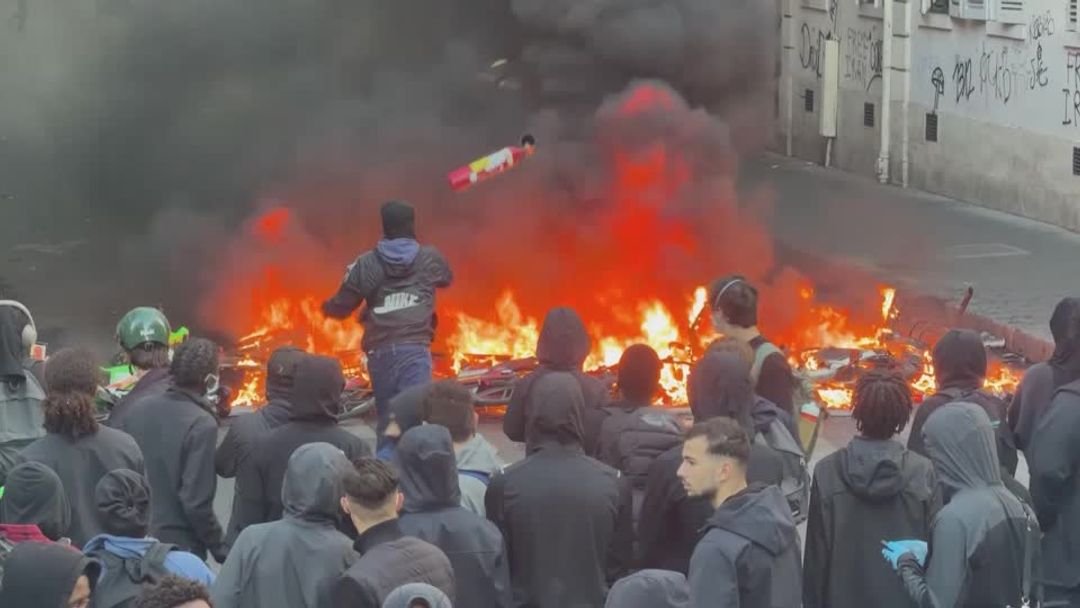
France has become one of the most visible centres of the latest unrest. Demonstrations that initially began over deteriorating school facilities in the northern suburbs of Paris have developed into wider protests involving anger over living costs and broader dissatisfaction.
The unrest has included looting, fires and damage to buildings. In Limoges, a 19th-century town hall was set on fire, while other incidents involved torched buildings and damaged shops.
For many demonstrators, the issue extends beyond fuel prices to the affordability of everyday life. Quentin Leviloux, a 21-year-old protester in Nantes, described the rising cost of food, fuel and other necessities as frightening, particularly for people earning close to the minimum wage.
His comments illustrate the financial pressure facing lower-income households, for whom even relatively small increases in essential expenses can significantly affect monthly budgets.
French President Emmanuel Macron acknowledged protesters’ legitimate concerns about the cost of living and fuel prices in a weekend address. At the same time, he condemned those involved in violence, vandalism and looting, distinguishing peaceful grievances from criminal acts.
This distinction matters politically. Governments must respond to economic dissatisfaction while maintaining public order, particularly when demonstrations expand beyond their original demands and include serious incidents of violence.
France’s political situation is especially significant because the country is approaching a presidential election in April, according to the Reuters report. With economic pressures already weighing on the government, fuel prices have become an important issue for both far-right and hard-left opposition figures.
Protests Spread Across Italy, Portugal, Spain and Other Countries
France is not the only European country experiencing unrest linked to economic pressures. Demonstrations, road blockades and clashes with police have been reported in Italy, Portugal, Spain, Belgium and Albania, although the immediate grievances differ from one country to another.
Italian Farmers Struggle With Rising Fuel Costs
In Gela, a town on Sicily’s southern coast, farmers have taken to the streets because rising fuel prices have made agricultural operations increasingly expensive. Tractors carrying Sicilian flags have become a visible symbol of their protest.
Farmers argue that the higher cost of operating machinery is undermining their ability to make a living. One protest banner captured their frustration with the words, “We cultivate the land, we harvest debts.”
Arcangelo Gambino, a farmers’ representative in Caltanissetta province, said fuel costs had more than doubled, leaving the agricultural sector at a standstill.
The consequences extend beyond farming businesses. Roadblocks organised by truckers, farmers and steelworkers have disrupted transport across parts of southern Italy, contributing to local fuel shortages and concerns about supermarket supplies.
In Milan, one of Italy’s wealthiest cities, demonstrations over rising living costs and inadequate public services also turned violent. Police clashed with protesters who threw stones, while stores were looted during Sunday’s unrest.
These developments illustrate how energy costs can affect different parts of the economy simultaneously. Farmers face higher production expenses, transport operators struggle with fuel bills, and consumers risk facing higher prices or disrupted supplies.
Portugal Faces Pressure Over Wages and Housing
Portugal has also witnessed large demonstrations over economic concerns. Tens of thousands of people marched through Lisbon on Saturday to protest low wages, rising housing costs and the broader increase in the cost of living.
The demonstrations have increased pressure on the country’s centre-right government to address affordability concerns. Housing expenses and wages have become particularly important issues for people struggling to maintain their standard of living.
Housing Crisis Fuels Unrest in Spain
In Spain, the eviction of an 87-year-old woman from her home triggered nationwide demonstrations over housing shortages and rising rents. The incident became a focal point for wider dissatisfaction with the availability and affordability of housing.
According to the Reuters report, the protests helped trigger a snap election scheduled for the following month. The development highlights how an individual housing dispute can become a symbol of broader economic grievances when many people face similar difficulties.
Belgium and Albania Also See Demonstrations
Belgium has experienced demonstrations amid the wider wave of unrest, while large rallies in Albania have been driven by anger over perceived government corruption, a shortage of jobs and concerns about education standards.
Although these protests do not all share the same immediate cause, they point to a wider pattern of public dissatisfaction. Economic insecurity, inadequate public services and limited opportunities are creating pressure on governments across different parts of Europe.
For political parties, the challenge is to translate this dissatisfaction into policies that address the underlying problems. For voters, the protests reflect growing expectations that governments should provide tangible relief from rising costs and deteriorating living conditions.
Marine Le Pen Makes Fuel Prices a Central Election Issue in France
Rising fuel prices have become a major political issue in France ahead of the presidential election expected in April 2027. The election comes as Macron’s government faces pressure over a growing budget deficit and concerns in financial markets about the country’s public finances.
Marine Le Pen, a leading figure in the far-right National Rally, has made fuel prices a central part of her political campaign. Jean-Luc Mélenchon, a prominent hard-left politician, has also emphasised the issue.
The prominence of fuel prices in competing campaigns shows how the cost of living can become a shared political concern even when parties offer different explanations and solutions.
Le Pen’s proposal to sharply reduce value-added tax on fuel has attracted broad public support, according to the Reuters report. The proposal is particularly relevant to voters in rural and semi-rural areas, where driving is often essential for reaching workplaces, shops and public services.
For these households, a rise in petrol or diesel prices can be difficult to avoid. Unlike residents of areas with extensive public transport networks, people in many rural communities cannot easily replace car journeys with cheaper alternatives.
Gilles Ivaldi said rising fuel prices were benefiting Le Pen politically, arguing that the issue had long been associated with her political positioning.
Polling by Elabe cited in the report indicated that Le Pen’s ratings had improved since the US-Iran war began, while Macron’s had declined.
These polling movements do not establish that fuel prices alone explain changes in political support. However, they demonstrate how economic dissatisfaction can influence the political environment ahead of an election.
The challenge for the French government is that fuel-price relief must be considered alongside the country’s strained public finances. Cutting taxes could reduce the immediate burden on motorists, but the wider fiscal consequences would also matter as the government attempts to control its deficit.
Germany’s AfD Uses Energy Costs to Challenge the Government
In Germany, the far-right Alternative for Germany (AfD) has gained ground in local elections and is leading national opinion polls, according to the report. Rising living costs have provided the party with another issue through which to criticise the government of Chancellor Friedrich Merz.
A survey published in October identified the cost of living as Germans’ leading concern for the fifth consecutive year. Inflation also rose to nearly a three-year high in September, while energy-price inflation reached 14.9%, according to the figures cited by Reuters.
For Germany, the energy shock carries particular economic significance because the country has a large industrial base and many businesses depend on reliable, affordable energy supplies.
The AfD argues that Germany should restore energy ties with Russia. The party maintains that Berlin’s support for Ukraine has contributed to economic difficulties and that renewed energy cooperation could help reduce costs.
This position challenges the mainstream political consensus supporting Ukraine following Russia’s full-scale invasion in 2022. It also turns an immediate household concern into a wider debate about foreign policy, energy security and Germany’s economic direction.
Jan Steckel, a professor specialising in the political economy of climate change at the Technical University of Munich, said past experience indicated a relationship between high energy prices and voter turnout for the AfD.
Steckel also explained that populist parties often present high energy costs as the result of avoidable government decisions rather than underlying geopolitical shocks. Such arguments can be politically effective because policy choices are easier to debate than complex international developments.
The distinction is important when assessing competing explanations for rising prices. Energy markets can be influenced by international conflicts, supply disruptions, infrastructure constraints and government policies. Determining the contribution of each factor requires examining the circumstances rather than assuming a single cause.
For the German government, persistent energy inflation presents both an economic challenge and a political one. If households and businesses continue to face higher expenses, dissatisfaction could provide opposition parties with further opportunities to challenge existing policies.
Italy’s Far Right Faces Competition From a New Political Movement
In Italy, Prime Minister Giorgia Meloni is facing growing competition from National Future, a new far-right party led by former army general Roberto Vannacci.
The party advocates restoring gas links with Russia, placing energy affordability at the centre of its political position. Its emergence adds another dimension to Italy’s political debate as farmers, transport operators and other groups protest against rising costs.
Energy policy could become an important point of competition among parties seeking to attract voters frustrated by higher household expenses and pressure on businesses.
However, the political consequences of the protests will depend on whether opposition movements can turn public dissatisfaction into sustained electoral support. Demonstrations over fuel prices do not automatically translate into votes for a particular party, and economic concerns are only one factor shaping voter decisions.
Poland’s Far Right Calls for Renewed Russian Energy Imports
Poland is another country where energy affordability is influencing political debate. Despite being one of Ukraine’s strongest supporters, Poland has seen growing support for the far-right Confederation of the Polish Crown amid concerns about energy bills.
The party’s leader, Grzegorz Braun, has called for Poland to resume purchasing Russian oil and gas. He has promoted this position alongside AfD politicians in Lubmin, Germany, where the damaged Nord Stream pipelines make landfall.
Braun’s argument reflects a broader challenge facing European governments: how to balance energy affordability with foreign-policy commitments and concerns about dependence on Russian supplies.
Calls to restore energy links with Russia are politically significant because they challenge the approach taken by governments that have sought to reduce reliance on Russian energy following the invasion of Ukraine.
The debate also illustrates how international conflicts can influence domestic politics long after the initial events. Policies originally framed around security and geopolitical alignment can become subjects of renewed scrutiny when their economic consequences are felt by households and businesses.
For European governments, the question is not simply whether energy prices should be lower. It is also how to improve affordability without creating new strategic vulnerabilities or undermining other policy objectives.
Why High Energy Prices Can Benefit Populist Parties
The rise of far-right parties amid the protests reflects a broader political dynamic in which economic hardship can weaken confidence in established political institutions.
When households struggle to afford fuel, food, housing and other essentials, voters may become more receptive to parties promising immediate change. Political movements outside the traditional mainstream can use this frustration to argue that existing governments have failed to protect ordinary people.
Fuel prices are particularly effective as a political issue because their effects are visible and widely understood. Motorists notice higher prices at filling stations, farmers see increased machinery costs, and transport companies face larger operating bills.
These direct experiences can make energy policy more politically compelling than complex discussions about international trade, fiscal constraints or geopolitical risk.
Populist parties may also frame price increases as the consequence of deliberate government decisions, offering a straightforward explanation for a complicated economic problem. That message can resonate with voters who feel that policymakers have not adequately explained why costs have risen or what can be done to reduce them.
However, a political promise to reduce fuel prices must be assessed against its practical implications. Tax reductions may lower costs for consumers, but they can also reduce government revenue. Restoring energy imports from a particular supplier may change the structure of supply, but it can introduce other economic and strategic considerations.
These trade-offs do not prevent governments from offering relief. They mean that the likely effects, costs and limitations of proposed measures matter when evaluating competing political claims.
Europe’s Energy Crisis Creates a Difficult Choice for Governments
The current unrest comes after years of economic strain following the COVID-19 pandemic and Russia’s 2022 invasion of Ukraine. The US-Iran conflict has added another source of disruption to energy markets, increasing the pressure on governments already struggling with inflation, economic growth and public spending.
European leaders must respond to immediate household concerns while considering longer-term questions about energy security, economic competitiveness and international relations.
Short-term relief measures could help households facing higher fuel bills, but governments must also consider the impact on public finances. Longer-term changes to energy supply may reduce some vulnerabilities, although they require investment, planning and decisions about future dependencies.
The protests also show why economic policy cannot be separated entirely from public confidence. Even when price increases are driven partly by events beyond a government’s control, citizens still expect elected leaders to explain their response and demonstrate that their concerns are being addressed.
For mainstream parties, the challenge is to provide credible answers without oversimplifying the causes of the crisis. For opposition parties, the opportunity lies in convincing voters that alternative policies would deliver better outcomes.
Conclusion: Fuel-Price Anger Is Reshaping Europe’s Political Debate
Rising fuel prices have become a powerful source of public dissatisfaction across Europe, contributing to protests in France, Italy, Portugal, Spain and other countries. The economic pressure is affecting households, farmers, transport operators and businesses, while concerns about housing, wages and public services are adding to the unrest.
The crisis is also creating political opportunities for far-right parties. Marine Le Pen’s National Rally is making fuel-tax reductions a central campaign issue in France, Germany’s AfD is calling for renewed energy ties with Russia, and far-right movements in Italy and Poland are promoting similar positions on Russian energy supplies.
Yet the protests are not driven by a single political ideology or grievance. They reflect a combination of economic insecurity, dissatisfaction with public services and concerns about whether governments can protect living standards during a period of international instability.
The coming elections will provide an important test of how far these concerns translate into political change. The outcome will depend not only on the intensity of public anger but also on the credibility of competing policy proposals and the ability of governments to respond to the pressures facing their citizens.
For Europe, the central challenge is to make energy and essential living costs more manageable while preserving economic stability and addressing longer-term security concerns. How governments handle that balance could shape the continent’s political debate well beyond the current wave of protests.
For breaking news and live news updates, like us on Facebook or follow us on Twitter and Instagram. Read more on Latest World on thefoxdaily.com.




COMMENTS 0