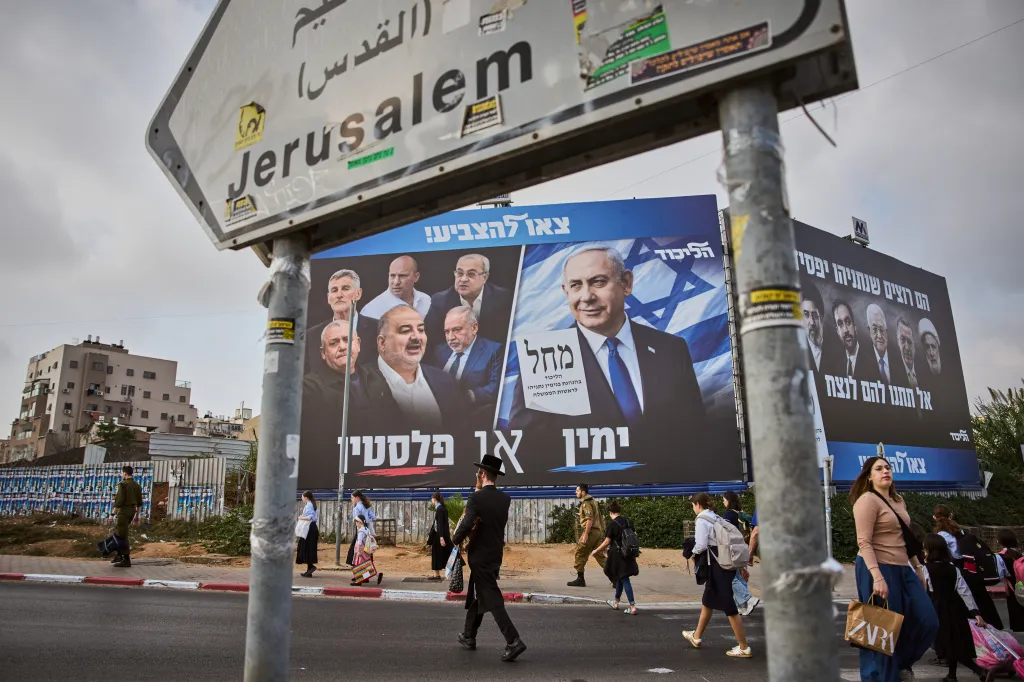
Israel’s upcoming national election could determine whether Prime Minister Benjamin Netanyahu retains power or an opposition alliance manages to form a new government after a closely contested campaign. With opinion polls indicating a tight race between Netanyahu’s right-wing bloc and rival parties, the outcome may depend less on which party wins the most seats and more on whether either side can secure a parliamentary majority.
The election is taking place against the backdrop of the October 7 Hamas attack, the subsequent wars in Gaza, Lebanon and Iran, and sustained political divisions over Israel’s security and domestic policies. It is also a major test for Netanyahu, the country’s longest-serving prime minister, whose governing coalition has relied on far-right and ultra-Orthodox partners.
Israel’s Knesset has 120 seats, and a government generally needs the support of at least 61 lawmakers to command a majority. Because the electoral system distributes seats proportionally among parties that cross the qualifying threshold, the largest party does not automatically win the right to govern.
Several scenarios could emerge from the election, including another Netanyahu-led government, an opposition coalition, an arrangement involving Arab-led parties, a national unity government or prolonged negotiations that eventually lead to another election.
Why Israel’s Election Is a Crucial Test for Netanyahu
The election is a significant political test for Netanyahu following the October 7 Hamas attack and the wars that followed. The attack exposed a major failure in Israel’s security arrangements and was followed by military campaigns that reshaped the country’s domestic politics and regional relationships.
Netanyahu’s current political position depends on a coalition that includes far-right and ultra-Orthodox parties. These partners have supported policies that place greater emphasis on nationalist and religious priorities, but their demands can also complicate negotiations over government formation.
Opinion polls have suggested a close contest between Netanyahu’s right-wing alliance and a Jewish-led opposition grouping. However, polling estimates vary considerably between media organisations, and the number of seats won by each party will not by itself determine who becomes prime minister.
According to polling cited by CNN from Channel 12, Yashar, a new centrist party led by former military chief of staff Gadi Eisenkot, was projected to win 23 seats, compared with 21 for Netanyahu’s Likud party. Channel 14, a pro-Netanyahu media outlet, projected a stronger result for Likud, with around 30 seats, while Eisenkot’s party was projected to win about 20.
These contrasting projections illustrate the uncertainty surrounding the contest. Even if one party emerges as the largest in the Knesset, its leader must still secure enough support from other parties to form a government.
How Israel’s Electoral System Works
Israel uses a proportional representation system in which voters choose party lists rather than directly electing an individual prime minister. Parties that receive at least 3.25% of the vote qualify for representation in the 120-member Knesset.
Seats are then distributed according to the parties’ share of the vote. This system allows multiple parties to enter parliament, making coalition negotiations a central feature of Israeli politics.
A party can win more seats than its rivals but still struggle to govern if it cannot assemble a coalition with a parliamentary majority. Conversely, a party that finishes second or third may help form the next government if its allies collectively command sufficient support.
Polls cited in the supplied reports suggested that between 11 and 13 parties could cross the electoral threshold. That would leave several parties with potential influence over coalition negotiations, particularly those whose seats could help either bloc reach the 61-seat mark.
Against this backdrop, five broad outcomes could shape Israel’s political future.
1. Netanyahu Returns to Power With Support From His Allies
One possible outcome is that Netanyahu remains prime minister even if Likud does not finish as the largest party. His return would depend on whether his right-wing bloc and potential partners could collectively secure enough seats to form a majority government.
Netanyahu’s traditional allies include far-right National Security Minister Itamar Ben-Gvir’s Jewish Power party and Finance Minister Bezalel Smotrich’s Religious Zionism party. Their support could be important if Likud falls short of the seats required to govern independently.
Ultra-Orthodox parties Shas and United Torah Judaism could also play a decisive role. Both have joined Netanyahu-led coalitions in the past, although their political relationships have not always been stable. Their participation in government negotiations could influence the composition and policy priorities of any new administration.
If Netanyahu’s bloc secures sufficient support, he could remain prime minister despite a strong showing by opposition parties. Such an outcome would underline the importance of coalition arithmetic in Israel’s parliamentary system.
However, the arrangement would depend on the willingness of potential partners to support Netanyahu and agree on the terms of a governing coalition.
2. An Opposition Alliance Forms the Next Government
A second possibility is that opposition parties manage to assemble a majority and end Netanyahu’s tenure as prime minister.
Four opposition parties have reportedly signed a non-aggression pact, committing to cooperate in their effort to unseat him. The grouping includes parties with different political positions, making coordination a central challenge.
Eisenkot’s Yashar party is positioned alongside political forces led by former prime minister Naftali Bennett and former defence minister Avigdor Liberman, as well as the Democrats party led by Yair Golan. Bennett and Liberman have their own ambitions for the top job and have not publicly endorsed Eisenkot as the opposition’s prime ministerial candidate, according to CNN’s reporting.
This means that opposition parties could agree on the objective of replacing Netanyahu without having reached agreement on who should lead the government.
If they win enough seats collectively, they would need to negotiate a workable coalition, settle disputes over leadership and agree on a common programme. Their ideological differences could complicate those talks, particularly on security, religion and domestic policy.
An opposition-led government is therefore one possible outcome, but its formation would depend on more than the combined seat totals of parties campaigning against Netanyahu.
3. A Coalition Receives Support From Arab-Led Parties
Another possibility is that Arab-led parties representing Palestinian citizens of Israel become important to the formation of a government.
The Joint List and Ra’am are projected in the supplied account to win a combined total of around 13 seats. Palestinian citizens of Israel make up roughly one-fifth of the country’s population, and Arab-led parties have previously played an important role in parliamentary debates and coalition calculations.
However, cooperation between these parties and Jewish-led opposition groups remains politically sensitive. Opposition figures, including Eisenkot, have reportedly rejected the possibility of forming an alliance with them, while Ra’am leader Mansour Abbas has remained open to such an arrangement if circumstances require it.
If neither the right-wing bloc nor the opposition can reach a majority without additional support, the position of Arab-led parties could become a significant factor in negotiations.
Such cooperation could take different forms, ranging from direct participation in a coalition to external parliamentary support. The precise arrangement would depend on the parties’ negotiating positions and the conditions attached to any agreement.
The possibility also carries political risks. Parties would need to weigh the benefits of securing a parliamentary majority against disagreements over policy and objections from parts of their respective electorates.
4. A National Unity Government Bridges Rival Political Camps
A national unity government could emerge if rival political groups conclude that cooperation is necessary to overcome a parliamentary deadlock or respond to national challenges.
Such a government typically brings together parties that would otherwise compete against each other. In Israel, unity arrangements have been considered in periods of intense political division, security pressure or difficulty forming a stable administration.
A broad coalition could offer a way to avoid another prolonged political crisis by bringing competing parties into a shared governing arrangement. It might also reduce the immediate dependence of a government on a narrow group of ideological allies.
However, a unity government would require substantial compromise. Parties would need to agree on leadership, the distribution of ministerial positions and a common policy agenda despite disagreements over security, religion, economic priorities and the future direction of the country.
The question of whether Netanyahu would remain prime minister would be central to such negotiations. Opposition parties seeking to replace him might be reluctant to enter a government that leaves him in office, while Likud and its partners would have their own conditions for participation.
A national unity arrangement is therefore a possible route out of a deadlock, but its formation would depend on whether rival leaders consider compromise preferable to continued political confrontation.
5. Rotating Premiership, an Alternative Prime Minister or Another Election
If no bloc can secure a stable majority, negotiations could produce more unusual arrangements or leave Israel facing another election.
Rotating premiership
Under a rotating premiership arrangement, two political leaders agree to share the office of prime minister for different periods. Netanyahu and Benny Gantz reached an agreement of this kind in 2020, but their coalition later collapsed before Gantz could assume the premiership.
A similar arrangement could be considered if rival parties conclude that sharing power is the only practical way to establish a government. However, such an agreement would require detailed terms and sufficient trust between the participating leaders to survive political disagreements.
A different member of the Knesset becomes prime minister
Another possibility is that parties agree to support a Knesset member other than Netanyahu or the most prominent opposition leader. Such an arrangement could emerge if the main candidates cannot secure enough support or if a compromise figure becomes acceptable to otherwise divided parties.
The decisive factor would remain whether the candidate could command the necessary parliamentary support to form a government.
Another election follows a political deadlock
If coalition negotiations fail and no viable government can be formed, Israel could face another election, prolonging political uncertainty.
Israel experienced five Elections between 2019 and 2022 as rival parties struggled to establish stable governments. That history illustrates how proportional representation and fragmented party politics can lead to repeated voting when competing blocs cannot agree on a governing arrangement.
Until a new government is formed, Netanyahu would remain caretaker prime minister if he continued in office under the applicable arrangements. A further election would give parties another opportunity to break the deadlock, but it would not guarantee that the underlying divisions would disappear.
What Will Determine Netanyahu’s Political Future?
The election’s outcome will depend on three closely connected factors: the number of seats won by each party, the willingness of smaller parties to join or support a coalition, and the ability of political leaders to negotiate a workable governing agreement.
Likud’s performance will matter, but the broader balance between Netanyahu’s allies and his opponents could be more decisive. Far-right and ultra-Orthodox parties may determine whether his bloc can reach a majority, while opposition parties will need to overcome differences over leadership and policy if they hope to replace him.
Arab-led parties could also influence the outcome if their support becomes necessary to form a government. Meanwhile, a unity arrangement or compromise candidate could become relevant if the principal blocs remain unable to secure sufficient backing.
Polling figures offer an indication of the contest but cannot determine the final result. Differences between projections from Channel 12 and Channel 14 also demonstrate why seat estimates should be treated cautiously, especially when coalition formation depends on the performance of multiple parties.
Conclusion
Israel’s election presents several possible paths for the country’s political future. Netanyahu could return to power with the support of his traditional allies, an opposition alliance could form a new government, Arab-led parties could become pivotal to coalition negotiations, or rival political camps could explore a unity arrangement.
If negotiations fail, a rotating premiership, a compromise candidate or another election could follow. None of these outcomes is determined solely by which party wins the most seats; the decisive question is whether a candidate can assemble sufficient support in the Knesset.
For Netanyahu, the contest is a major test of his ability to retain parliamentary backing after years of political division and the security crises that followed the October 7 Hamas attack. The final result will depend not only on voters’ choices but also on the coalition negotiations that begin after the ballots are counted.
For breaking news and live news updates, like us on Facebook or follow us on Twitter and Instagram. Read more on Latest World on thefoxdaily.com.



COMMENTS 0