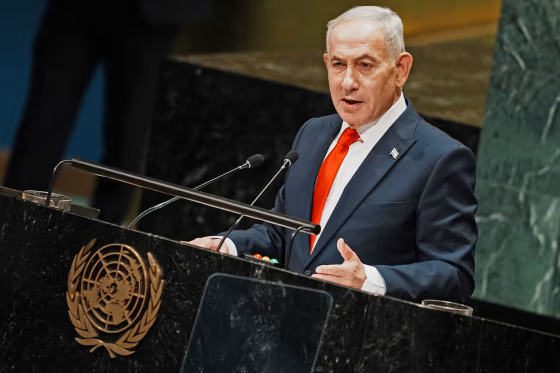
Israeli Prime Minister Benjamin Netanyahu arrived at the United Nations General Assembly facing a deeply divided international audience and a political challenge much closer to home. His speech on Thursday was delivered before a hall where hundreds of diplomats had walked out in protest over Israel’s conduct of the war in Gaza, but Netanyahu’s central political audience was not necessarily sitting inside the chamber.
With Israeli elections approaching next month, Netanyahu used the global stage to reinforce the image he has cultivated for years: a leader willing to confront international criticism while presenting himself to Israelis as a defender of the country during a period of multiple security threats.
Netanyahu was not scheduled to meet President Donald Trump or other US officials during his New York visit and was expected to return to Israel shortly after his address. Trump’s attention was focused on his summit with Chinese President Xi Jinping, adding to the sense that Netanyahu’s trip was unusually concentrated on the General Assembly speech itself.
The prime minister had anticipated a hostile reception. His response to the diplomats who left the chamber was direct and confrontational, telling those who remained that they should leave if they were unwilling to hear his case.
He then returned to the October 2023 Hamas attacks, Israel’s subsequent military campaign and what he described as the existential stakes of the conflict with Iran. He thanked Trump for supporting Israel and attacked several of Israel’s international critics, including New York City Mayor Zohran Mamdani.
Netanyahu’s U.N. Speech Was Also a Message to Israel
The walkout inside the General Assembly chamber provided one of the most visible moments of Netanyahu’s appearance. Hundreds of diplomats rose from their seats as he approached the lectern, protesting Israel’s military campaign and the humanitarian consequences of the war in Gaza.
Netanyahu did not attempt to soften his response. Instead, he presented the walkout as evidence of the hostility Israel faces internationally and continued with a speech centred on Israel’s security and its right to defend itself.
That approach also fits Netanyahu’s domestic political positioning. His political challenge is not limited to criticism from foreign governments. On the Israeli right, he faces voters and political rivals who argue that Israel must take an even tougher approach toward Iran and armed groups aligned with Tehran.
The United Nations therefore offered Netanyahu two audiences at once. The first was the international community, where he sought to defend Israel’s conduct and reject accusations directed at his government. The second was Israeli voters, who could watch a familiar political figure presenting himself as an uncompromising representative of Israel before a critical international audience.
Ephraim Ganor, a political and strategic affairs expert writing in the right-leaning Israeli newspaper Ma’ariv, argued that the General Assembly provided Netanyahu with an opportunity to address Israeli voters directly through his English-language speech and portray his record in favourable terms.
That domestic dimension is particularly important because the election campaign is unfolding while Israel remains engaged in a multifront regional conflict and faces continuing international criticism over Gaza.
Netanyahu Defends Israel’s War in Gaza
A major part of Netanyahu’s speech focused on the Hamas attacks of October 2023, in which about 1,200 people were killed and which triggered the latest major round of fighting between Israel and Hamas.
Netanyahu presented the attacks as the starting point for Israel’s military response and used them to reinforce his argument that Israel’s security situation leaves the country with little room for retreat.
He also rejected accusations that Israel’s military campaign in Gaza amounted to genocide. Palestinian Health officials have reported that more than 75,000 people have been killed during the conflict, a figure that has become central to international criticism of Israel’s conduct of the war.
Netanyahu described accusations of genocide against Israel as false and attacked countries and political figures that he said were spreading misinformation about Israel.
The issue has become one of the most consequential points of international disagreement surrounding the war. Supporters of Israel’s military campaign emphasise the October 2023 attacks and the threat posed by Hamas, while critics point to the scale of civilian deaths and the humanitarian crisis in Gaza.
Netanyahu’s speech did not attempt to bridge that divide. Instead, it presented a forceful defence of Israel’s position and challenged the legitimacy of the accusations being made against the country.
Iran and Israel’s Regional War Took Centre Stage
Netanyahu also framed Israel’s confrontation with Iran in existential terms.
“If we hadn’t done it, we’d all be dead,” he said, defending Israel’s military action against Iran. He added that Israel would continue defending itself and would continue fighting because, in his description, there was no alternative.
The emphasis on Iran was significant because Netanyahu’s domestic political pressure includes criticism from the Israeli right over whether the government has gone far enough in confronting Iran and Iranian-backed groups.
Israel’s security environment has expanded well beyond Gaza since October 2023. The country has faced threats and military confrontations involving Hamas, Hezbollah and Iran, while the conflict has also affected Lebanon and other parts of the region.
Netanyahu’s message therefore linked the Gaza War with the broader argument that Israel is engaged in a long-term struggle for national security. That framing allows him to present military decisions across multiple fronts as parts of a single defensive strategy.
Trump Gets Praise While Netanyahu Targets Critics
Netanyahu thanked President Donald Trump for supporting Israel, describing the conflict as a “battle against the barbarians.” The reference reinforced the close political relationship between Netanyahu and Trump at a time when the US remains Israel’s most important international ally.
At the same time, Netanyahu directed some of his sharpest criticism toward political figures and governments outside Israel.
New York City Mayor Zohran Mamdani was among his most prominent targets. Netanyahu accused Mamdani of antisemitism and of being sympathetic toward Hamas. Mamdani has denied supporting Hamas.
Netanyahu also directly addressed the New York mayor during his speech, saying that Mamdani could not silence him or the truth.
Mamdani later responded by accusing Netanyahu of using the speech to repeat what he described as baseless claims intended to justify Israel’s actions in Gaza. He also referred to the International Criminal Court arrest warrant concerning Netanyahu, which alleges war crimes and crimes against humanity.
The exchange illustrates how Netanyahu’s UN appearance extended beyond traditional diplomatic disputes. Domestic and international political figures who have criticised Israel became part of the speech, giving Netanyahu additional opportunities to present his arguments to audiences outside the General Assembly chamber.
Qatar and Turkey Also Come Under Attack
Netanyahu also criticised Qatar and Turkey, accusing them of contributing to what he described as antisemitism and the spread of false information about Israel.
Qatar has played a significant diplomatic role in efforts surrounding the Gaza conflict, while Turkey has emerged as one of Israel’s most outspoken critics over the war. Netanyahu’s decision to target both countries reflected the broader diplomatic divisions surrounding Israel’s military campaign.
The criticism was consistent with the overall tone of the speech: Netanyahu sought to challenge the narratives presented by governments and organisations that have condemned Israel while presenting his own account of the conflict directly to the international audience.
West Bank Settler Violence Becomes Another Flashpoint
The prime minister also addressed the growing violence involving Israeli settlers in the occupied West Bank, describing the perpetrators as a small group of young offenders.
Settler violence has become a growing concern for Palestinian communities in the West Bank, where attacks and confrontations have contributed to an increasingly tense environment.
Netanyahu’s description sought to separate the broader Israeli state from the actions of those involved in such violence. His characterisation of the perpetrators as a handful of juvenile delinquents placed emphasis on individual responsibility rather than presenting the violence as representative of Israeli policy as a whole.
The issue nevertheless remains politically sensitive because the West Bank has become another major point of disagreement between Israel and its international critics.
A Political Speech Built Around Familiar Netanyahu Tactics
Netanyahu’s appearances at the United Nations have often included dramatic visual elements designed to make his arguments memorable. Thursday’s speech continued that tradition.
During the address, Netanyahu held up a pager resembling the explosive-laden devices used in an Israeli operation that killed Hezbollah supporters in 2024.
“Remember the beepers?” he asked the audience, using the object to reinforce his message about Israel’s ability to strike its adversaries.
He also displayed a Starlink satellite internet device while addressing Iranian delegates. Netanyahu said that Iranians who eventually defected would be able to use such technology to communicate freely on social media.
The props served a broader purpose. Rather than relying solely on diplomatic language, Netanyahu repeatedly used objects, images and direct appeals to make the speech visually distinctive and underline his portrayal of Israel as a country capable of confronting its enemies.
The Gaza War Remains Central to Netanyahu’s Political Battle
Netanyahu’s appearance came at a moment when Israel’s military campaign in Gaza remains the subject of intense international scrutiny, while his domestic political position is shaped by competing demands from different parts of Israeli society.
Many governments and international critics have condemned the scale of civilian deaths and the humanitarian conditions in Gaza. At the same time, Netanyahu’s political opponents on the Israeli right have argued that the government must be more aggressive in dealing with Iran and its regional allies.
That creates a difficult political environment for the prime minister. A speech aimed at international critics must defend Israel’s military conduct, while a message aimed at his domestic base must demonstrate strength and resistance to external pressure.
Netanyahu’s UN address attempted to perform both functions simultaneously.
His repeated references to Israeli soldiers, Iran, Hamas and Israel’s right to defend itself were designed to reinforce the security-focused narrative that has defined much of his political career. His attacks on foreign critics served a similar purpose, portraying him as a leader willing to confront international opposition rather than adjust his position because of it.
The “NAZA” Documentary Adds a Domestic Political Dimension
Another issue hanging over Netanyahu’s appearance was the controversy surrounding “NAZA”, a documentary produced by two Israeli filmmakers.
The film features 24 anonymous Israelis described as military and intelligence officials discussing the process through which Israel’s military assessed civilian deaths during the Gaza war. The documentary has received praise abroad but generated strong condemnation inside Israel.
Israeli politicians have publicly criticised the filmmakers, with some calling for investigations and even demanding that they lose their Israeli citizenship.
Netanyahu’s reference to “heroic soldiers” appeared to intersect with this domestic debate over how Israel’s military and its personnel are portrayed in the context of the Gaza war.
The documentary controversy has become another example of how debates over the Gaza campaign are no longer confined to international forums. They are also part of an increasingly contested domestic conversation over military conduct, national security and the political narrative surrounding the war.
Netanyahu’s History of Dramatic U.N. Presentations
The Israeli prime minister has repeatedly used visual aids and theatrical presentation techniques during his appearances at the United Nations.
In previous years, he has brought maps to illustrate Israel’s regional position and the expansion of Iranian influence. In 2012, he famously displayed a cartoon-style depiction of an Iranian nuclear weapon and marked what he described as a red line representing a dangerous level of uranium enrichment.
Two years ago, Netanyahu displayed two maps contrasting what he described as the “blessing” of Israeli influence with the “curse” of Iran’s expanding regional power.
Last year, he said his speech was being broadcast into Gaza through large loudspeakers and streamed to mobile phones so that Israeli hostages held there could hear him.
He also previously wore an oversized QR code on his jacket that directed viewers to material showing the October 2023 Hamas attacks.
This year’s pager and Starlink device followed the same broader pattern: using physical objects to translate complex security and geopolitical arguments into images that could travel beyond the speech itself.
A U.N. Appearance With Limited Diplomatic Engagement
Netanyahu’s New York trip was notable not only for the speech but also for the relatively limited number of high-level diplomatic meetings scheduled around it.
He was not expected to meet Trump or other US officials during the visit, while the US president’s attention was focused on his meeting with china’s Xi Jinping.
Netanyahu was expected to leave New York shortly after delivering his address and return to Israel in time for the Jewish holiday of Sukkot.
The compressed schedule underscored the central importance of the General Assembly appearance itself. Netanyahu had travelled to New York to present Israel’s case, but the political significance of the speech extended far beyond the UN chamber.
What Netanyahu’s Speech Reveals About Israel’s Political Moment
Netanyahu’s UN appearance brought together several pressures confronting Israel at the same time: international condemnation over Gaza, continuing regional conflict with Iran and its allies, diplomatic friction with countries critical of Israel, and an approaching domestic election.
His response was to emphasise defiance, national security and Israel’s right to defend itself. Rather than treating the diplomatic isolation surrounding the war as a reason to soften his rhetoric, Netanyahu used the international criticism itself as part of his political message.
The walkout by diplomats became an illustration of the opposition Israel faces abroad. His attacks on critics allowed him to portray himself as confronting that opposition directly. His praise for Israeli soldiers and references to Hamas and Iran reinforced the security message aimed at his domestic audience.
Yet the speech also highlighted the unresolved divisions surrounding Israel’s conduct of the war. Critics continue to focus on the scale of Palestinian deaths and the humanitarian crisis in Gaza, while Netanyahu and his supporters emphasise the October 2023 attacks and the continuing security threats facing Israel.
With elections approaching, those competing narratives will remain central to Israel’s political debate. Netanyahu’s appearance at the United Nations was therefore not simply a diplomatic address. It was also a carefully constructed presentation of his record, his security outlook and his political identity to voters watching from home.
For breaking news and live news updates, like us on Facebook or follow us on Twitter and Instagram. Read more on Latest World on thefoxdaily.com.



COMMENTS 0