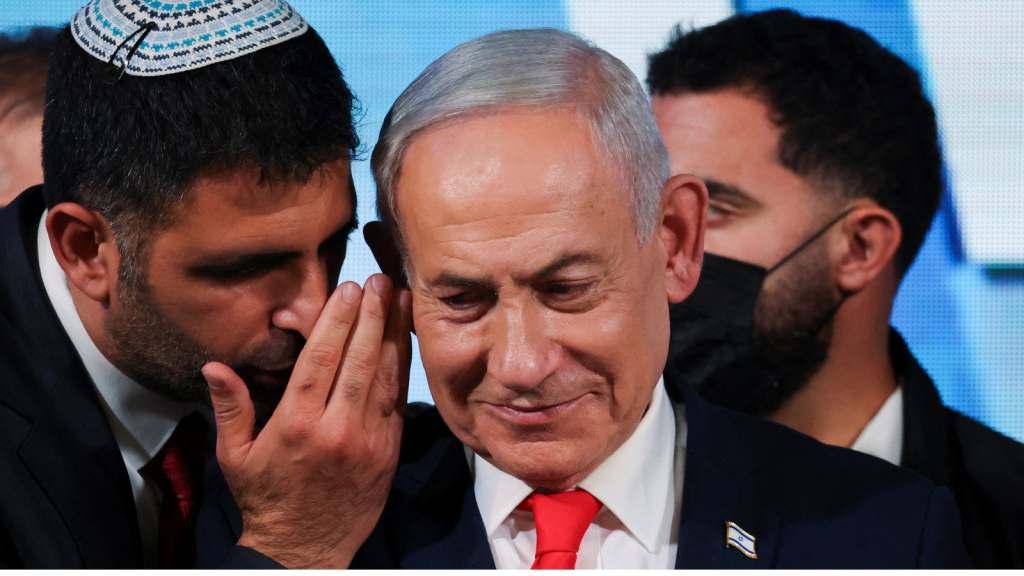
Israel’s October 27, 2026, parliamentary election has created a complicated political situation, with neither the right-wing bloc led by Prime Minister Benjamin Netanyahu nor the opposition bloc led by former military chief Gadi Eisenkot projected to secure the 61 seats required for a majority in the 120-member Knesset.
The Arab-led Ra’am and Joint List parties could play a decisive role in government formation after making significant electoral gains. According to provisional results reported by Israeli media, the two parties are projected to win a combined 19 seats, potentially giving an opposition grouping enough support to reach a parliamentary majority.
However, the seat arithmetic does not automatically translate into a viable coalition. Netanyahu has ruled out relying on Arab-led parties to form a government, while Eisenkot and several of his prospective allies have also expressed reservations about working with them.
The central question is whether the opposition will reconsider its position and seek support from Arab lawmakers to end Netanyahu’s tenure, or whether ideological differences and political commitments will prevent an alternative government from taking shape.
According to the latest partial count cited by The Times of Israel, Netanyahu’s bloc has 53 seats, compared with 48 for Eisenkot’s bloc. The projected 19 seats for Ra’am and the Joint List would bring the potential opposition grouping to 67 seats, above the 61-seat threshold. These figures remain provisional while counting continues.
Netanyahu Alleges Election Fraud and Rejects Cooperation With Arab Parties
Netanyahu has intensified allegations of irregularities involving Arab-led political parties, arguing that suspected foreign interference and improper activity affected the election. He has demanded an investigation by the police and Shin Bet, Israel’s internal security agency.
In a social media post, Netanyahu described the so-called “Ra’amgate affair” as an “earthquake” and alleged that the election had been stolen through voter bribery and other irregularities. He directed his criticism at Ra’am, also known as the United Arab List, and the Joint List alliance.
Netanyahu also alleged that foreign entities had interfered in the election and provided money to influence Arab voters. He claimed that the alleged activity was intended to change the balance of power in parliament and facilitate a government that would threaten Israel’s political and national character.
He argued that Zionist parties should not cooperate with Ra’am or the Joint List, describing a government dependent on what he called anti-Zionist Arab parties as unacceptable.
The allegations have been rejected by Arab political leaders, who say the claims are intended to undermine their electoral gains and discourage other parties from cooperating with them.
The Central Elections Committee’s chief, Justice Noam Sohlberg, had written to Shin Bet chief David Zini requesting an investigation into suspicions of improper influence involving funding from foreign entities allegedly acting against Israeli interests.
Sohlberg said he could not independently confirm the substance of the suspicions but considered a thorough investigation necessary. He asked the security agency to provide its findings within a week.
The letter did not identify the countries allegedly involved or provide further details about the suspected interference. Hebrew-language media reports said Likud believed Qatar and Turkiye might have been sources of funds allegedly sent to organisations involved in mobilising Arab voters.
However, police have reportedly dismissed Likud’s broader claim that Arab parties stole the election, saying there was no supporting evidence, according to a report by news agency PTI.
The distinction is important: a request to investigate suspicions does not establish that electoral fraud or foreign interference occurred. The allegations remain separate from the provisional seat projections, which will determine the parliamentary strength of the competing political blocs.
Can Gadi Eisenkot Form a Government With Arab Parties?
Eisenkot faces a difficult political choice because the opposition’s projected seat count falls short of a majority without support from Arab-led parties. Although the combined strength of Ra’am and the Joint List could provide the numbers needed to form a government, securing that support would require negotiations over political differences and the terms of cooperation.
Eisenkot has not made an unequivocal commitment to partner with the Arab parties if their support proves necessary. According to the supplied reporting, he had previously said that none of the parties met his conditions as potential allies and had ruled out a minority government dependent on Arab-led parties before the election.
He has also said that Israel must protect the integrity of its elections and thoroughly investigate every complaint concerning possible foreign interference. At the same time, he has cautioned against political actors using the investigation to influence the timing of the inauguration of the 26th Knesset.
The opposition’s challenge is therefore not limited to securing enough seats. Its leaders must also determine whether they can agree on a common political programme and a workable arrangement with parties whose support could be essential to government formation.
Yousef Jabareen, a leader of the Joint List alliance, accused Netanyahu of using allegations against Arab parties to prevent political change.
“Netanyahu knows that without the Arab parties, there’s no majority to unseat him. That’s why he incites against us,” Jabareen told The New York Times.
He added that the Joint List was prepared to cooperate with those seeking to remove Netanyahu and change his government’s policies.
Political analysts cited in the newspaper’s reporting suggested that the Joint List could support an Eisenkot-led government from outside the coalition rather than formally joining it. Such an arrangement could allow Arab lawmakers to help sustain a government without taking ministerial positions.
Democrats leader Yair Golan has also urged opposition partners to work with Arab citizens of Israel. He has called for the formation of a government of change in partnership with the country’s Arab citizens, reflecting a more open position towards cooperation.
Nevertheless, the positions of Eisenkot and other opposition leaders remain central to the negotiations. The potential parliamentary majority represented by Arab-led parties will matter only if the parties involved can reach an agreement that allows a government to take office and remain in power.
Ra’am and the Joint List: Different Political Approaches
Although Ra’am and the Joint List both represent Arab citizens of Israel, the parties have different political backgrounds, priorities and approaches to coalition politics. Those differences could influence the terms on which they are prepared to support a government led by Eisenkot.
Ra’am, led by Mansour Abbas, has roots in Islamist politics and has sought greater acceptance among Jewish political parties. Its approach has included efforts to demonstrate that Arab political representation can translate into practical gains for Arab communities through participation in government.
The Joint List, by contrast, is an alliance of smaller parties that includes left-wing groups and Palestinian nationalists. It has generally taken a more confrontational position towards Zionism and has historically been reluctant to join Zionist-led governments, according to The New York Times.
The two parties’ electoral gains could increase their influence over the government formation process, but their different approaches mean that cooperation with the opposition may not follow a single model.
Ra’am previously joined the government formed in 2021 under then-prime minister Naftali Bennett and Yair Lapid. Its participation marked an important example of an Arab-led party joining a governing coalition in Israel. The government ended in 2022, triggering another election.
Since then, Abbas has sought to make Ra’am more acceptable to Jewish voters and potential coalition partners. The party has recognised Israel’s Jewish character as a political reality and considered ways to integrate Arab citizens into national service.
Abbas has indicated that he is willing to join an Eisenkot-led coalition if a viable arrangement can be established. He told Channel 12 that political figures were speaking with his party, according to The Times of Israel.
The Joint List has indicated a different preference. Ahmad Tibi said the alliance would not seek ministerial positions or formal membership in a coalition but could consider supporting a government from outside in exchange for commitments on issues affecting Arab communities.
Among the issues Tibi identified were tackling crime in Arab communities and ending demolitions of Bedouin homes. These demands could become part of any negotiations over outside support for an alternative government.
The positions suggest that the two Arab-led parties may be willing to explore cooperation through different arrangements, depending on the policies and commitments offered by potential partners.
Political Differences Within the Opposition Complicate Coalition Talks
The opposition’s difficulties extend beyond its relationship with Arab-led parties. Several political leaders have made commitments that restrict the combinations they are prepared to consider, complicating efforts to assemble a stable majority.
Avigdor Liberman has pledged not to form a government that relies on Arab parties, according to The Times of Israel’s October 28 reporting. Naftali Bennett has also pledged not to sit with Arab parties in the current political contest, although he previously led a government that included Ra’am in 2021.
Yair Golan has ruled out sitting in a government with the Haredi parties or with Likud while Netanyahu remains its leader, according to The Jewish Chronicle. His position narrows the possible combinations involving parties associated with the religious right or Netanyahu’s leadership.
Eisenkot has rejected serving under Netanyahu, including through a rotation arrangement in which the premiership would change hands during a government’s term. Netanyahu, meanwhile, has said that partners are welcome without a rotation agreement, according to Israel Hayom’s October 28 report.
Eisenkot has described his priority as forming a Zionist government committed to military conscription. The issue is significant because United Torah Judaism left Netanyahu’s government over the draft law, highlighting disagreements about military service and exemptions for members of the Haredi community.
These positions illustrate why the parliamentary numbers alone cannot determine the outcome of coalition negotiations. Even if a collection of parties has enough seats on paper, disagreements over military conscription, religious policy, Arab-party participation and the premiership can prevent an agreement.
The leaders involved must also consider the political consequences of reversing public commitments made before or immediately after the election. Any agreement with Arab-led parties could face opposition from politicians who have ruled out such cooperation, while a government formed without them may struggle to secure sufficient parliamentary backing.
How a Government Could Take Office Without 61 Seats
Although 61 seats represent a majority in the 120-member Knesset, the process of forming a government is not determined solely by whether a coalition formally holds that number of seats.
A government must secure more votes in its favour than against in the relevant Knesset confidence vote. This means that a government can take office with fewer than 61 coalition members if it receives sufficient outside support or benefits from abstentions.
There are several possible arrangements for parties that do not want to join a governing coalition formally.
- Formal coalition membership: A party joins the government and may receive ministerial positions in exchange for supporting the coalition’s programme.
- External support: A party remains outside the government but agrees to support it on a confidence vote or other parliamentary matters.
- Abstention: A party does not vote in favour of the government but also does not vote against it, potentially allowing the government to secure the necessary majority in a confidence vote.
The government formed by Bennett and Lapid in 2021 was sworn in with 60 votes in favour and 59 against, with one abstention. That example illustrates how a government can take office without having 61 coalition members voting in support.
However, governing with fewer than 61 seats can create difficulties after the initial confidence vote. A government may need support from parties outside its coalition to pass legislation, approve budgets and survive subsequent parliamentary challenges.
For Eisenkot, external support from Ra’am or the Joint List could therefore represent one possible route to government formation if formal coalition membership proves politically unacceptable to some partners.
Such an arrangement would still require sufficient agreement over the issues on which the government would depend on outside support. The parties would also need to determine whether their differences could be managed without repeatedly threatening the government’s survival.
What Are the Possible Outcomes of Israel’s Coalition Deadlock?
The provisional results leave several possible routes for government formation. Each depends on whether the parties can reconcile their public commitments with the parliamentary arithmetic and reach an agreement that can survive a confidence vote.
1. An Opposition Government With Arab-Party Support
One possibility is that Eisenkot and his prospective partners reach an agreement with Ra’am and the Joint List. Cooperation could take the form of a formal coalition, external parliamentary support or another arrangement that allows the opposition to secure enough votes to form a government.
This outcome would require some opposition leaders to reconsider or reinterpret their stated positions on working with Arab parties. It would also require agreement on the terms of cooperation, including the policies and commitments that Arab lawmakers would expect in return for their support.
The two Arab-led parties may not demand the same arrangement. Ra’am has previously participated in a governing coalition, while Joint List leaders have indicated that they could support a government from outside without seeking ministerial positions.
2. Prolonged Coalition Negotiations
A second possibility is an extended political deadlock. If neither Netanyahu’s bloc nor the opposition can assemble a viable government, negotiations could continue as parties explore different combinations and seek compromises.
The difficulty would be particularly pronounced if opposition leaders continued to reject cooperation with Arab parties while also ruling out an arrangement with Netanyahu. In that situation, the projected seat distribution might not translate into a governing majority.
Disagreements over military conscription, the role of religious parties and the terms of any cooperation with Arab lawmakers could further complicate negotiations.
3. A Unity Government
Another possibility is a unity arrangement involving political parties from different blocs. Such a government would require a negotiated agreement on leadership, policy priorities and the distribution of ministerial positions.
However, Eisenkot’s rejection of serving under Netanyahu, including through a rotation arrangement, represents an obstacle to a unity government under the terms described in the supplied reporting. Netanyahu has said that prospective partners are welcome without a rotation, leaving the question of leadership unresolved.
4. Another Election
If political leaders cannot reach an agreement that produces a viable government, another election could become one of the possible outcomes. The Times of Israel has identified a fresh election alongside an Arab-backed opposition government and a unity arrangement as potential scenarios.
A new election would not be automatic simply because coalition talks encounter difficulties. The parties would first have to navigate the relevant political and parliamentary processes, while negotiations could continue in an attempt to find an arrangement acceptable to enough lawmakers.
When Will Israel Announce the Final Election Results?
The seat figures cited in the latest reporting remain projections rather than an official allocation. The Central Elections Committee is expected to publish the final results by November 4, according to the supplied PTI report.
The data available at 8:02 a.m. Israel time on October 29, 2026, indicated that 91.7 per cent of votes and 98.6 per cent of regular polling stations had been counted. Approximately 430,000 to 480,000 double-envelope ballots were still being counted.
The projected distribution was based on the Central Elections Committee count as reported by N12 and Calcalist. The remaining ballots could affect the final seat allocation, so the current figures should not be treated as a definitive parliamentary result.
Once the official results are announced, President Isaac Herzog is expected to consult political factions before assigning a lawmaker the task of forming a government, according to PTI.
Those consultations will provide an opportunity for parties to outline their preferred coalition arrangements and explain whether they are prepared to support a candidate for prime minister. The process will also clarify whether the projected opposition majority can be converted into a workable governing arrangement.
Why Arab Parties Could Influence Israel’s Next Government
Arab citizens make up approximately one-fifth of Israel’s population. The projected 19 seats for Ra’am and the Joint List would represent a substantial increase from the 10 seats the two parties held in the outgoing Knesset, according to The New York Times.
The reported gains have placed Arab-led parties in a potentially decisive position at a time when neither major political bloc has secured a projected majority independently.
Their influence stems not only from their seat count but also from the difficulty other parties face in assembling an alternative majority without them. If the opposition seeks to form a government, it must determine whether it can work with Arab lawmakers despite disagreements over ideology, national identity and security policy.
For Ra’am and the Joint List, the negotiations could provide an opportunity to seek commitments on issues affecting Arab communities. These include crime, public services and the treatment of Bedouin communities, as reflected in the positions described by their leaders.
At the same time, cooperation with Arab-led parties remains politically contentious among several opposition figures and has been explicitly rejected by Netanyahu. The resulting tension places the question of Arab-party participation at the centre of the government formation process.
Conclusion: Netanyahu’s Rivals Face a Crucial Coalition Decision
Israel’s 2026 parliamentary election has left the country facing a complex government formation process. Netanyahu’s bloc is projected to hold 53 seats, while Eisenkot’s bloc has 48. The projected 19 seats held by Ra’am and the Joint List could provide the numbers needed for an alternative grouping to reach a majority, but political disagreements remain unresolved.
Netanyahu has ruled out relying on Arab-led parties and has called for an investigation into allegations of foreign interference and electoral irregularities. Police have reportedly said there is no supporting evidence for Likud’s broader claim that the election was stolen, while Arab political leaders have rejected the accusations.
Eisenkot must now navigate competing priorities within the opposition, including objections to cooperation with Arab parties and disagreements over military conscription, religious parties and the premiership. Ra’am and the Joint List have indicated different approaches to possible cooperation, ranging from formal coalition participation to external support.
The final election results, expected by November 4, will establish the official distribution of seats. Whether those numbers produce an opposition government, a unity arrangement, prolonged negotiations or another election will depend on the agreements political leaders can reach and the support they can secure in the Knesset.
For breaking news and live news updates, like us on Facebook or follow us on Twitter and Instagram. Read more on Latest World on thefoxdaily.com.



COMMENTS 0