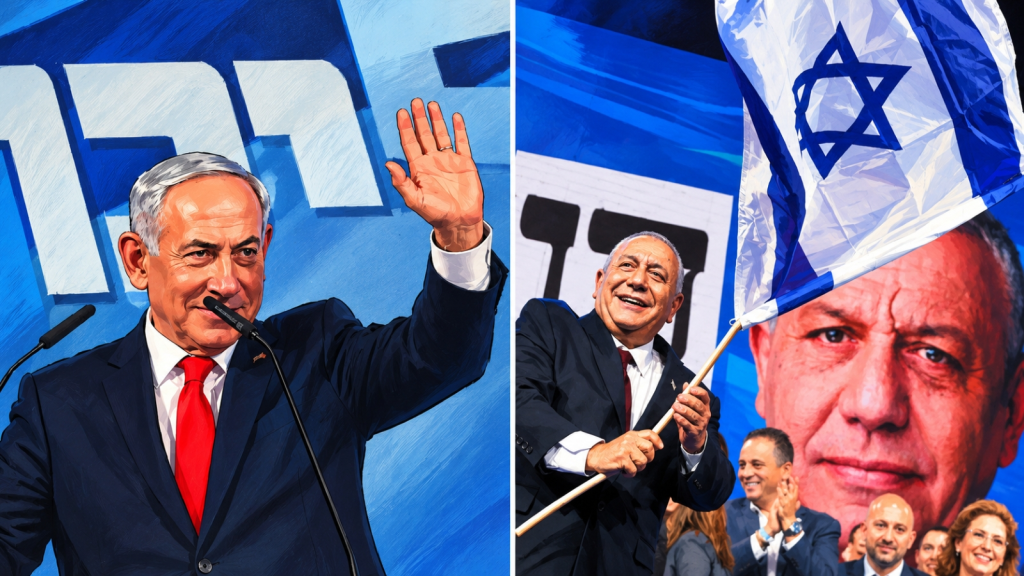
Israel’s 2026 election has produced an uncertain parliamentary picture, with Prime Minister Benjamin Netanyahu’s bloc falling short of the seats required to form a government. The remaining double-envelope ballots could change the final distribution of seats in the Knesset and influence negotiations between political parties.
According to the reported preliminary results, Netanyahu’s bloc held 53 seats, while the opposition alliance led by Gadi Eisenkot had 48. Arab-led parties accounted for another 19 seats. None of these groupings had reached the 61 seats required for a majority in Israel’s 120-member parliament.
The outstanding ballots have therefore become an important part of the election process. The Times of Israel reported that approximately 600,000 double-envelope ballots were awaiting counting, while Ynet put the expected number at more than 650,000. Other reports cited estimates of between 650,000 and 700,000 ballots.
These figures are preliminary estimates rather than a confirmed final count. Before the ballots can be included in the national results, election officials must verify voter eligibility and ensure that nobody has voted more than once.
Although the additional votes could affect the number of seats won by individual parties, they will not automatically determine who becomes prime minister. Even after the final results are announced, political leaders must negotiate to establish a government capable of winning parliamentary confidence.
What Are Double-Envelope Votes in Israel’s Elections?
Double-envelope votes are special ballots used by eligible voters who cannot vote at their designated polling stations. The arrangement allows people in specific circumstances to participate in an election while enabling officials to verify their eligibility before counting their votes.
Unlike ordinary ballots, which are processed at designated polling stations, double-envelope ballots undergo an additional verification procedure. Election officials must establish that the voter has not already cast a ballot elsewhere before the vote can be added to the national tally.
The system is designed to balance two important requirements: protecting the integrity of the election and preserving the secrecy of each voter’s choice.
According to the Israel Democracy Institute, voters place their ballot papers inside anonymous inner envelopes. These are then sealed inside outer envelopes that carry identifying information. Officials check the outer envelopes against the electoral records to prevent duplicate voting.
Once the verification process is complete, the identifying information is separated from the ballot. The anonymous inner envelope can then be processed without linking the voter’s identity to their political choice.
This additional procedure takes time, particularly when the number of special ballots is large. As a result, the final seat distribution may remain uncertain even after most ordinary ballots have been counted.
Who Can Vote Through the Double-Envelope System?
The system covers several categories of eligible voters who may be unable to reach their regular polling stations or who vote through designated arrangements.
These categories include:
- Soldiers and reservists: Personnel whose military duties may prevent them from voting at their designated polling stations.
- Police personnel: Eligible officers whose duties or circumstances require special voting arrangements.
- Prisoners: Eligible voters who cannot attend ordinary polling stations because they are in custody.
- Hospital patients: People whose medical circumstances may prevent them from voting at their regular polling locations.
- Certain medical and election workers: Eligible personnel whose responsibilities affect their ability to vote through ordinary arrangements.
- Voters with limited mobility: Eligible voters covered by special arrangements because of mobility-related restrictions.
- Evacuees: Eligible residents using designated polling stations under applicable arrangements.
- Israeli representatives serving abroad: Eligible personnel covered by special overseas voting provisions.
The exact eligibility requirements depend on the applicable election rules and the voter’s circumstances. The double-envelope procedure provides a way to include eligible voters whose situations differ from those of people voting at their usual polling stations.
Military personnel and reservists are particularly relevant to the 2026 count because the number of people serving away from their ordinary residences can affect the volume and geographical distribution of special ballots.
How Many Double-Envelope Votes Are Expected in 2026?
Initial reports put the number of outstanding double-envelope ballots at approximately 600,000 to 650,000 or more, with some estimates reaching 700,000.
The Times of Israel reported that around 600,000 ballots were awaiting counting. Ynet estimated that the total would exceed 650,000, while IsraelFM, citing the TPS-IL news agency, reported a range of 650,000 to 700,000.
The different figures reflect estimates reported during the counting process. They should not be treated as interchangeable with the final number of valid ballots ultimately included in the results.
The number of ballots alone does not reveal which political parties will benefit. Their impact depends on how voters distribute their choices among the competing parties, how those votes affect the national totals and whether changes in party vote shares alter the allocation of parliamentary seats.
That distinction is important because Israel uses proportional representation. A party does not simply receive a fixed number of seats based on its performance in one locality. Its national vote share, the electoral threshold and the seat-allocation rules all influence the final result.
When Will the Double-Envelope Votes Be Counted?
The Central Elections Committee must process the special ballots after the necessary checks have been completed. The procedure includes verifying the outer envelopes, checking that voters have not already cast ballots and separating identifying information from the anonymous votes.
Reports from The Times of Israel and Ynet indicated that counting could continue into Friday morning, depending on the volume of ballots and the time required for verification.
The final schedule depends on the number of envelopes received, the verification process and the work required to incorporate the valid ballots into the national totals.
Reports cited in the supplied election coverage indicated that the official results were scheduled to be announced by November 4. Until the verification and counting process is completed, the reported distribution of seats remains provisional.
Even after the final results are published, Israel may face a further period of political negotiations. The official seat tally determines parliamentary representation, but forming a government requires a separate process involving the president and the elected parties.
Why Could Double-Envelope Votes Change the Election Result?
Israel’s proportional representation system makes the distribution of votes among individual parties important. The outstanding ballots are added to the national totals, potentially changing party vote shares and the number of seats awarded under the electoral rules.
The preliminary results put Netanyahu’s bloc at 53 seats, eight short of the 61 needed for a parliamentary majority. The opposition alliance led by Gadi Eisenkot had 48 seats, while Arab-led parties held a reported 19.
Because the main political groupings were short of a majority, even a relatively small change in the seat distribution could affect coalition calculations. A party gaining or losing seats may change the options available to political leaders seeking support for a government.
The electoral threshold also matters. Parties close to the 3.25% threshold may gain or lose parliamentary representation depending on their final vote totals. Such changes can influence the broader allocation of seats, rather than affecting only the party whose votes cross the threshold.
However, the number of outstanding ballots does not establish the likely direction of the result. Without a confirmed breakdown of those votes, it is not possible to determine which parties will gain seats or whether the overall balance between political blocs will change.
Could the Double-Envelope Votes Help Netanyahu?
The outstanding ballots could affect Netanyahu’s parliamentary position, but the extent and direction of any change depend on how the votes are distributed among the parties.
According to The Times of Israel, special ballots have traditionally tended to favour Zionist parties over Arab and ultra-Orthodox parties. However, the unusually large number of reservists serving in 2026 makes the voting pattern harder to predict.
That historical tendency should not be treated as a guarantee about the current election. Past voting patterns cannot establish how the outstanding ballots will be distributed in a particular election, especially when the number and circumstances of eligible voters differ.
If parties within Netanyahu’s bloc gain seats, his coalition negotiations could change. If the additional votes benefit parties outside his bloc, his position could become more difficult. The final effect will depend on the verified results and the parliamentary relationships between the parties.
Even if Netanyahu’s bloc gains seats, it would still need sufficient support to secure a majority or establish another arrangement capable of winning a confidence vote. The double-envelope count can change the parliamentary arithmetic, but it cannot replace the need for political agreements.
Could the Double-Envelope Votes Help the Opposition?
The remaining ballots could also change the opposition’s seat totals. The same electoral rules apply regardless of which political bloc receives the additional votes, and there is no guarantee that the count will benefit one side over the other.
The opposition alliance led by Gadi Eisenkot was reported to hold 48 seats in the preliminary count. That left it short of the 61-seat threshold, meaning its ability to form a government would depend on the final results and the availability of support from other parties.
Changes involving smaller parties could also influence the opposition’s options. If a party gains representation or increases its parliamentary strength, it could become more important in negotiations. Conversely, a change in the allocation of seats could reduce the number of potential partners available to an alliance.
The decisive question is therefore not simply whether the opposition gains seats. It is whether the final distribution creates a combination of parties capable of supporting a government in a confidence vote.
Why Are Arab-Led Parties Important in the Election?
Arab-led parties were reported to hold 19 seats in the preliminary results, giving them a potentially significant role in a parliament where neither main political bloc had secured a majority.
Their final representation could change as the remaining ballots are counted. Their role in government formation, however, depends on the positions taken by the parties involved and the willingness of other political groups to cooperate with them.
Netanyahu has described relying on anti-Zionist Arab parties to form a government as “unthinkable”, according to the supplied election coverage. He has also argued that the right has a “decisive majority” among the Zionist public.
Eisenkot has ruled out partnering with Arab-led parties, according to the same coverage. Nevertheless, analysts have discussed the possibility that some Arab-led parties could support a government from outside the cabinet without taking ministerial positions.
This distinction matters because supporting a government does not necessarily require joining its cabinet. Parliamentary backing can take different forms, and the practical implications depend on the confidence vote and the agreements reached between parties.
Under the parliamentary arithmetic described in the reports, a minority government is legally possible if it receives more votes in favour than against in a confidence vote. Such an arrangement would still need sufficient parliamentary support to operate and pass legislation.
The final seat tally could therefore affect not only the size of the two main blocs but also the influence of parties outside them. However, the reported seat count alone does not establish whether any particular coalition arrangement will be agreed.
Three Possible Scenarios for Government Formation
With neither main bloc holding 61 seats in the preliminary results, several possible paths could emerge after the double-envelope votes are counted. Each depends on the final seat distribution and the ability of political leaders to secure parliamentary support.
1. Netanyahu Secures Additional Support
Netanyahu could seek support from parties outside his existing bloc. The feasibility of this route would depend on the final seat totals, the political conditions set by potential partners and whether enough lawmakers were willing to support his government.
His stated opposition to relying on anti-Zionist Arab parties limits one potential avenue for cooperation. Any alternative arrangement would need to account for the positions of the parties involved and the number of seats they could contribute.
2. The Opposition Builds a Parliamentary Majority or Minority Arrangement
The opposition alliance led by Eisenkot could seek support from other parties to assemble a government. The 19 seats attributed to Arab-led parties in the preliminary count make their potential parliamentary role significant, even though Eisenkot has ruled out partnering with them.
One possibility discussed by analysts is support from outside the cabinet rather than participation in the government itself. Whether that approach could work would depend on the final results and the willingness of lawmakers to back the relevant confidence vote.
A minority government could be possible under parliamentary rules if it secured more votes in favour than against. However, such a government would need to maintain sufficient support to function after its formation.
3. Political Deadlock Leads to Another Election
If the rival camps remain unable to agree on a government, Israel could face another election after the relevant parliamentary procedures are followed. In that scenario, the existing government could continue in a caretaker capacity while the political process moves forward.
Israel has experienced repeated elections and prolonged coalition negotiations in the past. The country held three elections between 2019 and 2020 before a power-sharing agreement ended a similar period of deadlock.
Analyst Asaf Ronel was cited in the supplied coverage as saying another election within months was the most likely outcome if rival political groups continued refusing to work with Arab-led parties. That is an attributed assessment, not a confirmed outcome of the current election.
The final results and the positions taken by party leaders will determine whether negotiations produce a government or the deadlock continues.
How Is Israel’s Government Formed After an Election?
Israel does not directly elect its prime minister through a separate nationwide presidential-style ballot. Voters elect members of the Knesset, and the government is formed through a process that depends on parliamentary support.
After the official Election Results are published, President Isaac Herzog consults representatives of the elected parties. He then assigns the task of forming a government to the lawmaker he judges most likely to secure the support needed to win a confidence vote.
The party with the largest number of seats does not automatically have to receive the first opportunity. The president’s decision is based on the prospects of forming a government, rather than solely on which party finished first in the seat count.
The supplied coverage cites the 2009 election as an example. President Shimon Peres selected Benjamin Netanyahu of Likud, which had won 27 seats, over Tzipi Livni of Kadima, which had won 28 seats. The example illustrates that the government formation process depends on the ability to assemble parliamentary backing.
The time limits for forming a government are established by law. If the initial effort fails, further steps may be available under the applicable procedures. If no government can be formed, the process can ultimately lead to another election.
Consequently, the final double-envelope count is an important step, but it is not the last stage of the political process. The results will establish the distribution of seats, while negotiations and confidence votes will determine whether a government can take office.
When Will Israel Announce the Final Election Results?
The Times of Israel reported that the official results were scheduled to be announced by November 4. The final timing depends on the completion of the verification and counting process.
Until the Central Elections Committee finishes processing the special ballots, the published seat distribution should be treated as provisional. Estimates of the number of outstanding ballots may also change as officials establish how many votes are valid and ready to be counted.
Once the results are confirmed, attention will shift from counting ballots to coalition negotiations. Political leaders will need to determine whether they can secure sufficient support from other parties to establish a government.
Even a clear final seat distribution may not immediately resolve the political deadlock. The parliamentary arithmetic, the positions of potential coalition partners and the president’s assessment of who can form a government will all shape the next stage.
Can Double-Envelope Votes Alone Determine Who Becomes Prime Minister?
No. Double-envelope votes can affect the final allocation of seats in the Knesset, but they do not directly elect the prime minister.
The verified ballots will be added to the national results and may change the parliamentary strength of individual parties. The president will then consult representatives of the elected parties and assign a lawmaker considered most likely to form a government.
That candidate must secure sufficient parliamentary support to win a confidence vote. The process can involve negotiations over coalition membership, government responsibilities and policy commitments.
For Netanyahu, the outstanding ballots could change the size of his bloc and the options available to him. For Eisenkot and the opposition, the same votes could alter their seat totals and the range of possible parliamentary arrangements.
The central uncertainty is how the remaining ballots will be distributed among the parties. Until the verification process is complete, neither the final seat allocation nor the outcome of coalition negotiations can be established with certainty.
What Happens Next?
Israel’s 2026 election remains dependent on two connected processes: completing the count and determining whether any political combination can command sufficient support in the Knesset.
The double-envelope ballots matter because the preliminary results leave the main political blocs short of a majority. Their final distribution could alter individual party seat totals, affect the influence of smaller parties and reshape the negotiations that follow.
But counting the remaining ballots will not, by itself, resolve the political impasse. Once the official results are announced, the president’s consultations and the parties’ willingness to cooperate will determine whether a government can be formed or whether Israel faces another period of deadlock.
For breaking news and live news updates, like us on Facebook or follow us on Twitter and Instagram. Read more on Latest World on thefoxdaily.com.





COMMENTS 0