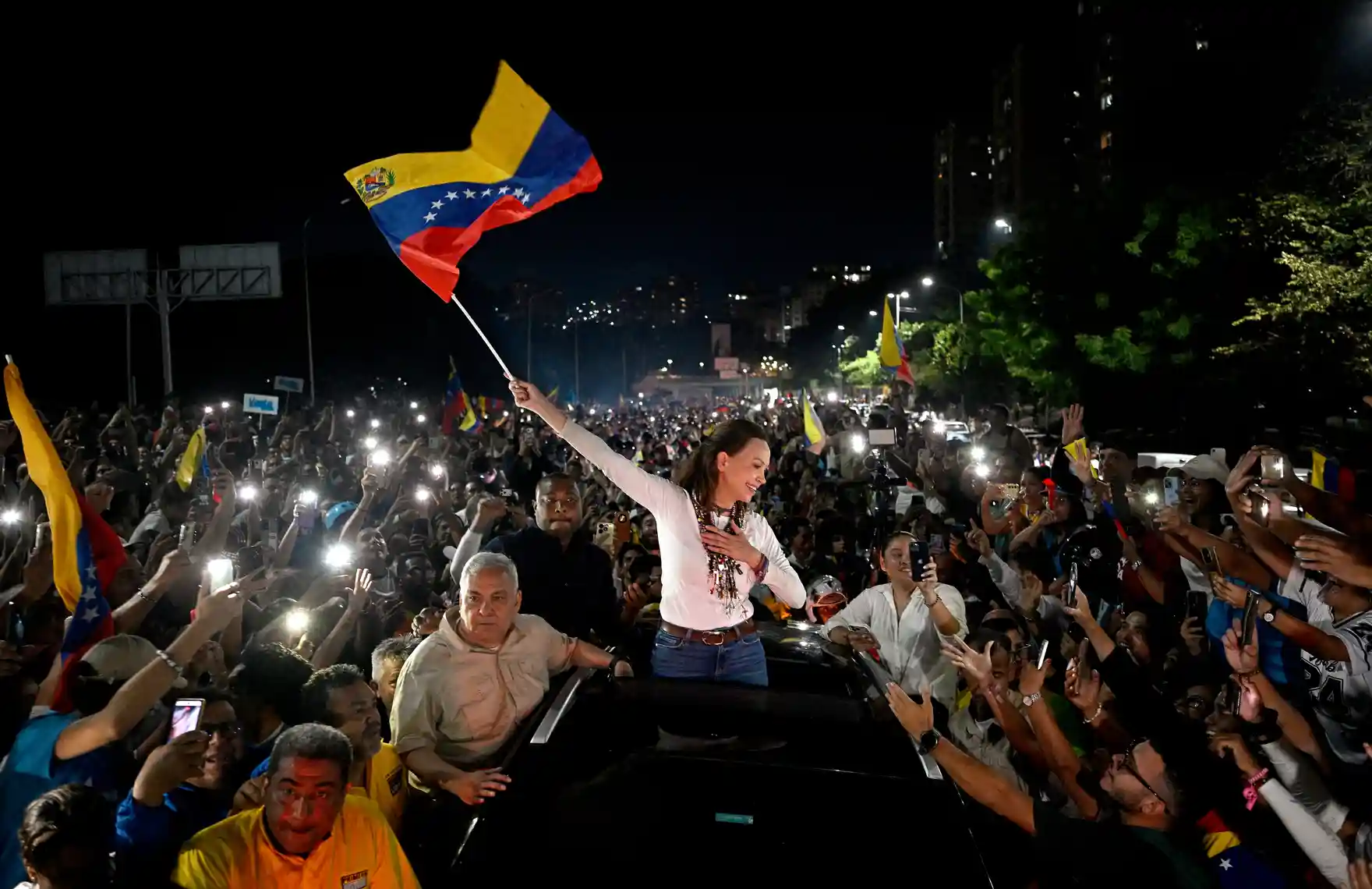
Venezuelan opposition leader and Nobel Peace Prize laureate MarÃa Corina Machado has returned to Venezuela after nearly a year in exile, receiving an enthusiastic welcome from supporters as she travelled towards the capital, Caracas. Her return comes at a politically sensitive moment for the country, where interim president Delcy Rodríguez remains in power following the removal of former president Nicolás Maduro.
Machado announced her arrival on Sunday through a post on X, writing, “I’m here. With you.” Her close ally Edmundo González, who remains in exile, also confirmed that she had returned to Venezuelan soil, describing the development as an important moment for the country’s opposition movement.
Footage shared on social media showed Machado surrounded by supporters at the Sanctuary of the Divine Shepherdess in Barquisimeto, the capital of Lara state, around 220 miles west of Caracas. Hundreds gathered outside the church, chanting “Freedom!” as she made her appearance.
Her return drew large crowds along the route to Caracas, with supporters gathering on streets and highways to greet her. The journey from Barquisimeto to the capital reportedly took around eight hours because of the crowds. The reception highlighted the continued enthusiasm among her supporters, while raising questions about the political implications of her return and the response of Rodríguez’s government.
Machado Announces Her Return to Venezuelan Soil
Machado, 59, announced her return on Sunday, ending months of uncertainty about whether she would be able to re-enter Venezuela after leaving the country in December. The circumstances surrounding her arrival were not immediately clear, and the available account did not establish how she managed to return.
Her close ally González welcomed the news in a social media post, saying Machado’s presence would help lead and guide the opposition’s political process. He also indicated that he intended to return to Venezuela himself, although no specific date was provided.
Machado’s arrival in Barquisimeto was documented in images and videos circulated online. At the Sanctuary of the Divine Shepherdess, supporters gathered around her, holding mobile phones and attempting to capture the moment.
After leaving the church, she began travelling east through Yaracuy state towards Caracas. Videos shared by aides showed her leaning out of a vehicle’s sunroof to reach supporters gathered along the roadside.
As the convoy approached the capital on Sunday night, tens of thousands of cheering supporters reportedly lined the route. Machado greeted the crowds, shaking hands and embracing people as the vehicle moved through the streets.
“This country is giving lessons to everyone,” she shouted as the convoy entered Caracas, according to the supplied report.
She also described her political goals in a social media post, writing: “For the reunion of every family, for freedom of every political prisoner, for the freedom of Venezuela.” The message connected her return with the opposition’s wider demands for political freedom, the release of prisoners and the ability of Venezuelans living abroad to reunite with their families.
Why Machado Left Venezuela
Machado left Venezuela in December, weeks before Maduro was captured in January, according to the supplied account. During her time outside the country, she reportedly made more than half a dozen unsuccessful attempts to return, including after a devastating earthquake struck Venezuela’s northern coast in June.
Her absence reflected the difficult political circumstances facing the opposition under Maduro’s government. Machado had spent years campaigning for political change and became one of the most prominent figures challenging the former president’s rule.
Her movement was widely believed to have defeated Maduro in the 2024 presidential election, but he refused to hand over power. The disputed outcome deepened the confrontation between the government and the opposition and left questions about the country’s political future unresolved.
Machado was awarded the 2025 Nobel Peace Prize for her peaceful challenge to Venezuela’s authoritarian government. The award brought further international attention to her campaign and her role in the country’s opposition movement.
After Maduro’s capture, some observers expected US President Donald Trump to support Machado taking power. Instead, the Trump administration embraced Rodríguez, Maduro’s former vice-president, who assumed leadership of the country.
The decision altered expectations about Venezuela’s political transition. Machado’s return now places her back in the country at a time when the relationship between Washington and Rodríguez’s administration has become an important factor in determining the political landscape.
Trump Administration’s Position Adds to the Uncertainty
The circumstances surrounding Machado’s return have raised questions about the position of the Trump administration. According to the supplied report, the administration had reportedly opposed her return because it believed her presence could complicate its relationship with Rodríguez.
Machado and Rodríguez are political rivals with sharply different positions on Venezuela’s future. Machado has called for political change and fresh presidential elections, while Rodríguez currently leads the government following Maduro’s removal.
Asked by reporters on Sunday about Machado’s return, Trump said he was unaware of the details but described her favourably.
“I don’t know anything about it, but I think she’s a very nice woman. She gave me her Nobel prize, so how can I say anything else?” Trump said.
He added: “I hope she’s safe. She’s a very nice woman. But we’re doing very well in Venezuela.”
Machado has repeatedly praised Trump for the operation that removed Maduro. She also gave him her 2025 Nobel Peace Prize medal, a gesture that attracted international attention and became part of the public discussion about their relationship.
US Secretary of State Marco Rubio, meanwhile, claimed that US-supported reconciliation efforts had created conditions that allowed Machado to return safely after around 10 months in exile.
Rubio said her return was the direct result of reconciliation talks that had already seen hundreds of political prisoners freed and hundreds of opposition figures return from exile.
His statement presented the return as part of a wider political process. However, the supplied account does not independently establish the precise role played by US officials in arranging Machado’s journey or whether Rodríguez’s government formally authorised her return.
Machado’s Return Could Complicate Rodríguez’s Position
Machado’s reappearance in Venezuela presents a new challenge for the country’s interim leadership. Rodríguez and Machado are political adversaries, and the opposition leader’s return could increase pressure for a clearer timetable for elections and a broader political transition.
Before Machado’s arrival, members of the Venezuelan government had repeatedly suggested that she could face arrest if she returned because of her long-running campaign for political change. Yet there was no visible sign of security forces interfering with her journey towards Caracas on Sunday.
The absence of an apparent intervention has prompted questions about whether her return had been accepted or facilitated through political understandings involving Washington and Rodríguez’s government. The supplied report raises this possibility but does not confirm that such an agreement existed.
How the authorities respond in the coming days will be important in determining whether Machado can resume political activity openly. Her presence could provide the opposition with a more visible focal point inside Venezuela, but it does not automatically resolve disputes over electoral legitimacy or guarantee a change in government.
The scale of the crowds accompanying her journey also demonstrates the continuing mobilisation of her supporters. Large public gatherings can increase political pressure, although the response from other parts of Venezuelan society and the institutions controlling the state remains uncertain.
Fresh Presidential Elections Remain a Key Demand
Machado has called for fresh presidential elections to be held by July 2027. It remains unclear whether the Trump administration supports that timeline, particularly given its developing relationship with Rodríguez’s government.
The question of elections is central to the country’s political future. Machado’s movement maintains that the opposition won the 2024 presidential election, while Maduro refused to relinquish power after the vote. A new election timetable would therefore raise questions about electoral guarantees, political participation and the conditions under which competing candidates could campaign.
For the opposition, Machado’s return could help renew pressure for an electoral process that reflects the results it claims were recorded in 2024. For Rodríguez’s government, any move towards new elections would involve decisions about the timing and terms of a political process that could alter the balance of power.
Washington’s position is also significant. Although Trump has spoken favourably about Machado, his administration has established a working relationship with Rodríguez. That relationship could influence how strongly the United States pushes for elections and what conditions it attaches to future cooperation with Venezuela.
The available information does not establish whether a July 2027 election will take place or what specific arrangements might be adopted. For now, Machado’s demand remains a political objective rather than a confirmed electoral timetable.
Oil Deal With the United States Shapes Venezuela’s Political Context
Relations between Washington and Caracas are also shaped by economic interests, particularly Venezuela’s oil sector. Trump announced what he described as “the biggest oil deal in world history” with Venezuela in August, according to the supplied report.
He subsequently characterised the agreement as the spoils of January’s brief “war”. The remarks underscored the importance of the oil relationship in the aftermath of Maduro’s removal.
The agreement adds an economic dimension to the political choices facing the Trump administration. Its cooperation with Rodríguez has developed alongside changes in Venezuela’s leadership, while Machado’s return could introduce additional pressure over the country’s political direction.
Venezuela’s oil resources have long made the country strategically important, and developments in its energy sector can have implications for international commercial and diplomatic relationships. However, the supplied information does not provide the agreement’s financial terms, production commitments or a detailed assessment of its economic effects.
The relationship between oil cooperation and political reform remains uncertain. Washington may face competing considerations involving its economic interests, its stated approach to Venezuela’s political transition and its dealings with both the interim government and opposition figures.
What Machado’s Return Means for Venezuela
Machado’s return marks a significant development for Venezuela’s opposition after nearly a year in exile. Her arrival was followed by large crowds, public expressions of support and renewed attention to her demands for political freedom and fresh elections.
But the enthusiastic reception does not, by itself, determine what happens next. The opposition still faces questions about its ability to influence the government, while Rodríguez remains in office and the Trump administration continues to pursue its relationship with the interim leadership.
The next phase will depend on whether Machado can operate openly in Venezuela, how the authorities respond to her presence and whether reconciliation efforts lead to further political changes. The position of the United States will also matter, particularly as questions over elections and oil cooperation remain unresolved.
For Machado’s supporters, her return represents an opportunity to renew their campaign inside the country. For Rodríguez’s government, it introduces a prominent political rival whose presence could intensify demands for democratic change.
Machado has returned to a country still navigating the consequences of Maduro’s removal and a contested political transition. Her reception in Barquisimeto and Caracas shows the strength of the support mobilised around her, but whether that enthusiasm can translate into concrete political change remains an open question.
For breaking news and live news updates, like us on Facebook or follow us on Twitter and Instagram. Read more on Latest World on thefoxdaily.com.


COMMENTS 0