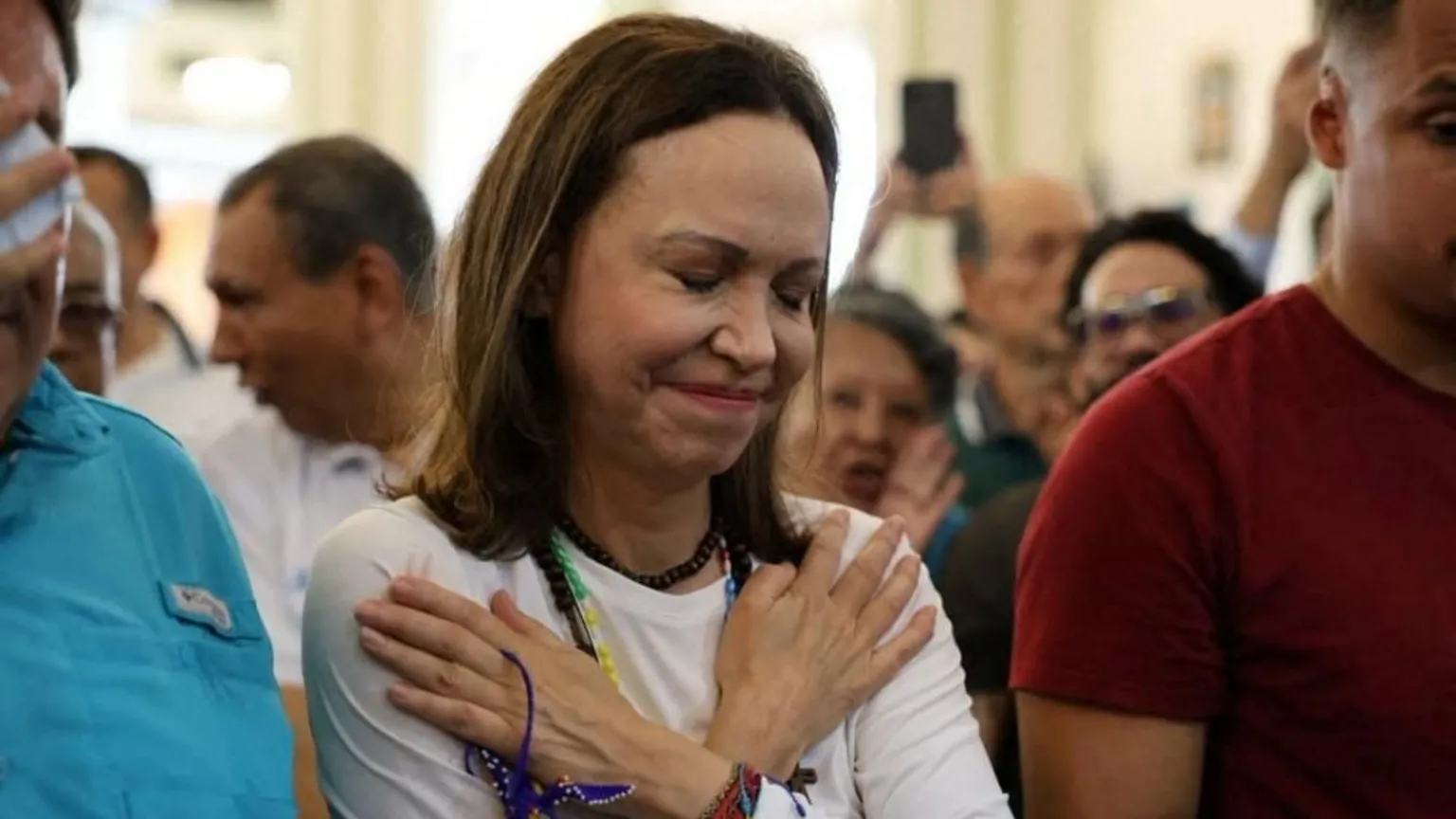
Venezuelan opposition leader and Nobel Peace Prize laureate María Corina Machado returned to Venezuela on Sunday after months in exile, renewing calls for a presidential election as questions over the country’s democratic future continue to grow. Her return comes amid uncertainty over the leadership of the country, the timing of new Elections and the role of the United States in Venezuela’s political transition.
Machado announced her arrival on social media with the message, “I am here. With you.” Her reappearance was her first in Venezuela since December, following her departure from the country and the political upheaval surrounding the removal of former President Nicolás Maduro by the U.S. military.
Edmundo González, another leading opposition figure who stood against Maduro in the 2024 presidential election, confirmed Machado’s arrival in a post on X. He said he would join her “very soon,” describing her return as an important moment for Venezuelans seeking political change.
The development comes as acting President Delcy Rodríguez, a longtime Maduro ally backed by the Trump administration, remains in office without a new presidential election being scheduled. Machado and her allies have called on the authorities to establish an election date, while U.S. officials have argued that economic stabilization and institutional rebuilding should come first.
Machado Returns to Venezuela After Months in Exile
Machado appeared publicly in Venezuela on Sunday, walking into a church in the town of Lara, west of Caracas, where dozens of people welcomed her with applause, handshakes and embraces. Supporters raised their mobile phones to record the moment as people called out her name and welcomed her home.
Her return followed a period of hiding inside Venezuela and a departure that took her to Norway in December, where she received the Nobel Peace Prize for her opposition to Maduro’s government.
Machado had previously vowed to return to Venezuela and, according to her party, made seven unsuccessful attempts to do so. These included a planned journey by charter boat that was cancelled after the operator said the vessel was not fit for navigation, as well as an attempt to fly to the Caribbean island of Curaçao before continuing to Venezuela by speedboat. Her team said the aircraft was denied permission to land.
Opposition activists have accused Venezuelan authorities of obstructing Machado’s return, a claim the government has denied. Questions have also been raised about whether the Trump administration played a role in efforts to discourage her from returning. U.S. officials have denied holding her back, although they have said they advised her against returning on some occasions because of safety concerns.
Machado’s reappearance therefore marks a significant development for an opposition movement that has continued to demand a democratic transition despite political repression, disputed election results and uncertainty over the country’s leadership.
González Says Machado’s Return Is an Important Moment
González, who replaced Machado as the opposition’s presidential candidate in 2024 after authorities barred her from running, publicly welcomed her return.
In his message on X, González said: “Today is a very important day for Venezuelans. Our sovereign voice returns with her to lead and guide this process!” He added: “You know it, this is until the end.”
His statement reflects the opposition’s continued efforts to challenge the political arrangements that followed the disputed 2024 election. Machado and González have maintained that the opposition secured a decisive victory, despite the official announcement that Maduro had won.
Their immediate political demand has been for a presidential election to be scheduled. However, the authorities have not announced a date, leaving uncertainty over how and when Venezuelans will next be able to choose their national leadership through a vote.
Delcy Rodríguez Remains Acting President Without a Scheduled Election
Since Maduro’s removal, Venezuela has been governed by acting President Delcy Rodríguez, a longtime ally of the former president who received the Trump administration’s backing to succeed him.
Rodríguez was initially expected to serve for 90 days as acting president. Venezuela’s highest court said her interim appointment could be extended by the National Assembly for another 90 days. However, the ruling-party-controlled assembly did not vote to extend her term, according to the supplied account, and Rodríguez has remained in office without a new presidential election being scheduled.
The duration of her leadership and the absence of an election date have become central issues in the dispute over Venezuela’s political future. Machado and her allies argue that the country needs a clear path towards a presidential vote, while Rodríguez has indicated that Venezuelans themselves will determine when the next election should take place.
Speaking to the United Nations General Assembly in September, Rodríguez said Venezuelans would decide the “right moment” for the next election. The statement did not establish a specific timetable.
The situation has also raised questions about the authority and legitimacy of the interim arrangement, particularly among opposition supporters who believe the results of the 2024 election should determine who governs the country.
What Trump Said About Machado’s Return
U.S. President Donald Trump was asked about Machado’s return on Sunday. He said he did not know about it but described her positively and expressed hope that she would remain safe.
“I don’t know anything about it, but I think she’s a very nice woman. She gave me her Nobel Prize. So how can I say anything else? And I hope she’s safe. She’s a very nice woman. But we’re doing really well in Venezuela,” Trump said.
Trump’s remarks came as his administration continued to support Rodríguez’s interim leadership following the removal of Maduro. That approach has surprised many Venezuelans who expected Washington to work more directly with Machado and the opposition after the former president’s departure.
The administration has emphasized economic stabilization rather than setting an immediate election timetable. U.S. officials have argued that Venezuela needs to rebuild its institutions before holding a new vote.
U.S. Secretary of State Marco Rubio has said that the country must stabilize its economy and rebuild institutions, including its courts and electoral council, before new elections can take place. However, at a news conference earlier in October, Rubio also said Machado had “every right to enter her country whenever she wants to return.”
The administration’s position illustrates the tension between its stated focus on economic and institutional recovery and the opposition’s demand for a defined electoral process.
Why Machado Was Barred From the 2024 Presidential Election
Machado emerged as a leading opposition figure after winning an opposition primary in October 2023. She intended to challenge Maduro in the 2024 presidential election but was barred by the government from running for office.
González subsequently became the opposition’s candidate. The supplied account says substantial credible evidence showed that he defeated Maduro by a margin of more than two to one. Nevertheless, Venezuela’s National Electoral Council, whose membership was dominated by ruling-party loyalists, declared Maduro the winner.
The disputed result intensified tensions between the government and opposition. The period surrounding the election was marked by widespread repression, including reported forced disappearances, torture and other human rights violations. More than 2,000 people, including poll workers, were detained in the days following the vote, according to the supplied report.
The election dispute remains central to the opposition’s argument that Venezuela needs a credible electoral process. Machado and González have continued to challenge the official outcome and call for a political transition based on the results they say were reflected in the evidence collected by the opposition.
Machado’s Detention and Departure From Venezuela
Machado was briefly detained in January 2025 after participating in a protest against Maduro’s planned swearing-in ceremony. She subsequently went into hiding in Venezuela for 11 months before making a clandestine departure from the country.
She reappeared in Norway in December, where she was awarded the Nobel Peace Prize in recognition of her peaceful challenge to Maduro’s government. Her time abroad meant she was unable to participate openly in Venezuela’s political life in the same way as before.
Her return follows months of uncertainty over whether she could safely re-enter the country. Her party’s account of seven unsuccessful attempts, together with the allegations of obstruction and the government’s denials, highlights the difficulties surrounding her movements.
The latest appearance brings Machado back into the country’s political landscape at a moment when the opposition is seeking clarity over the interim government’s authority and the prospects for new elections.
U.S. Prioritizes Economic Stabilization Before Elections
The timing of Venezuela’s next election remains a major point of disagreement. Machado and her allies want Rodríguez’s government to announce a date, while senior U.S. officials have emphasized the need to stabilize the economy and rebuild state institutions first.
Rubio has argued that Venezuela’s courts and electoral council need to be rebuilt before another election can take place. These institutions are particularly important in a country where the credibility of the 2024 presidential result remains contested.
Supporters of an election timetable may view the lack of a scheduled vote as an obstacle to restoring democratic accountability. By contrast, the U.S. administration’s stated position places institutional and economic recovery ahead of a new electoral contest.
The available account does not provide a detailed timetable for institutional reforms, an election or a formal transition from Rodríguez’s interim leadership. As a result, the immediate path forward remains uncertain.
Machado’s Return Puts Venezuela’s Democratic Future Back in Focus
Machado’s return has renewed attention on the question of how Venezuela will move from its current interim leadership towards a government chosen through a presidential election. Her public appearance offers the opposition a visible focal point as it continues to press for a vote and challenge the official account of the 2024 result.
Yet her return alone does not resolve the dispute over political authority. Rodríguez remains in office, no election date has been announced, and the U.S. administration continues to stress economic stabilization and institutional rebuilding before a new vote.
The situation also leaves open questions about the safety of opposition leaders, the conditions under which political activity can take place and whether Venezuela’s electoral institutions can regain public confidence.
For now, Machado’s arrival signals a renewed phase in the opposition’s campaign for a democratic transition. Whether that momentum leads to a presidential election will depend on decisions by Venezuela’s interim authorities, the condition of its political institutions and the role played by the United States in the country’s next phase.
For breaking news and live news updates, like us on Facebook or follow us on Twitter and Instagram. Read more on Latest World on thefoxdaily.com.


COMMENTS 0