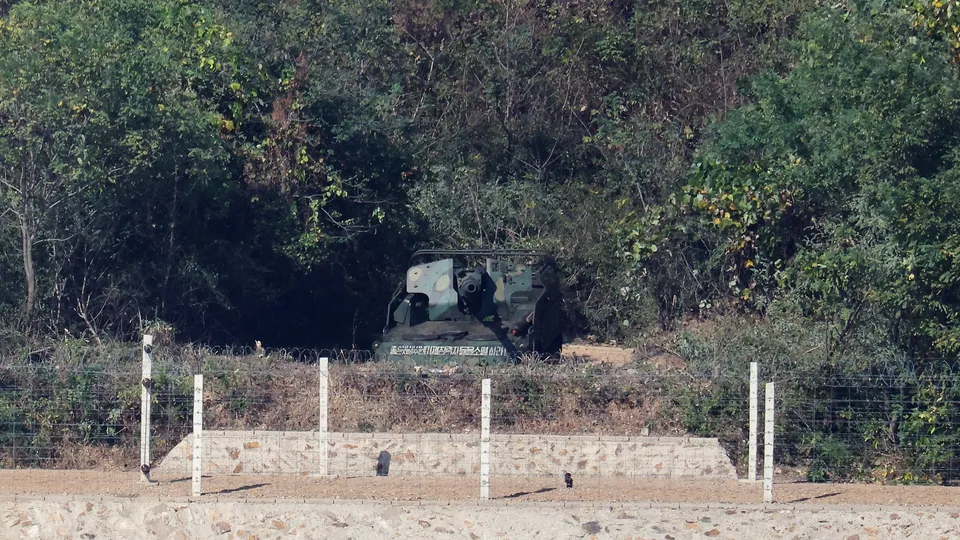
Tensions between North Korea and South Korea have intensified following reports of North Korean artillery vehicles positioned near the heavily fortified border and a fresh exchange of accusations at the United Nations. Pyongyang has rejected Seoul’s allegations over a September landmine explosion, warning that any violation of its sovereignty could trigger self-defence measures.
The latest developments come amid increased military activity along the Demilitarised Zone (DMZ), which separates the two countries. A Reuters witness in South Korea reported seeing three North Korean armoured vehicles near the frontier, with their gun barrels pointed south, while North Korean soldiers were observed carrying out fencing work inside the zone.
The reported artillery deployment, combined with competing accounts of border incidents and military conduct, has raised concerns about the risk of further escalation. However, the available information does not establish that either side is preparing to launch an attack.
North Korean Howitzers Spotted Near the Border
A Reuters witness observing the border from a South Korean observatory spotted three North Korean armoured vehicles positioned near the frontier on Monday, October 26, according to the report. The vehicles were seen with their gun barrels pointing south, while approximately 20 to 30 North Korean soldiers were observed working on fencing inside the DMZ.
South Korea’s Yonhap news agency identified the vehicles as self-propelled 122-mm howitzers. Their visible positioning near the border was described as an unusual public display of artillery, drawing attention to the military situation along the frontier.
Self-propelled howitzers are artillery systems mounted on vehicles, allowing them to move under their own power rather than requiring separate towing vehicles. Their presence near a sensitive border can carry military and signalling significance, although the purpose of a particular deployment cannot be established from visual observations alone.
Lim Eul-chul, a professor at Kyungnam University in Seoul, told Reuters that North Korea’s decision to display the artillery so conspicuously was unusual. He interpreted the positioning as a signal that Pyongyang intended to enforce its border policy through force rather than dialogue or negotiation.
Lim also suggested that the deployment could serve as a warning to South Korea against further escalation along the border. In his assessment, the display might be intended to deter actions that could lead to an accidental military clash.
North Korean Troops Conduct Exercises Near the DMZ
The reported artillery positioning comes alongside other North Korean military activity near the border. Yonhap reported on Sunday that North Korean soldiers were conducting drills along the coast of Kaepung county, approximately 1.5 kilometres from the South Korean observatory.
The presence of troops carrying out fencing work inside the DMZ adds another dimension to the dispute. The zone was established under the Korean War Armistice Agreement and remains one of the most heavily monitored and militarily sensitive areas in the world.
Military activity close to the Military Demarcation Line (MDL), which runs through the DMZ, can create risks when personnel from either side approach or cross the boundary. In an environment where forces remain on alert, misunderstandings or miscalculations could lead to a confrontation even without a deliberate decision to initiate a wider conflict.
Although the reported movements have attracted attention, the available information does not confirm that the artillery vehicles were preparing to fire or that a direct confrontation was imminent. Their positioning and purpose remain matters of interpretation.
North Korea Accuses South Korea in Letter to the UN
Alongside the reported military activity, North Korea has taken its accusations against South Korea to the United Nations Security Council. In a letter sent on Sunday, Pyongyang rejected Seoul’s claims about a September landmine explosion and accused the South Korean government of misrepresenting its border construction activities as a military incursion.
According to North Korean state media KCNA, Pyongyang’s representative to the UN argued that South Korea was using the incident to portray North Korean activities along the border as a violation of the South’s territory.
The letter warned that any violation of North Korea’s sovereignty could prompt self-defence measures. It also stated that South Korea would be “wholly accountable for all the ensuing consequences,” according to the report.
North Korea further repeated allegations that South Korean forces had opened fire on North Korean personnel. Pyongyang characterised the alleged actions as a violation of the UN Charter, which places restrictions on the threat or use of force against another country’s territorial integrity and political independence.
The accusations reflect the competing positions of the two governments over border incidents and military conduct. North Korea has denied responsibility for the landmine explosion, while South Korea has maintained that its forces use warning broadcasts and warning shots when North Korean soldiers cross the Military Demarcation Line.
What Is the Dispute Over the September Landmine Explosion?
The latest diplomatic exchange follows a letter South Korea sent to the UN Security Council the previous week concerning an explosion inside the DMZ on September 21.
Seoul alleged that the explosion was caused by a landmine planted by North Korean troops and described the incident as a violation of the Korean War Armistice Agreement. The UN Command, which oversees the DMZ, also said that a North Korean mine placed across the demarcation line violated the armistice.
Pyongyang has denied responsibility for the incident and rejected South Korea’s characterisation of its border activities. The two sides therefore continue to present conflicting accounts of the explosion and the circumstances surrounding it.
The dispute is significant because the DMZ is governed by arrangements designed to prevent renewed hostilities following the Korean War. Allegations involving mines, gunfire or unauthorised crossings can become diplomatic and military flashpoints because they raise questions about compliance with the armistice and the management of the border.
The available information does not independently establish responsibility for the September explosion. South Korea’s allegation, North Korea’s denial and the UN Command’s assessment should therefore be distinguished rather than treated as interchangeable accounts.
How South Korea Says It Responds to Border Crossings
South Korea has maintained that its military uses warning broadcasts and fires warning shots when North Korean soldiers cross the Military Demarcation Line. The MDL marks the division between the two sides within the DMZ, an area where military movements are especially sensitive.
Warning procedures are intended to communicate that personnel have approached or crossed a boundary and to discourage further movement. However, the use of warning shots and the interpretation of troop movements can become points of dispute when the two governments disagree over what occurred or which side was responsible.
In the current episode, North Korea has portrayed South Korean actions as provocative, while Seoul has raised concerns about the landmine explosion and its implications under the armistice. The competing claims illustrate how incidents along the border can quickly develop into broader diplomatic confrontations.
Why the Latest Escalation Matters
North Korea and South Korea remain separated by a heavily fortified border, with military forces operating close to one another. In this setting, visible artillery deployments, troop exercises and allegations of violations can increase uncertainty about the intentions of the other side.
The reported presence of self-propelled howitzers near the frontier is notable because artillery can play a major role in a military confrontation. However, the observation of artillery vehicles does not by itself establish an intention to attack. Assessing the significance of the deployment requires additional information about the vehicles’ mission, operational readiness and wider military movements.
The diplomatic dispute adds to that uncertainty. North Korea’s warning that it could take self-defence measures places pressure on relations, while South Korea’s complaint to the UN and the UN Command’s assessment of the landmine incident underline the importance of the armistice framework.
There is also a risk that competing interpretations of military activity could contribute to an accidental clash. When troops operate close to the demarcation line, a crossing, warning shot or misunderstanding may be interpreted differently by the two sides. Clear communication and restraint can therefore be important in limiting the risk of escalation.
What Happens Next?
The immediate situation centres on the reported North Korean artillery positioning, continued military activity near the DMZ and the competing claims submitted to the United Nations. North Korea has rejected South Korea’s allegations over the landmine explosion, while Seoul and the UN Command have maintained that the incident raises concerns under the Korean War Armistice Agreement.
The available information does not confirm whether the reported artillery vehicles will remain near the frontier, whether further military movements are planned or whether the two governments will take additional diplomatic steps. It also does not establish that a wider military confrontation is imminent.
For now, the developments highlight the fragility of security along the Korean border. The reported howitzers have drawn attention to North Korea’s military posture, while the UN exchange has intensified the dispute over sovereignty, border activity and responsibility for the September landmine explosion. Further developments will depend on military movements, official statements and how both sides manage the competing allegations.
For breaking news and live news updates, like us on Facebook or follow us on Twitter and Instagram. Read more on Latest India on thefoxdaily.com.






COMMENTS 0