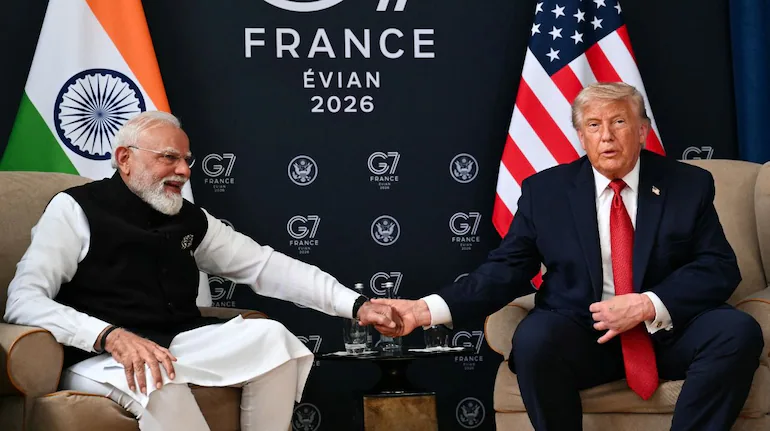
Prime Minister Narendra Modi is set to meet US President Donald Trump in Manila on November 17, as the leaders of the four Quad countries gather for a high-level discussion on security and economic cooperation in the Indo-Pacific. The meeting, scheduled on the sidelines of the Association of Southeast Asian Nations (ASEAN) summit in the Philippine capital, will also bring together Australian Prime Minister Anthony Albanese and Japanese Prime Minister Sanae Takaichi.
The gathering comes at a significant moment for the four-country grouping. It will be the first Quad leaders’ summit in two years and the first since Trump began his second presidential term in January 2025. The discussions are expected to test the group’s ability to maintain a common strategic approach despite differences over trade, economic priorities and relations with China.
Quad Leaders’ Meeting in Manila: Who Will Attend?
The Manila meeting will bring together the heads of government of India, the United States, Australia and Japan. White House Assistant Press Secretary Olivia Wales confirmed Trump’s participation on Tuesday evening, November 17.
Wales said the US president would take part in a multilateral meeting with Quad leaders to discuss shared interests in peace, prosperity and security across the Indo-Pacific region.
The previous leaders’ summit was hosted by then US President Joe Biden in Delaware on September 21, 2024. The gap since that meeting makes the Manila gathering particularly important for the grouping, which has relied on ministerial-level engagement during the intervening period.
For Modi, the meeting will also provide an opportunity to engage directly with Trump in a multilateral setting at a time when India-US relations are navigating trade disagreements and wider strategic concerns.
Maritime Security and South China Sea Tensions
Maritime security is expected to be one of the central issues at the Quad summit, with particular attention likely to focus on the South China Sea. The strategically important waterway connects major shipping routes between the Indian and Pacific oceans and plays a critical role in international commerce.
China’s extensive territorial claims in the region overlap with claims made by several Southeast Asian countries, including the Philippines and Vietnam. These competing positions have contributed to tensions over maritime access, navigation rights and control of strategically important waters.
The issue is particularly relevant to the Manila meeting because the Philippines is among the countries directly affected by disputes in the South China Sea. Greater coordination among Quad members could reinforce their shared interest in maintaining open sea lanes, freedom of navigation and respect for international maritime rules.
India has consistently argued that disputes in the region should be addressed in accordance with international law. New Delhi has also stressed that any proposed Code of Conduct for the South China Sea must not undermine the rights of countries that are outside the negotiations.
Rudrendra Tandon, secretary for the eastern region in India’s Ministry of External Affairs, said any agreement must comply with international maritime law, particularly the United Nations Convention on the Law of the Sea (UNCLOS).
He also emphasised that such an arrangement must take into account the legitimate rights of countries that are not participating in the negotiations.
India’s position reflects its broader approach to the Indo-Pacific, which prioritises a rules-based maritime order and the ability of countries to conduct legitimate activities in international waters without coercion.
Economic Security, Critical Minerals and Supply Chains
Beyond maritime issues, economic security is expected to occupy a prominent place in the discussions. The four countries have increasingly focused on reducing vulnerabilities in supply chains for strategically important goods and technologies.
Critical minerals are likely to be an important part of this conversation. These resources are essential for industries ranging from electric vehicles and renewable energy to advanced electronics, defence equipment and semiconductor manufacturing. Concentrated production and processing capacity can create supply risks, making cooperation on reliable sources and diversified supply networks a shared priority.
India, the United States, Australia and Japan have complementary economic and technological capabilities that could support greater cooperation. Australia has significant mineral resources, Japan has advanced industrial and technology expertise, the United States has major research and innovation capabilities, and India offers a large manufacturing base and growing technology sector.
The leaders are also expected to discuss strategic infrastructure and ways to strengthen supply-chain resilience. Such cooperation is intended to reduce exposure to disruptions and ensure that essential materials and technologies remain accessible during periods of geopolitical or economic uncertainty.
For India, these discussions are closely linked to its ambitions to expand domestic manufacturing, attract investment in advanced industries and strengthen its position in global technology supply chains.
Artificial Intelligence Supply Chains and Pax Silica
Artificial intelligence could emerge as another important subject at the Manila summit. As AI becomes increasingly important to economic growth, national security and technological competition, countries are paying greater attention to the infrastructure and materials required to support its development.
The expected discussions could include cooperation through Pax Silica, a US-led initiative focused on strengthening supply chains associated with artificial intelligence. India is a member of the initiative, giving New Delhi an opportunity to participate in a wider effort to improve cooperation across critical technology networks.
AI supply chains extend beyond software and advanced computing systems. They depend on semiconductors, specialised materials, manufacturing equipment, data infrastructure and reliable access to energy. Disruptions in any of these areas can affect the development and deployment of advanced technologies.
Closer coordination among Quad countries could help address these vulnerabilities while creating opportunities for investment, research and industrial collaboration. For India, participation in such initiatives could support its efforts to develop a stronger role in the global semiconductor and artificial intelligence ecosystem.
Modi-Trump Interaction Comes Amid India-US Trade Tensions
The expected interaction between Modi and Trump will take place against the backdrop of ongoing trade negotiations between India and the United States. Although the two countries agreed on a trade framework in February, discussions over tariffs and market access have continued.
Washington is seeking greater access to India’s agricultural market, while New Delhi wants competitive tariff terms compared with those offered to other trading partners. These differences reflect the challenge of balancing economic interests with the broader strategic partnership between the two countries.
The Manila meeting could provide an opportunity for Modi and Trump to exchange views on the negotiations and assess the direction of bilateral economic relations. However, no separate formal bilateral meeting between the two leaders has been confirmed.
Trade disagreements are significant because economic cooperation has become an increasingly important part of the India-US relationship. Both countries have interests in expanding investment, strengthening technology partnerships and diversifying supply chains. Progress on these areas could help reinforce their strategic partnership, even as negotiations over market access remain difficult.
Pakistan Factor Adds Another Dimension to India-US Relations
India-US relations have also faced strains over Washington’s closer engagement with Pakistan. New Delhi has traditionally viewed developments involving Pakistan through the lens of regional security and cross-border terrorism, making US policy towards Islamabad an important factor in its assessment of the wider relationship.
Against this background, the Modi-Trump interaction in Manila could offer an opportunity to discuss broader regional concerns alongside trade and Indo-Pacific security. The multilateral format, however, means that the main focus of the gathering will remain the shared priorities of the four Quad members rather than a comprehensive review of bilateral issues.
India will be seeking to preserve its strategic partnership with Washington while maintaining an independent foreign policy approach. The challenge for both governments will be to prevent disagreements in individual areas from weakening cooperation on wider regional and global priorities.
Why the Manila Summit Matters for the Quad
The Quad, comprising India, the United States, Australia and Japan, was revived in 2017 amid growing concerns about China’s expanding economic, diplomatic and military influence in the Indo-Pacific. Since then, the grouping has developed cooperation across maritime security, technology, infrastructure, health, disaster response and economic resilience.
Although the Quad is not a formal military alliance, its members share an interest in maintaining a stable regional order and ensuring that the Indo-Pacific remains open and accessible. Its cooperation has become increasingly relevant as competition over technology, trade routes and strategic resources intensifies.
The four countries have continued diplomatic engagement since Trump’s return to office, with their foreign ministers meeting five times during this period. The Manila summit will provide an opportunity to translate that engagement into renewed leadership-level coordination.
However, maintaining unity will require more than agreement on broad strategic principles. The four governments have different economic priorities and distinct relationships with China. Trade disputes and national interests could complicate efforts to establish common positions on some issues.
The summit’s importance will therefore depend not only on the statements made by the leaders but also on whether they can identify practical areas for cooperation in maritime security, critical technologies and supply-chain resilience.
What to Expect From Modi and Trump’s Manila Meeting
The Quad gathering offers Modi and Trump an important opportunity to engage at a time when both countries have reasons to strengthen their cooperation but also face unresolved differences. Maritime security, economic resilience and technology supply chains provide common ground, while trade negotiations and regional diplomatic concerns remain more complicated areas of the relationship.
For the Quad, the Manila meeting is an opportunity to demonstrate that the grouping remains relevant despite the leadership transition in Washington and changing geopolitical conditions. A renewed commitment to cooperation could help reassure regional partners that the four countries remain invested in Indo-Pacific stability.
The key question will be whether the leaders can move beyond shared declarations and establish concrete priorities for the coming months. Their discussions could shape the Quad’s direction on maritime security, critical minerals, artificial intelligence and strategic infrastructure at a time when the Indo-Pacific is becoming increasingly important to global economic and security interests.
For breaking news and live news updates, like us on Facebook or follow us on Twitter and Instagram. Read more on Latest World on thefoxdaily.com.





COMMENTS 0