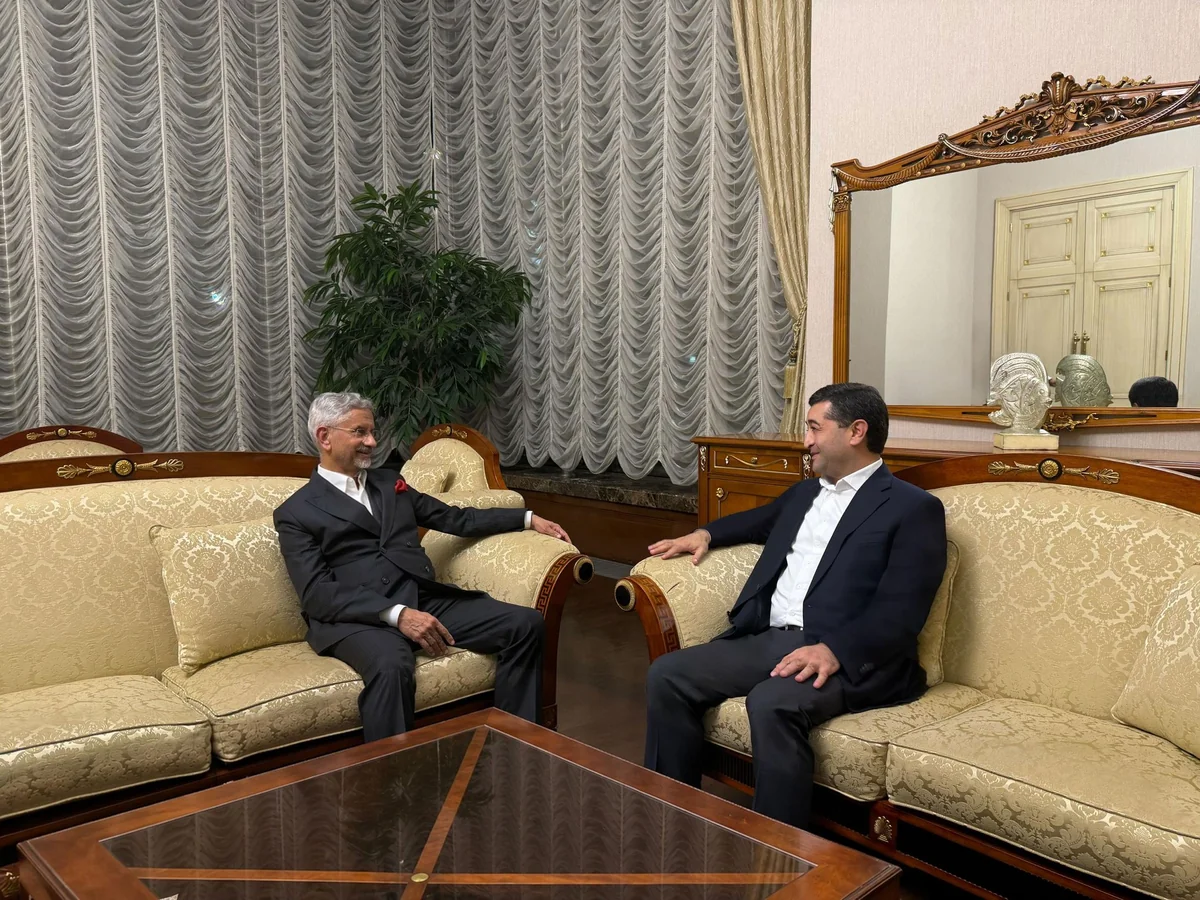
External Affairs Minister S Jaishankar met Uzbekistan’s Foreign Minister Bakhtiyor Saidov in Baku on Friday to discuss key bilateral priorities, with both sides stressing the importance of implementing agreements reached by their leaders in a timely and effective manner.
The meeting took place during Jaishankar’s day-long visit to Azerbaijan, where he also held discussions with Azerbaijani President Ilham Aliyev and Foreign Minister Jeyhun Bayramov to review bilateral relations and explore opportunities for closer cooperation.
India and Uzbekistan have expanded their diplomatic engagement in recent months, including through high-level exchanges and agreements covering trade, mining, tourism and energy. The latest meeting in Baku focused on advancing the existing bilateral agenda and ensuring that commitments made at the highest political level translate into practical outcomes.
According to news agency Press Trust of India (PTI), the two foreign ministers discussed key bilateral issues and underlined the need for effective implementation of agreements reached by their respective leaders.
Jaishankar Meets Bakhtiyor Saidov in Baku
Jaishankar shared a photograph with Saidov on X after their meeting, writing: “Nice to see Uzbek @FM_Saidov at Baku.” He did not provide further details about the discussions.
Saidov, however, said the meeting covered key issues on the bilateral agenda. In his post on X, he stated that the ministers had “emphasised the importance of the timely and effective implementation of agreements reached at the highest level”.
The emphasis on implementation comes as India and Uzbekistan pursue a broader strategic partnership and seek to increase bilateral trade. Delivering on existing commitments is an important part of advancing cooperation across sectors identified by both governments.
Saidov arrived in Baku from Georgia on Friday after attending the first joint meeting of foreign ministers from Georgia and five Central Asian countries: Kazakhstan, Kyrgyzstan, Tajikistan, Turkmenistan and Uzbekistan.
The regional meeting brought together officials from countries with shared interests in connectivity and cooperation across Central Asia and the South Caucasus. Saidov’s subsequent meeting with Jaishankar provided an opportunity to review India-Uzbekistan priorities alongside his regional diplomatic engagements.
India and Uzbekistan Upgrade Ties to Comprehensive Strategic Partnership
India and Uzbekistan have held several high-level exchanges this year, according to PTI. During Prime Minister Narendra Modi’s visit to Uzbekistan in August, the two countries upgraded their relationship to a comprehensive strategic partnership and set a target of raising bilateral trade to $5 billion.
During the two-day visit, Modi was conferred the Oliy Darajali Do‘stlik Order, Uzbekistan’s highest honour for foreign leaders. The visit also resulted in the signing of 11 agreements intended to strengthen cooperation in several areas, including mining and tourism.
India and Uzbekistan also agreed to establish a framework for the long-term supply of uranium from Uzbekistan to India. The agreement adds an energy-related dimension to a bilateral relationship that includes economic cooperation and strategic engagement.
The $5 billion trade target provides a benchmark for the two governments as they work to expand commercial exchanges. Achieving it will depend on progress across agreed areas of cooperation and on the implementation of arrangements reached during high-level meetings.
The latest discussions between Jaishankar and Saidov reiterated the importance of following through on these commitments. While neither minister publicly provided a detailed account of the meeting, Saidov’s statement identified the effective implementation of high-level agreements as a central priority.
Jaishankar Reviews India-Azerbaijan Relations
Alongside his engagement with the Uzbek foreign minister, Jaishankar held meetings with Azerbaijani President Ilham Aliyev and Foreign Minister Jeyhun Bayramov during his visit to Baku.
Following his discussion with Bayramov, Jaishankar described the talks as “very productive” and said they had helped chart a way forward for bilateral relations.
The two sides discussed opportunities to expand economic cooperation in trade, investment and energy. They also agreed to coordinate more closely on connectivity and considered areas such as air links, tourism and people-to-people exchanges.
These issues are relevant to efforts to strengthen commercial and cultural connections between India and Azerbaijan. Better transport links and closer coordination on connectivity projects can support trade, facilitate travel and create additional opportunities for economic engagement.
Jaishankar also thanked Azerbaijan for helping evacuate Indian nationals, particularly students, from Iran during the regional conflict earlier this year. The acknowledgement highlighted a practical aspect of bilateral cooperation alongside discussions on trade, investment and regional connectivity.
International North-South Transport Corridor in Focus
Connectivity featured prominently in the discussions between Jaishankar and Bayramov, including the International North-South Transport Corridor (INSTC), a multimodal freight network spanning approximately 7,200 kilometres.
The corridor is designed to connect India with Iran, the Caspian region, Russia, Central Asia and Europe through a combination of transport routes and modes. Its development involves coordination across countries and transport systems to facilitate the movement of goods between markets.
Jaishankar said closer coordination on the project was important in an increasingly globalised economy. The corridor offers a framework for discussing transport links and trade routes that could support India’s economic engagement with countries across the region.
India and Azerbaijan’s involvement in the INSTC makes connectivity a continuing subject of bilateral discussions. Progress depends on cooperation among participating countries and on the practical arrangements needed to move freight across different routes and transport networks.
The ministers’ discussions also covered air links and tourism, areas that can complement freight connectivity by supporting travel and people-to-people contact. Their agreement to coordinate more closely reflects a wider effort to identify practical avenues for expanding bilateral relations.
Jaishankar Visits Historic Ateshgah Fire Temple
Earlier on Friday, Jaishankar visited the historic Ateshgah fire temple near Baku, a site associated with the historical and cultural connections between the Indian subcontinent and Azerbaijan.
In a post on X, Jaishankar described the temple as a “symbol of the historical and cultural connect between our two peoples”. The visit highlighted the cultural dimension of India’s engagement with Azerbaijan alongside diplomatic and economic discussions.
The pentagonal, castle-like complex was largely built and used during the 17th and 18th centuries by Hindu and Sikh merchants from the north-western part of the Indian subcontinent. Its walls feature inscriptions in Sanskrit and Gurmukhi, including Hindu invocations and a Sikh verse.
The site’s inscriptions and historical associations provide evidence of connections between communities from the Indian subcontinent and the region around Baku. Jaishankar’s visit drew attention to these links as India and Azerbaijan continue discussions on tourism and cultural exchanges.
Trade, Energy and Regional Connectivity Shape India’s Central Asian Engagement
The meetings in Baku brought together several strands of India’s regional engagement: strengthening the strategic partnership with Uzbekistan, exploring economic opportunities with Azerbaijan and improving connectivity across a wider regional network.
For India and Uzbekistan, the immediate focus highlighted by Saidov was the timely and effective implementation of agreements reached at the highest level. The comprehensive strategic partnership and $5 billion trade target provide an established framework for further cooperation, while agreements covering mining, tourism and uranium supply identify specific areas for follow-up.
India-Azerbaijan discussions, meanwhile, addressed trade, investment, energy, tourism and transport connections. The INSTC remains one of the key regional initiatives linking India’s connectivity interests with routes through Iran, the Caspian region and beyond.
Jaishankar’s meetings and cultural visit also reflected the range of issues shaping India’s engagement in the South Caucasus and Central Asia. Alongside formal agreements, cooperation on travel, evacuation assistance and cultural exchanges contributes to the broader bilateral relationship.
Although the public statements offered limited details about the specific outcomes of the Jaishankar-Saidov meeting, both sides identified implementation as a priority. The next stage of India-Uzbekistan cooperation will depend on how effectively the commitments already made are carried forward across their agreed areas of partnership.
For breaking news and live news updates, like us on Facebook or follow us on Twitter and Instagram. Read more on Latest World on thefoxdaily.com.






COMMENTS 0