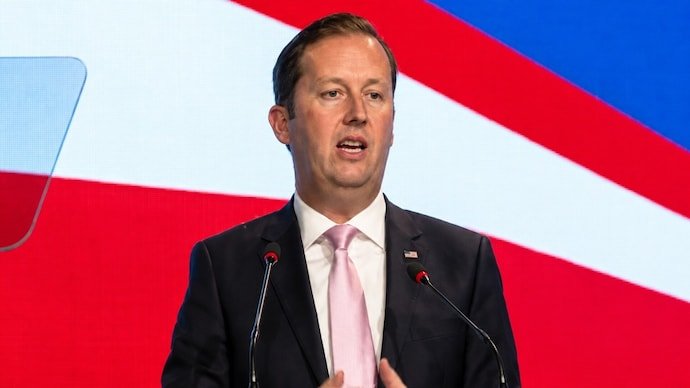
Pakistan has summoned the US Chargé d’Affaires in Islamabad and lodged a strong protest after US Ambassador to India Sergio Gor described Jammu and Kashmir as “an important part of India” during his first visit to Srinagar on Wednesday.
Gor made the remark after meeting Jammu and Kashmir Chief Minister Omar Abdullah. He also indicated that Washington would review its travel advisory for the region, suggesting that the United States could reassess its current security warning if conditions continue to improve.
Pakistan’s Foreign Office strongly objected to the ambassador’s description of Jammu and Kashmir, calling it factually incorrect and arguing that it was inconsistent with what Islamabad considers the longstanding US position on the Kashmir dispute.
The episode has therefore created a fresh diplomatic flashpoint involving Pakistan and the United States, while placing Gor’s Kashmir visit under intense political scrutiny.
What Sergio Gor said about Jammu and Kashmir
Gor’s comments came during his first visit to Srinagar since taking charge as US Ambassador to India. Speaking after meeting Omar Abdullah, he described Jammu and Kashmir as an important part of India and praised the region’s natural beauty.
“This is an important part of India,” Gor said, adding that it was his first visit to the region and that he found it an incredibly beautiful place.
The wording immediately attracted attention because the political status of Jammu and Kashmir remains one of the most sensitive issues between India and Pakistan.
For India, Jammu and Kashmir is an integral part of the country. Pakistan, however, continues to maintain that the region is disputed and that its final status should be determined in accordance with the position Islamabad has advanced through references to United Nations Security Council resolutions and what it describes as the aspirations of the Kashmiri people.
Gor’s direct description of Jammu and Kashmir as part of India was therefore significant not simply because it was made during a diplomatic visit, but because it came publicly in Srinagar and in the presence of the region’s elected chief minister.
Why Pakistan summoned the US Chargé d’Affaires
Pakistan responded by summoning the US Chargé d’Affaires in Islamabad and lodging what it described as a “strong demarche.” Islamabad said it “strongly condemned and categorically rejected” the characterization of Jammu and Kashmir as part of India.
Pakistan also argued that the ambassador’s statement departed from Washington’s stated position on the Kashmir dispute.
According to Pakistan’s Foreign Office, the remarks were irresponsible and inconsistent with what it described as the United States’ long-documented approach to the issue. Islamabad also linked the matter to international law and the UN Charter.
The diplomatic response shows how quickly a statement made during an ambassadorial visit can move beyond the immediate India-US relationship and become part of the wider India-Pakistan dispute.
It is important to distinguish between Pakistan’s characterization of the US position and what Gor himself said in Srinagar. Pakistan objected to his wording and argued that it contradicted Washington’s previous approach. The immediate trigger for the protest, however, was the ambassador’s own public description of Jammu and Kashmir.
Gor’s Kashmir visit was about more than politics
Although his comments on the region’s status dominated headlines, Gor’s meeting with Omar Abdullah also focused on economic and developmental issues.
The US ambassador said discussions covered ways to deepen economic cooperation and create opportunities that could benefit both the United States and India.
Abdullah said the conversation included tourism, horticulture and the new economy. He described the meeting as positive and said there was scope for engagement between the United States and Jammu and Kashmir to widen and deepen over time.
That economic dimension is important because Jammu and Kashmir is seeking greater investment, tourism activity and international economic engagement while simultaneously dealing with security concerns.
A US ambassadorial visit can therefore carry significance beyond Diplomacy. It can also influence how international businesses, tourists and institutions view a region, particularly when the visiting diplomat publicly comments on security conditions and travel restrictions.
US travel advisory could become another major issue
Gor also drew attention to the US travel advisory for Jammu and Kashmir.
The ambassador said the United States periodically reviews travel warnings and that Washington would examine whether the existing advisory should be downgraded. He did not announce an immediate change.
Gor said the United States would look at whether the travel warning currently recommended for the region remained appropriate. He also suggested that Americans could enjoy visiting Jammu and Kashmir because of its scenery and opportunities.
This distinction matters. A review of a travel advisory is not the same as an immediate change in the advisory. Gor indicated that the issue would be assessed, but stopped short of announcing a formal downgrade.
For the tourism sector, however, even the prospect of a review could be significant. Travel advisories are closely watched by international visitors because they provide an official assessment of security risks. Any eventual reduction in the warning could improve perceptions among potential American travellers.
Why the travel advisory matters for Kashmir tourism
Tourism is an important part of Jammu and Kashmir’s economy, making international perceptions of security particularly relevant.
For foreign tourists, the decision to visit a destination is influenced not only by what they see in promotional campaigns but also by government travel advice issued by their own countries.
A US decision to revise its advisory would not automatically mean that every foreign government would take the same step. Each country makes its own security assessment. But a change by Washington could nevertheless become an important signal for international tourism.
Gor’s comments therefore created two parallel headlines from the same visit: a politically sensitive statement on Jammu and Kashmir’s status and a potentially significant indication about the US travel warning.
Omar Abdullah’s position before meeting Gor
Omar Abdullah had already made clear before the meeting that he did not expect Washington to resolve Jammu and Kashmir’s internal issues.
He said he preferred to listen to the US ambassador rather than use the meeting to present complaints, emphasizing that the Centre in New Delhi would have to address the region’s problems.
That approach gave the meeting a more practical focus. Instead of turning the encounter into a discussion over the political dispute, the two sides spoke about economic cooperation and areas such as tourism and horticulture.
Abdullah also acknowledged that some “legacy issues” remained to be addressed over time, while expressing hope that engagement between the United States and Jammu and Kashmir would expand.
The timing of Gor’s first Srinagar visit
Gor’s visit comes against the backdrop of major changes in Jammu and Kashmir since 2019, when the Indian government revoked the region’s special constitutional status and reorganised the former state into the Union Territories of Jammu and Kashmir and Ladakh.
His Srinagar trip also follows continued international attention on security and tourism in the region, including concerns arising after the Pahalgam terror attack mentioned in the context of the visit.
The ambassador’s decision to travel to Srinagar and then continue to Ladakh makes the trip notable as an effort to engage directly with both Union Territories.
The visit also comes as India and the United States continue to expand strategic cooperation. Gor has recently emphasized the importance of the bilateral relationship and described the partnership as important for addressing broader Global Security challenges.
Against that backdrop, his Kashmir comments are likely to be examined closely in both New Delhi and Islamabad.
Why the statement matters diplomatically
The immediate issue is not simply whether Pakistan agrees with Gor’s description. The larger question is how Washington communicates its position on an issue that has historically required careful diplomatic language.
For Pakistan, the statement is sensitive because Islamabad has consistently sought international attention to the Kashmir dispute and has rejected language that treats Jammu and Kashmir as settled Indian territory.
For India, the remark is significant because it came from the sitting US ambassador during a visit to Srinagar and directly referred to Jammu and Kashmir as part of India.
That creates a sharp contrast between the two governments’ positions. Pakistan has interpreted the wording as a departure from what it considers the established US approach, while Gor’s actual public statement was unambiguous in how he described the region.
At the same time, one ambassadorial statement should not automatically be interpreted as a complete formal change in every aspect of US foreign policy. Diplomatic positions can involve statements from multiple government departments, official documents and broader policy language. The significance of Gor’s comment will therefore depend partly on whether Washington subsequently clarifies or reinforces it.
What could happen next
The immediate next step is likely to be continued diplomatic messaging from Pakistan and close monitoring of Washington’s response.
The United States could leave Gor’s comments to stand without a broader policy clarification, or it could provide additional language explaining Washington’s position on Jammu and Kashmir. Either approach would be watched closely in India and Pakistan.
The travel advisory is another issue to follow. Gor said Washington would review the warning, but no immediate downgrade was announced during his Srinagar visit. Any future change could have practical consequences for American tourism and would likely receive attention from businesses and tourism stakeholders in Jammu and Kashmir.
Gor’s scheduled visit to Ladakh also means his broader regional trip is not limited to the diplomatic controversy generated in Srinagar. His meetings and public comments there could provide further clues about Washington’s approach to engagement with the two Union Territories.
A diplomatic controversy with wider implications
Pakistan’s decision to summon the US Chargé d’Affaires demonstrates the sensitivity surrounding even seemingly straightforward descriptions of Jammu and Kashmir. The controversy began with a single sentence from an American ambassador but quickly developed into a formal diplomatic protest.
For India, Gor’s description of Jammu and Kashmir as an important part of the country is notable because of who made it and where it was made. For Pakistan, the statement represents a challenge to its longstanding position on the disputed status of the region.
Meanwhile, the economic and tourism elements of Gor’s visit offer a separate dimension. His discussion with Omar Abdullah about tourism, horticulture and the new economy, combined with his comments about potentially reviewing the US travel advisory, could prove more consequential for Jammu and Kashmir’s international engagement over the longer term.
The central question now is whether the diplomatic dispute remains limited to Pakistan’s protest or develops into a broader discussion about Washington’s policy language on Jammu and Kashmir. The next statements from the United States and any decision on the travel advisory will be closely watched.
For breaking news and live news updates, like us on Facebook or follow us on Twitter and Instagram. Read more on Latest World on thefoxdaily.com.






COMMENTS 0