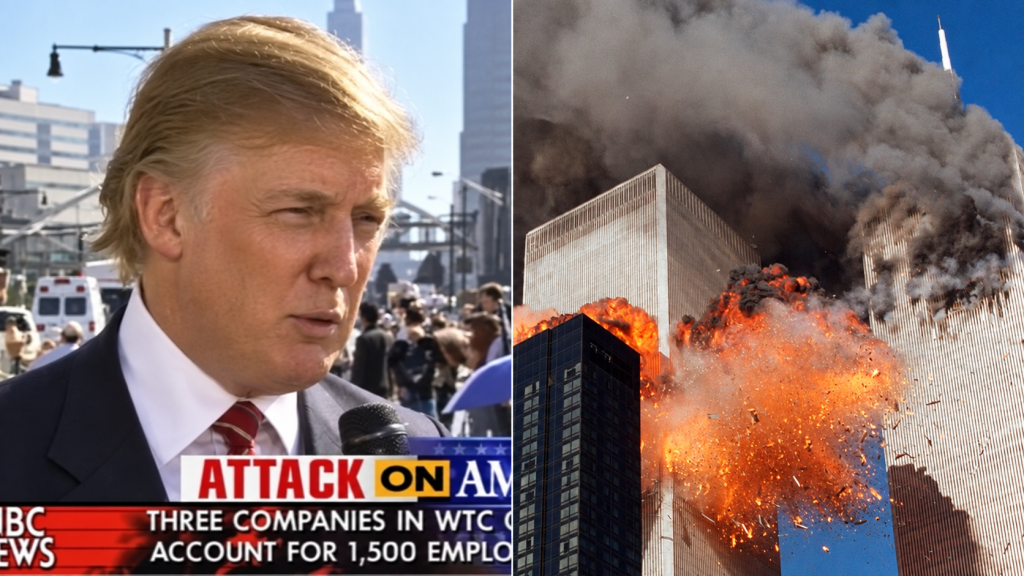
President Donald Trump is facing renewed scrutiny over his account of what he did around Ground Zero after the September 11, 2001 terrorist attacks, after he said two firefighters physically carried him away from a building near the World Trade Center because they feared it was about to collapse.
Trump made the claim while speaking at a September 11 commemorative event, describing an encounter in which he said two “big strong” firefighters grabbed him under the arms and ran with him to safety. He said he was willing to leave the area because a nearby building was believed to be coming down.
The account has quickly become the subject of fact-checking because there is no independent documentation publicly establishing that Trump was carried to safety by firefighters on September 11 or that he was inside the building he identified during the danger period.
Trump has separately and repeatedly claimed that he went to Ground Zero soon after the attacks with construction workers from his company and spent substantial time helping with the recovery effort. Available contemporary records do confirm that he was publicly present near the disaster site on September 13, 2001, but fact-checkers have not found evidence supporting several of his broader claims about the extent of his involvement.
What exactly did Trump claim about September 11?
Trump’s latest account centres on One Liberty Plaza, the office tower directly across from the World Trade Center site.
He said that he was near the building when there was concern that it could collapse. According to Trump, two firefighters then grabbed him and physically carried him away from the danger zone.
Trump described the firefighters as large and strong and said they lifted him by his arms and began running. He added that he told them he could run on his own, but they continued carrying him because they believed the building was coming down.
The story is unusually specific compared with his earlier descriptions of his presence around Ground Zero. That specificity makes it possible to examine the claim against contemporary records, eyewitness accounts and the historical timeline of the attacks.
So far, those sources have not produced evidence confirming the rescue episode.
Where was Trump on September 11, 2001?
One of the most important facts in assessing the story is where Trump was during the attacks themselves.
Contemporary reporting and accounts place Trump at or near Trump Tower in Midtown Manhattan during the initial attack period, rather than at the World Trade Center site.
Trump Tower is several miles north of the World Trade Center complex. That does not, by itself, rule out his later Travel to Lower Manhattan, but it is important when considering the distinction between being in New York during the attacks and being physically at Ground Zero as the towers collapsed.
The two planes that struck the World Trade Center hit the North and South Towers in Lower Manhattan in the morning of September 11. Both towers later collapsed, producing an enormous debris field and a dangerous Environment that remained under the control of emergency authorities.
Trump’s latest account does not appear to claim that he was at the World Trade Center when the planes hit. He has instead described being there shortly afterward. That distinction matters, but it also means the timing of his arrival becomes central to evaluating the story.
The earliest verified footage puts Trump near Ground Zero on September 13
One of the strongest pieces of contemporary evidence concerning Trump’s presence comes from September 13, 2001, two days after the attacks.
Trump gave interviews near the Ground Zero area and spoke publicly about bringing construction workers from his company to assist with recovery and cleanup.
In one television interview, he said he had more than 100 workers at the site and that additional workers were expected. In another interview, he described being present to encourage them.
Those interviews establish that Trump was in the vicinity of Ground Zero two days after the attacks. They do not, however, independently establish that his workers were directly involved in the official recovery operation on the scale he later described.
The distinction is important because the rescue and recovery effort was already being managed through a highly organized emergency structure involving the New York City Fire Department, the New York Police Department, emergency-management officials, contractors and other agencies.
Fact-checkers examining Trump’s claims have found no reliable documentation demonstrating that he arrived with a private force of approximately 100 workers who then participated in the official response in the way he has sometimes suggested.
A veteran FDNY official said he had no record of Trump’s involvement
One of the most significant challenges to Trump’s earlier Ground Zero claims came from Richard Alles, a former New York City Fire Department battalion chief who was involved in the September 11 response.
Alles said he had no knowledge of Trump being at the site during the recovery operation or of Trump bringing a large team of workers to help.
His recollection is significant because personnel responsible for coordinating the emergency response would have had substantial contact with companies and workers entering the heavily controlled disaster area.
Alles also indicated that there would have been records if a construction crew of the size Trump described had been formally working under the emergency command structure.
This does not prove that Trump never visited the area or that no private workers associated with him were ever present. But it does mean that the strongest versions of his claims have not been independently corroborated by the people who were managing the site.
What about the claim that firefighters carried him?
This is the most difficult part of the latest story to verify.
Trump has not provided names of the two firefighters he says carried him. There is also no publicly available emergency record that independently confirms the incident.
That does not establish that the encounter was impossible. Emergency conditions around Lower Manhattan after the attacks were chaotic, and many events were not documented in detail.
But the burden of proof becomes important when a highly specific personal account is presented decades later as a fact.
For a dramatic event involving two firefighters physically carrying a prominent New York businessman away from a potentially collapsing building, independent confirmation would be expected if records, eyewitnesses or surviving personnel were available.
So far, fact-checkers have not found that confirmation.
One Liberty Plaza was genuinely part of the danger zone
The physical setting described by Trump was not imaginary.
One Liberty Plaza stands immediately across from the World Trade Center site and was affected by the disaster. During the attacks, buildings around Lower Manhattan faced the risk of fires, falling debris and structural damage.
There was also genuine fear that additional structures could collapse after the towers came down.
That context makes Trump’s account superficially plausible: the surrounding area was extremely dangerous, and emergency personnel were moving people away from unstable structures.
The problem is not whether firefighters were dealing with collapsing buildings. They were. The unresolved question is whether Trump was personally inside or immediately outside One Liberty Plaza at the point he describes and whether two firefighters actually carried him away.
Those are separate factual questions from the broader reality of the disaster zone.
Trump says he was there “as soon as the law allowed”
After the fact-checks appeared, Trump rejected the criticism and doubled down on his account.
He said he was not claiming to have been present at the exact moment the towers collapsed. Instead, he emphasized that he went to the World Trade Center site shortly afterward and said he arrived as soon as the law permitted.
Trump also shared videos of his earlier interviews to demonstrate that he really had been at the site after the attacks.
Those clips are important because they provide contemporary evidence of his presence in Lower Manhattan by September 13. But they do not independently prove every detail of his newer narrative about September 11 or the immediate aftermath.
The distinction between “I was there” and “I was there and was rescued by firefighters” is therefore central to the fact-checking dispute.
The White House says not everything Trump did was documented
The White House has defended the president rather than conceding the lack of documentary evidence.
In response to demands for proof of the firefighter story, the administration’s position was that Trump was a private citizen in 2001 and that not everything he did would necessarily have been documented.
That argument is plausible in a narrow sense. Trump was not a government official on September 11, so there would have been no presidential movement records, Secret Service logs or White House documentation covering his activities.
But the absence of government records does not independently validate the claim either.
The dispute therefore comes down to the evidence available outside government records: photographs, news reports, interviews, eyewitness testimony, emergency records and the recollections of first responders.
Those sources have documented parts of Trump’s post-attack presence, but they have not established the firefighter-carrying account.
Trump has made other unverified claims about 9/11
The current controversy is part of a longer history of disputed statements by Trump concerning the September 11 attacks.
In the years after the attacks, he claimed that he was heavily involved in the response and said workers associated with his organization had been at the site. Those claims have repeatedly been examined by fact-checkers.
He has also made other statements about watching the attacks from Trump Tower and claimed to have witnessed people jumping from the World Trade Center.
Those accounts have been challenged because Trump Tower was several miles from the World Trade Center and because independent evidence has not substantiated the specific details he described.
Trump also repeated a separate claim that Muslims in New Jersey celebrated the attacks as they happened. That allegation has been repeatedly investigated and has not been supported by reliable evidence on the scale described.
These earlier controversies matter because they provide context for why news organizations and fact-checkers are examining the newest story so closely rather than accepting it at face value.
The timeline matters more than the rhetoric
One of the most useful ways to evaluate the controversy is to separate the timeline into distinct stages.
| Date or period | What is established | What remains disputed or unverified |
|---|---|---|
| September 11, 2001 | Al-Qaeda hijackers attacked the World Trade Center, Pentagon and United Airlines Flight 93 crashed in Pennsylvania; nearly 3,000 people died. | Trump’s claim that two firefighters carried him away from a danger zone near One Liberty Plaza has not been independently corroborated. |
| September 12, 2001 | Lower Manhattan remained an active emergency and recovery area under tight control. | No reliable public evidence has established the specific firefighter encounter described by Trump. |
| September 13, 2001 | Contemporary video shows Trump speaking near the Ground Zero area and discussing construction workers. | The broader claim that around 100 of his workers participated in the recovery effort has not been independently verified. |
| Following years | Trump repeatedly described his role in the aftermath of the attacks. | Several details of his accounts have remained unsupported or disputed by contemporary evidence. |
That timeline helps explain why the newest allegation is being treated differently from the basic fact that Trump visited the area after the attacks.
Being near Ground Zero was not the same as being part of the rescue operation
Another important distinction is between visiting the disaster area and participating in the emergency response.
The September 11 response involved firefighters, police officers, emergency medical workers, military personnel, construction workers, engineers and volunteers. The conditions were extraordinarily dangerous, particularly in the first days after the towers collapsed.
Trump has sometimes used language acknowledging that he was not a first responder while simultaneously describing himself as spending substantial time at Ground Zero.
Those statements can coexist in principle. A private citizen could visit or assist without being a first responder.
But describing oneself as being actively involved in the recovery, especially alongside claims of bringing large numbers of workers to the site, raises questions about what those workers actually did and whether they were operating within the formal emergency command system.
That is why first-person recollection alone is insufficient to establish the scale of the role.
Why 9/11 claims are being scrutinized so closely
September 11 is not an ordinary political subject in the United States.
The attacks killed nearly 3,000 people, including 343 New York City firefighters and 23 New York City police officers. Thousands of survivors and first responders later developed illnesses associated with exposure to dust and toxic materials at the World Trade Center site.
The disaster also transformed US Foreign Policy, homeland security and national Politics for decades.
Because of that history, claims about personal involvement in the immediate rescue and recovery efforts carry unusual emotional and symbolic weight.
Statements that appear to place a public figure directly inside the most dangerous moments of the disaster are therefore expected to withstand careful historical scrutiny.
There is a difference between “unproven” and “disproved”
The language used to describe Trump’s claim also deserves attention.
Calling a statement unverified means that available evidence does not establish that it happened. Calling it disproved requires stronger evidence showing that the event could not have happened or that the account directly conflicts with reliable evidence.
In the firefighter episode, the strongest conclusion supported by the publicly available evidence is that the claim has not been corroborated.
Fact-checkers have found evidence of Trump near Ground Zero on September 13, but not evidence establishing the specific rescue described in his latest account.
That is an important distinction in historical reporting. A lack of documentation does not automatically prove a memory is false, but it prevents the claim from being presented as an established fact without qualification.
Trump’s response is itself part of the controversy
Trump has argued that media organizations are deliberately attacking him and has dismissed the fact-checking as “fake news”.
He has also pointed to old video clips as evidence that he was genuinely present at the World Trade Center site after the attacks.
Those videos address one part of the dispute but not the whole question.
The fact that Trump was demonstrably in Lower Manhattan two days later does not establish that he was physically carried by firefighters on September 11. Similarly, the existence of construction workers associated with his company does not automatically establish the scale or nature of their involvement in official recovery operations.
A fact-check therefore has to examine each claim separately rather than treating all of Trump’s statements about 9/11 as one single proposition.
Why the latest claim creates a new historical question
Trump’s story is notable because it adds a dramatic personal episode to a narrative he has been telling for years.
Earlier versions focused on his presence at the site, his workers and his alleged involvement in the aftermath. The latest version adds a moment of physical rescue by firefighters.
That evolution makes historical verification especially important. Personal memories can become more detailed over time, but additional details do not necessarily make a story more reliable unless independent evidence supports them.
In this case, the earliest documented evidence places Trump near Ground Zero on September 13. The record supporting the specific firefighter rescue remains absent from the public evidence examined by major fact-checkers.
The larger issue is how political memory shapes major events
The Trump controversy points to a broader phenomenon in political life: public figures sometimes become part of historical events through personal stories that are repeated so often that the distinction between memory and documented history becomes blurred.
That is particularly significant for events as consequential as September 11.
Historical memory is built from many sources official records, photographs, contemporary journalism, eyewitness testimony and later recollections. No single person’s account should automatically override all other evidence.
At the same time, historians and journalists must leave room for experiences that genuinely were never documented.
The correct approach is therefore neither automatic acceptance nor automatic rejection. It is to separate what can be independently established from what remains a personal claim.
What the evidence supports so far
Several elements of Trump’s broader account can be established.
He was a prominent New York businessman at the time of the attacks. He was in New York when the attacks occurred. He appeared near Ground Zero on September 13 and gave interviews about his construction workers. He did have business and construction interests that were relevant to the rebuilding discussion.
What has not been independently established is the more expansive version of the story: that Trump was directly involved in the immediate rescue effort, that he brought around 100 workers into the organized recovery operation in the manner he has described, or that two firefighters physically carried him away from One Liberty Plaza on September 11.
Those claims should therefore be treated separately from the verified fact that he visited Lower Manhattan shortly after the attacks.
The fact-check does not erase Trump’s presence in New York
One potential problem with political fact-checking is that correcting one exaggerated claim can be interpreted as denying everything about a person’s involvement.
That would be inaccurate here.
The historical record does show that Trump was near the World Trade Center site within days of the attacks. Contemporary footage provides direct evidence of his presence on September 13.
The dispute is over what happened on September 11 and how substantial Trump’s role was in the recovery effort afterward.
That distinction allows the historical record to remain precise without unnecessarily turning the issue into an all-or-nothing argument.
Why the firefighter story remains unsubstantiated
The central problem for Trump’s latest account is straightforward: there is currently no independent evidence confirming the specific rescue story.
No named firefighter has publicly corroborated the account. No emergency record has been produced showing Trump being carried from One Liberty Plaza. No contemporary photograph or video has surfaced documenting the episode.
The White House has not supplied documentary evidence either, instead arguing that Trump’s status as a private citizen meant many of his movements would not have been formally recorded.
Trump’s own later recollections and the existence of video proving his presence in Lower Manhattan days afterward are not enough to establish the specific incident.
What remains unanswered
The most important unresolved questions are relatively narrow.
Who were the two firefighters Trump says carried him? Was he actually inside One Liberty Plaza or immediately outside it? At what time did the incident supposedly occur? Are there witnesses who can confirm it? Was the encounter recorded in an FDNY log, dispatch record, photograph or contemporary news account?
Until evidence addressing those questions emerges, the incident remains a personal account rather than an established historical fact.
Trump’s 9/11 story sits between memory and the historical record
The renewed controversy over Trump’s September 11 claims is ultimately less about whether he ever visited Ground Zero the contemporary record shows that he did and more about the extent and timing of his involvement.
His latest claim that two firefighters lifted him from a building near the World Trade Center has not been independently verified. His broader assertions about bringing large numbers of workers to Ground Zero and directly participating in recovery efforts have also faced scrutiny from first responders and fact-checkers.
The White House has defended the president by arguing that he was a private citizen and that not every action would have left a formal government record. Trump, meanwhile, has continued to insist that his account is accurate and has pointed to contemporary videos showing his presence near the disaster site after the attacks.
The evidence therefore supports a narrower conclusion than Trump’s most expansive version: he was in New York during the September 11 attacks and was documented near Ground Zero on September 13, but the dramatic story of being physically carried away by firefighters on September 11 remains unsubstantiated by independent evidence.
Twenty-five years after the attacks, that distinction matters. September 11 is a defining event in modern American history, and its record is preserved not only through memories but through thousands of contemporary documents, photographs, interviews and eyewitness accounts. Personal recollections can remain meaningful, but when they become historical claims, they still have to be weighed against the evidence.
For breaking news and live news updates, like us on Facebook or follow us on Twitter and Instagram. Read more on Latest World on thefoxdaily.com.



COMMENTS 0