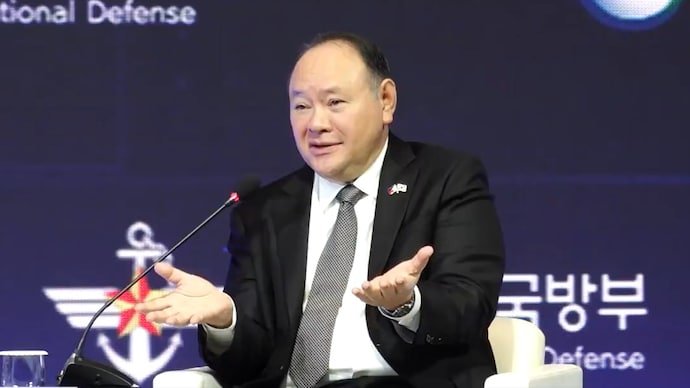
An unexpected diplomatic confrontation unfolded at a defence forum in Seoul after Philippine Defence Secretary Gilberto Teodoro was handed a note from a Chinese military attaché while he was speaking about security challenges in the South China Sea.
Rather than setting the message aside, Teodoro stopped his remarks, picked up the paper and read its contents aloud to the audience. The note reiterated Beijing’s rejection of the 2016 international arbitration ruling on the South China Sea and argued that the decision had violated fundamental principles of international law.
Teodoro then used the interruption to publicly challenge China’s position, questioning why the message had been delivered during his remarks and accusing Beijing of “coercion, bullying and aggression.”
The unusual exchange at the Seoul Defense Dialogue on September 8, 2026 quickly became a symbol of the increasingly direct confrontation between Manila and Beijing over the South China Sea, where disputes over maritime rights, fishing, military activity and access to resources remain unresolved.
How the Chinese note reached Teodoro
The incident happened during a panel discussion at the Seoul Defence Dialogue, where Teodoro was addressing maritime security and the importance of respecting international rules.
Video from the event showed a man in a white sports coat approaching Teodoro from behind and placing a sheet of paper on the table in front of him. According to the forum organisers, the message had come from a Chinese military attaché based at the Chinese Embassy in Seoul.
The attaché reportedly handed the note to a staff member and asked for it to be passed to Teodoro. The staff member apparently believed it was a message originating from Teodoro’s own delegation and delivered it to him while he was still speaking.
That procedural mistake created the extraordinary moment that followed.
Teodoro paused, looked at the paper and told the audience that he believed it was from China. He then asked whether he could read it aloud before proceeding through the text line by line.
What did China say in the note?
The note restated Beijing’s long-standing position on the 2016 South China Sea arbitration.
It argued that China’s position was clear and consistent and maintained that the arbitration process had violated fundamental principles of international law. It also rejected the legal effect of the tribunal’s decision.
The message referred to the case brought by the Philippines under the United Nations Convention on the Law of the Sea, or UNCLOS. The case challenged China’s extensive claims in the South China Sea, including claims based on historic rights.
The tribunal in The Hague issued its ruling in 2016, concluding that there was no legal basis for China to claim historic rights to resources within areas covered by the Philippines’ exclusive economic zone on the basis of the so-called nine-dash line.
China has consistently rejected the ruling, arguing that the tribunal had no jurisdiction over the dispute and that the decision was invalid. Beijing continues to maintain its broader claims in the South China Sea.
Teodoro turns the note into a public rebuttal
Instead of responding privately, Teodoro transformed the unexpected note into a public rebuttal.
As he read its contents, he challenged the Chinese position in real time. When the message referred to the arbitration decision as violating international law, Teodoro questioned whether that effectively meant China considered UNCLOS itself to be contrary to international law.
When he reached the portion rejecting the binding force of the arbitration ruling, Teodoro responded sarcastically that this was because Beijing did not want to be subjected to the provisions of UNCLOS.
He then bluntly told the audience that China rejected the decision because it had lost the case.
The exchange drew attention because Teodoro did not merely repeat the Philippines’ formal position. He directly challenged the representative of a much larger military power in front of an international defence audience.
Teodoro says the delivery itself was disrespectful
For Teodoro, the contents of the note were only part of the problem. He also objected to the manner in which the message had been delivered.
He questioned how China expected to deal with the Philippines in a civil manner at an international forum while interrupting a speaker during an ongoing session.
Teodoro said the move was disrespectful not only to him but also to South Korea, the host country, and the other participants attending the defence dialogue.
He argued that international forums are intended to facilitate discussion, diplomacy and disagreement through established channels. Delivering a political message in the middle of another country’s defence secretary’s remarks, in his view, crossed a line of diplomatic conduct.
His response was therefore about both substance and symbolism: the legal disagreement over the South China Sea and the way China chose to communicate its position.
“Coercion, bullying and aggression”: Teodoro escalates the language
After reading the note, Teodoro described China’s approach in unusually direct terms.
“This is actual coercion, bullying and aggression,” he said, arguing that basic diplomatic decency should be part of China’s conduct.
Teodoro also said he would keep the document as a reminder of what he characterized as China’s desperation and ineffective position in front of an international audience.
He then turned toward the person involved in delivering the note and made a sarcastic remark suggesting that the individual had done his country a great service and jokingly expressed hope that the person would not face punishment for it.
The remarks turned what might otherwise have been a quiet diplomatic exchange into a highly visible public confrontation.
Why the South China Sea dispute remains so important
The dispute between China and the Philippines is part of a much broader contest over the South China Sea, one of the world’s most strategically important maritime regions.
The waters carry enormous volumes of commercial Shipping and are believed to contain significant natural resources. Several governments, including China, the Philippines, Vietnam, Malaysia and Brunei, have overlapping territorial or maritime claims in different parts of the sea.
China claims sovereignty over a large area using its historic rights narrative and the nine-dash line. The Philippines has relied heavily on the 2016 arbitration ruling to defend its maritime rights under international law.
Beijing does not accept the ruling, while Manila continues to regard it as a central legal foundation for its position.
The disagreement has become increasingly difficult to separate from day-to-day interactions at sea, including encounters involving coast guard vessels, naval ships, fishing boats and maritime militia-linked vessels.
The Philippines says it faces pressure inside its exclusive economic zone
During his remarks, Teodoro said the Philippines faces challenges from China on a regular basis, particularly in waters Manila considers part of its exclusive economic zone.
Under UNCLOS, an exclusive economic zone can extend up to 200 nautical miles from a coastal state’s baseline, giving that country sovereign rights over natural resources in the zone while preserving certain navigation freedoms for other states.
The distinction between an EEZ and territorial waters is important. An EEZ does not give a coastal state complete sovereignty over every activity taking place there. Instead, it provides specific resource and jurisdictional rights under international law.
The Philippines argues that some Chinese actions interfere with those rights. China rejects Manila’s interpretation and continues to defend its own claims and activities in the disputed areas.
Grey-zone tactics are at the heart of Manila’s security concerns
The incident in Seoul also connects to a broader debate over what military planners call grey-zone activities.
Grey-zone tactics generally refer to actions designed to pressure another country without crossing the threshold of a conventional armed conflict. They can include coast guard deployments, maritime blockades, patrols, law-enforcement measures, economic pressure, information operations and other forms of coercion.
For the Philippines, repeated encounters in disputed waters create a difficult strategic problem. Manila must protect its maritime rights without allowing incidents to escalate into an armed confrontation.
Teodoro has increasingly argued that China’s actions should not be viewed as isolated incidents but as part of a wider pattern of pressure intended to influence the behaviour of neighbouring states.
That explains why the language surrounding the South China Sea has become progressively sharper.
The 2016 arbitration ruling remains the legal dividing line
The arbitration decision continues to be one of the biggest differences between Manila and Beijing.
The case was brought by the Philippines under UNCLOS and was decided by an arbitral tribunal constituted under the treaty. The tribunal found, among other conclusions, that China’s broad historic-rights claims to resources inside the Philippines’ EEZ had no legal basis under the convention.
The award also addressed the legal status of several maritime features and concluded that none of the Spratly Islands were capable of generating an EEZ collectively as a group.
China rejected the process and the outcome, saying the tribunal had no jurisdiction and that the award was invalid. Beijing has maintained that disputes in the South China Sea should be resolved through direct negotiations rather than arbitration imposed without Chinese consent.
This disagreement over the arbitration framework is why even a brief exchange about UNCLOS can quickly turn into a much larger geopolitical argument.
Why the Seoul setting made the confrontation significant
The incident took place not during a bilateral Philippines-China meeting but at a multilateral defence forum in South Korea.
That setting matters because the Seoul Defence Dialogue brings together officials and experts from across the Indo-Pacific and beyond to discuss regional security challenges.
Teodoro was therefore speaking to a multinational audience when the Chinese message arrived. By reading it aloud, he ensured that Beijing’s position and his own response were heard by participants who otherwise might never have seen the document.
The episode also placed South Korea in an unusual position. Seoul was hosting the discussion, while two other countries were publicly confronting each other over a dispute involving the wider Indo-Pacific security architecture.
For regional governments, such incidents reinforce how the South China Sea dispute is no longer simply a bilateral disagreement. It is increasingly connected to alliances, freedom of navigation, military cooperation and the broader balance of power in Asia.
Manila is strengthening alliances as tensions continue
Teodoro said the Philippines has been compelled to strengthen its defence arrangements and partnerships because of the challenges it faces.
Under President Ferdinand Marcos Jr., Manila has significantly deepened security cooperation with the United States while also expanding defence relationships with other countries, including Japan, Australia, Canada, New Zealand, France and the United Kingdom.
The Philippines and United States are bound by a Mutual Defense Treaty, while the two countries have also expanded military cooperation through additional arrangements allowing greater access to selected Philippine facilities.
South Korea has emerged as another important defence partner for Manila, particularly in military modernization and equipment. The Philippines has acquired South Korean defence systems and has continued to explore additional cooperation.
China views the strengthening of outside military partnerships in the region with concern, while Manila argues that stronger alliances are necessary to deter coercion and protect Philippine sovereignty and maritime rights.
China’s note was unusual, but the disagreement is not new
The way the Chinese message was delivered created the drama, but the substantive argument has existed for years.
Beijing has repeatedly stated that it does not recognize the 2016 arbitration award. Manila has repeatedly said that the ruling is final and binding under UNCLOS.
Both sides therefore entered the Seoul encounter with positions that were already deeply established. The significance of the incident was that those positions collided in real time, in front of an international audience and without the formality of a scheduled bilateral negotiation.
That helps explain why the exchange resonated so widely online. A dispute that normally unfolds through diplomatic statements suddenly became a live confrontation captured on video.
The episode highlights the limits of diplomatic messaging
Diplomatic notes are usually designed to communicate official positions without requiring a public confrontation. In this case, however, the delivery method had almost the opposite effect.
By reaching Teodoro while he was speaking and being read aloud, the Chinese message gained far greater visibility than a conventional written statement might have received.
Teodoro’s decision to read it publicly ensured that his criticism received the same exposure.
The incident demonstrates how easily communication between rival states can become part of the strategic contest itself. Words, timing, setting and delivery can all carry political meaning, especially when the countries involved disagree over territory and international law.
What the confrontation means for the Philippines-China relationship
The exchange does not by itself represent a new military escalation, but it reflects the increasingly difficult political Environment surrounding Philippines-China relations.
Manila continues to seek diplomatic and economic engagement with Beijing while simultaneously strengthening its military alliances and publicly challenging Chinese actions in disputed waters.
China, meanwhile, continues to reject the legal framework Manila uses to support its maritime claims and has criticized Philippine cooperation with outside powers.
That combination creates a relationship in which economic interaction and strategic confrontation can exist at the same time.
The South China Sea will remain the central test of whether the two countries can manage that contradiction without allowing individual incidents to trigger a much more serious crisis.
Teodoro’s response sends a broader message
Teodoro’s reaction in Seoul was ultimately about more than a single piece of paper.
By publicly reading China’s position and immediately challenging it, the Philippine defence chief reinforced Manila’s argument that the South China Sea dispute should be judged through international law, particularly UNCLOS, rather than simply through competing claims of national power.
He also made clear that the Philippines does not intend to treat Chinese pressure as an issue that should be discussed only behind closed doors.
The most striking part of the incident may therefore be what happened after the note arrived. China attempted to put its position directly in front of the Philippine defence chief. Teodoro responded by putting that position in front of the entire room and challenging it point by point.
As tensions continue in the South China Sea, that public exchange illustrates the increasingly direct language being used by Manila and the growing importance of international forums as venues for the wider strategic contest in the Indo-Pacific.
For breaking news and live news updates, like us on Facebook or follow us on Twitter and Instagram. Read more on Latest World on thefoxdaily.com.




COMMENTS 0