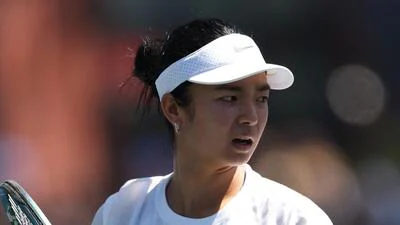
Alexandra Eala has become much more than a promising Tennis player from the Philippines. At just 21, the left-hander has emerged as a global attraction whose popularity is growing alongside her ranking, creating a remarkable connection between elite tennis and Filipino identity.
That connection was particularly visible at the US Open, where Eala attracted unusually large crowds despite sharing the tournament environment with established stars such as Aryna Sabalenka, Naomi Osaka and Alexander Zverev. Her growing audience reflects both her results on court and a cultural idea known as “kapwa”, which can broadly be understood as a shared sense of identity and belonging.
For Filipino supporters, Eala represents something bigger than an individual athlete. She is competing at the highest level in a sport where the Philippines has historically had limited representation, giving fans around the world an opportunity to see someone from their community succeeding on an international stage.
Her rise has therefore become a story about rankings, victories and Grand Slam progress, but also about representation, national pride and the changing global face of women’s tennis.
Why Alexandra Eala is attracting so much attention
Eala’s popularity is unusual because it has expanded beyond her home country and Filipino communities abroad.
At the US Open, a spectator named Jordan Manlapig observed that Eala’s practice session appeared to attract an exceptionally large crowd. The contrast was striking because the same practice environment featured some of the biggest names in the sport.
Manlapig, whose parents are Filipino, had followed Eala since her breakthrough at the 2022 US Open girls’ singles tournament. His experience reflects how quickly her supporters have transformed from a relatively small community into an international fan base.
The phenomenon is particularly interesting because Eala’s popularity is not simply the product of aggressive marketing. Her performances have created genuine moments for supporters to rally around.
From the Philippines to the world stage
The Philippines has produced major sporting personalities across several disciplines, but tennis has traditionally occupied a much smaller space in the country’s sporting culture.
That makes Eala’s progress particularly significant.
Her journey began with a family connection to tennis. What initially served as a way to bond with her grandfather gradually developed into a serious sporting pathway.
Eala later joined the Rafa Nadal Academy in 2018, giving her access to a high-level development environment and exposing her to the demands of international tennis from a young age.
Her development was not built on an established blueprint for Filipino players. She has spoken about how she and her family had to learn many aspects of professional tennis themselves because there were relatively few players from the Philippines operating at that level.
That makes her progress more than a personal achievement. It also demonstrates what can happen when a young athlete from an underrepresented tennis nation reaches the international stage.
The breakthrough that changed Eala’s trajectory
Eala’s rise accelerated through a series of important performances.
Her victory in the 2022 US Open girls’ singles tournament was an early landmark. She became the first Filipino to win that title, establishing herself as a player capable of succeeding on one of tennis’s biggest junior stages.
Her transition into the professional game was naturally more demanding. Junior success does not automatically translate into WTA success because professional tennis requires greater physical consistency, tactical maturity and the ability to compete against experienced players week after week.
Eala nevertheless continued to progress.
Her run to the semi-final of the 2025 Miami Open was an especially important step because it demonstrated that she could perform against established professionals in a major WTA event.
She also earned her first Grand Slam match victory at the 2025 US Open before continuing her upward trajectory into 2026.
Wimbledon helped accelerate her global profile
Eala’s run to the fourth round at Wimbledon in 2026 added another major chapter to her development.
Grand Slam performances carry a different level of visibility because they bring together the sport’s biggest audiences, broadcasters and media organizations.
As Eala progressed, more international fans became familiar with her game and her personality.
That combination helped produce the unusual situation now visible in New York: Eala’s popularity is no longer restricted to Filipino supporters. Tennis fans from different countries are beginning to follow her as a player in her own right.
Her ranking rise tells only part of the story
| Stage | Key development | Why it mattered |
|---|---|---|
| 2018 | Joined the Rafa Nadal Academy | Entered a high-level international development environment |
| 2022 | Won the US Open girls’ singles title | Became the first Filipino to win the event |
| 2025 | Reached the Miami Open semi-final | Established herself as a serious professional contender |
| 2025 | Won her first Grand Slam match at the US Open | Added major-stage experience |
| 2026 | Reached the Wimbledon fourth round | Further strengthened her position among rising stars |
| 2026 | Entered the world’s top 20 | Turned a promising career into an established global presence |
“Kapwa” explains something rankings cannot
The most fascinating element of Eala’s rise may not be a statistic at all.
It is the Filipino concept of kapwa.
The idea broadly reflects a shared identity: the belief that another person’s achievement can feel connected to one’s own experience because of a common community or identity.
That helps explain why Eala’s matches can attract unusually strong support from Filipino audiences.
When she wins, supporters are not merely celebrating a tennis result. They are celebrating evidence that someone from their community can succeed in an international environment where Filipino representation has historically been limited.
Manlapig described the feeling as seeing themselves in Eala.
Eala has expressed a similar understanding of her popularity, recognizing that supporters connect with her because they see elements of their own experiences in her journey.
Why representation matters in tennis
Tennis is an international sport, but its professional landscape has historically been dominated by players from a relatively concentrated group of countries with strong tennis systems.
That makes athletes from less-established tennis nations particularly important.
Eala’s success can potentially create a different relationship between the Philippines and tennis. Young athletes watching her compete may begin to view the sport as a realistic pathway rather than something distant from their sporting environment.
This is one of the biggest potential long-term effects of her rise.
Her greatest legacy may eventually extend beyond her own trophies if her success encourages more children in the Philippines to pick up a racket and pursue competitive tennis.
Eala’s popularity is already producing unusual scenes
The evidence of her growing popularity has appeared in several cities.
At a WTA 500 tournament in Washington, tournament chairman reported that roughly 80 percent of ticket enquiries were connected to Eala’s matches.
Her popularity was also reflected in Toronto, where her match attracted a sellout crowd on a Wednesday.
At the US Open, her appearance at the Stars of the Open event created an atmosphere more commonly associated with a major entertainment performance than a routine tennis session.
Digital audiences have followed the same trend.
A YouTube video involving Eala’s match with Iva Jovic attracted significantly more views than a video featuring another highly regarded young American prospect and a French Open finalist.
These numbers should not be interpreted as a direct measure of sporting quality, but they do illustrate something important: Eala has developed an audience that actively seeks out her matches.
The Eala effect goes beyond the Philippines
One of the strongest indicators of Eala’s growing influence is the geographic spread of her supporters.
Filipino communities in cities such as New York have embraced her, but her audience is increasingly international.
This creates an interesting feedback loop.
Strong performances generate attention. Attention creates larger crowds and online audiences. Those audiences then increase the visibility of her next tournament appearance.
That cycle can accelerate a young athlete’s transition from promising player to genuine sports personality.
Humility has become part of her appeal
There is another factor that helps explain Eala’s popularity: her attitude toward her own rise.
Despite moving into the world’s top 20 and becoming a major attraction at Grand Slam events, Eala has remained cautious about describing herself as a transformative figure in tennis.
She has even characterized herself as a “drop in the ocean” when discussing her impact.
That humility resonates because it creates a contrast with the scale of the attention surrounding her.
She is becoming increasingly famous without appearing overwhelmed by the idea that she must immediately become the face of Filipino tennis.
Her journey is also a story of learning
Eala’s comments about her development reveal another important part of her story.
Coming from a country without a deep professional tennis tradition meant that her family could not simply follow an established national blueprint.
They had to navigate international junior competition, training, travel and professional development while learning along the way.
That experience could become useful if Eala’s success eventually contributes to the development of tennis infrastructure and knowledge in the Philippines.
The first generation often has to find the path. Future generations can follow it more easily.
Why Eala’s left-handed game adds another dimension
Eala is also a left-handed player, which gives her a natural tactical difference against many opponents.
Left-handers can create unusual patterns in rallies because their angles and serving directions often differ from what right-handed players encounter most frequently.
At the elite level, however, being left-handed is not enough to produce success. Eala’s continued ranking progress indicates that her overall game, movement, decision-making and competitive development are the more important foundations of her rise.
Her challenge now is to turn breakthrough performances into consistency.
The next challenge: converting popularity into sustained success
There is a natural danger that comes with rapid fame.
When an athlete becomes a national symbol, every match can begin to carry expectations beyond the actual sporting contest.
Eala will need to balance the enthusiasm surrounding her with the ordinary demands of professional tennis.
Not every tournament will produce a deep run. Not every opponent will be beaten. Rankings will rise and fall.
The key measure of her development will therefore be consistency over multiple seasons rather than one spectacular tournament.
Prediction: Eala could become a gateway for Filipino tennis
If Eala continues progressing at her current level, her influence in the Philippines could become considerably larger.
The most significant opportunity may not simply be increased television audiences or sponsorship interest. It could be the creation of a stronger tennis pathway for young Filipino players.
Her success provides something that infrastructure alone cannot create: a visible example.
A young player watching Eala compete at a Grand Slam can now imagine a future that previously seemed much more distant.
That is how sporting movements often begin—not necessarily with an immediate flood of champions, but with one athlete making the highest level feel possible.
From national breakthrough to global phenomenon
Eala’s story has now moved beyond the question of whether she can become a successful professional.
She has already established herself as a top-level competitor.
The more intriguing question is how far the combination of sporting success and cultural connection can take her.
Her Filipino identity is not separate from her tennis career. It is part of the reason so many people have connected with her.
At the same time, her results are giving that connection credibility. Fans are not supporting an abstract dream; they are watching a young player defeat established opponents, progress through major tournaments and climb the rankings.
Conclusion: Alexandra Eala is changing the conversation around Filipino tennis
Alexandra Eala’s rise represents one of the most compelling stories in women’s tennis in 2026.
Her journey from learning tennis through her family to training at the Rafa Nadal Academy, winning the 2022 US Open girls’ singles title, reaching the 2025 Miami Open semi-final, recording a Grand Slam match victory and advancing to the fourth round at Wimbledon has transformed her into a major international figure.
Her growing popularity also reveals something that rankings and trophies cannot fully capture. Through the Filipino idea of kapwa, supporters see Eala’s success as a shared achievement.
That connection has helped her draw remarkable crowds across different tournaments and build an audience extending well beyond the Philippines.
The next stage of her career will be about consistency, adaptation and handling the expectations that accompany sudden global recognition. But regardless of how her ranking develops from here, Eala has already achieved something historically important.
She has made Filipino tennis visible on the biggest stages of the sport—and, perhaps more importantly, she has given an entire generation a player in whom they can see themselves.
For breaking news and live news updates, like us on Facebook or follow us on Twitter and Instagram. Read more on Latest Sports on thefoxdaily.com.






COMMENTS 0