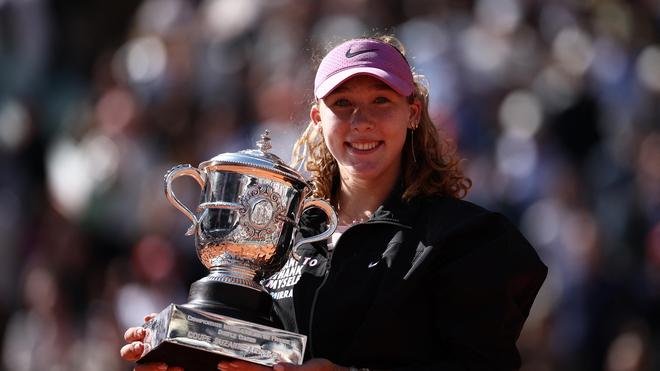
The Moment a Star Was Crowned
In professional Tennis, there are performances that win matches and there are performances that define careers. The two are not always the same thing. Sometimes a player wins a match scrappily, grittily, through survival and margins and an opponent’s errors, and the victory counts for everything on the scoreboard while revealing little about where the winner is going. And then there are the performances like the one Mirra Andreeva produced on Saturday on Court Philippe Chatrier the kind that say, clearly and without qualification, that this player has arrived at a level from which she is not going back.
Andreeva, 19 years old and playing in her first Grand Slam final, defeated Polish qualifier Maja Chwalinska 6-3, 6-2 to win the 2026 French Open women’s singles title the first Grand Slam championship of her career, and a performance that will be discussed for years as the moment the sport recognized what had been building for months. She is the youngest Roland Garros women’s champion in more than three decades. She is the first teenager to lift the Suzanne Lenglen Cup since Iga Swiatek won it in 2020. And she is, as of Saturday evening in Paris, a major champion.
Who is at the center of this? Mirra Andreeva Russian, 19, eighth seed, and now Grand Slam champion. Who did she defeat? Maja Chwalinska, the Polish qualifier who had been one of the tournament’s great stories until the final stage demanded more than any fairytale could provide. When? Saturday, June 6, 2026. Where? Court Philippe Chatrier, Roland Garros, on a blustery Parisian afternoon. Why does it matter? Because the youngest French Open champion since Monica Seles has arrived and she has arrived in a way that suggests the sport will be
The Historical Context: Joining Seles, Swiatek, and the Teenage Champions
The record books provide the clearest frame for what Andreeva achieved on Saturday. The last time a player younger than 19 won the French Open women’s singles title was in 1992, when Monica Seles already the dominant force in women’s tennis won her third consecutive Roland Garros title at the age of 18. That Seles remains the only younger French Open women’s champion in the Open Era is a measure of how extraordinarily difficult it is to win a Grand Slam at such an age, on clay, at a tournament that historically rewards experience, physical maturity, and the accumulated knowledge of how to manage the pressure of fifteen days in the world’s most demanding major.
Andreeva’s achievement also places her in the specific company of Iga Swiatek, who won Roland Garros in 2020 as a teenager and went on to become one of the most dominant players in the history of women’s tennis. The Suzanne Lenglen Cup last lifted by a teenager was lifted by the player who subsequently won it three more times and became world number one for years. The historical parallel is not a guarantee of what Andreeva’s career will become, but it is a reminder that the path from teenage Roland Garros champion to all-time great is one that the tournament has already seen walked.
Chwalinska‘s presence in the final added its own historical footnote, though in less triumphant circumstances. She became only the second female player in the Open Era to reach a Grand Slam final as a qualifier the first being Emma Raducanu, who did not merely reach the 2021 US Open final but won it in one of the most extraordinary achievements in the history of women’s tennis. The comparison between Chwalinska’s run and Raducanu’s will be inevitable and is ultimately unfair to both Raducanu’s New York achievement was singular and unrepeatable; Chwalinska’s journey to the final at Roland Garros was, by any measure, a remarkable achievement that simply encountered a player, on the day, too good to be overcome.
The Chwalinska Story: Nine Matches and a Fairytale That Almost Was
To understand the final, you need to understand what Maja Chwalinska had done to get there. Beginning in qualifying meaning she had to win three matches just to enter the main draw the world number 114 embarked on a nine-match winning run that dismantled opponent after opponent with tactical intelligence and a variety of shot-making that seemed to baffle everyone she faced. Drop shots, change of pace, fearless forehand winners in critical moments Chwalinska played without the inhibitions that ranking and reputation typically impose, because she had nothing to defend and everything to gain.
Hundreds of Polish fans filled sections of Philippe Chatrier for the final. The Chwalinska story had captured the imagination of a nation, and the scenes of supporters who had traveled to Paris to witness a compatriot’s Grand Slam final were genuinely moving. The fairytale was fully constructed. The final was the chapter it needed.
But Grand Slam finals are uniquely merciless environments, and they have a particular capacity to reveal the difference between a player performing at the peak of their career as Chwalinska had been for the previous two weeks and a player ready to perform under the specific pressure of the biggest match they have ever played. As the scoreline ultimately reflected, the occasion was too large for Chwalinska on Saturday. Not because she is not a good enough tennis player her run to the final proved otherwise but because the transition from inspired underdog to Grand Slam finalist demands a psychological reset that very few players can execute in the moment.
On a court that suddenly seemed vast and unforgiving, Chwalinska looked a shadow of the player who had outmanoeuvred opponent after opponent to reach the championship match.
The Match in Full: From Nervy Beginning to Clinical Conclusion
The opening set was appropriately tense for a Grand Slam final between two players navigating the specific pressure of the occasion from very different positions. Chwalinska, serving first, survived a marathon opening game in which she saved three break points through deft drop shots and a forehand winner that showed — briefly — that the Chwalinska who had conquered the draw still existed beneath the nerves. Andreeva, for her part, contributed two double faults in a single service game as errors flowed freely from both rackets.
The first set found its decisive moment at 3-3. What had been an unstable, error-prone contest began to tilt irrevocably in one direction as Andreeva located the depth and weight on her heavy groundstrokes that had been absent in the opening games. The Russian began forcing Chwalinska onto the defensive rather than allowing the Pole the space to construct points around her trademark variety. The dynamic shifted from two nervous players trading errors to one confident player imposing herself on a struggling opponent.
Andreeva broke for 4-3 when Chwalinska netted a sliced backhand. She consolidated to 5-3 and then pounced on a nervy final service game to claim the first set 6-3 a scoreline that, by the end, represented the nature of the contest more accurately than the early exchanges had suggested it might.
The second set removed any remaining doubt. Andreeva broke immediately to lead 2-0 after another unforced forehand error from Chwalinska, who then wasted three break points three chances to arrest the momentum and dropped serve again to fall 4-0 behind. The occasion had consumed the Pole entirely. Her drop shots and changes of pace, so effective across nine previous matches, yielded diminishing returns against a player who had grown in authority with every game and was now moving through the match with the confidence of a champion.
Chwalinska rallied to 5-2 a minor resurgence that provided her supporters with one final moment of hope before Andreeva, facing the championship point on her opponent’s serve, produced the definitive shot of the match: a crosscourt backhand winner that sealed the title and triggered the celebration.
| Player | Set 1 | Set 2 | Result |
|---|---|---|---|
| Mirra Andreeva (RUS) 8th seed | 6 | 6 | Winner First Grand Slam title |
| Maja Chwalinska (POL) Qualifier, WR 114 | 3 | 2 | Runner-up — First Grand Slam final |
Andreeva’s Journey to This Moment: The Making of a Champion
For those who have tracked Mirra Andreeva’s development in women’s tennis, the French Open title is both a surprise in its timing and entirely logical in its arrival. She is a player who has been identified as an exceptional talent since she was competing on the junior circuit physically imposing for her age, technically complete in ways that young players rarely are, and psychologically equipped for competition in ways that coaching can develop but cannot entirely install.
Her game is built on heavy, penetrating groundstrokes that she can sustain across long rallies without the pace or weight diminishing. She is not a player who wins through variety or deception primarily she is a player who wins by making her opponents feel, over time, that the court is getting smaller and the options fewer. That grinding quality, allied to the physical conditioning required to sustain it across fifteen days of a Grand Slam, is exactly the profile that Roland Garros rewards.
As eighth seed, she entered the tournament as a genuine contender rather than a dark horse the selection committee for seedings had placed her in the bracket that reflected her recent form and ranking trajectory. Her run through the draw confirmed the seeding’s accuracy, including the semi-final demolition of Sorana Cirstea that sent her to the final with the clear-eyed confidence of a player who had not been truly tested under pressure in the fortnight.
The final, in its opening stages, did test her. The nerves were visible. The double faults came. For a passage of the first set, the final looked like it might produce the upset story it seemed to be teasing. Then, at 3-3, Andreeva did what great champions do: she found a gear that had been held in reserve, elevated her level at the precise moment the match demanded it, and never released the accelerator until the crosscourt backhand winner had landed in the corner.
The Blustery Chatrier and the Stage That Devoured Chwalinska
The conditions on Philippe Chatrier on Saturday were not straightforward. A blustery wind added a variable to both players’ shot-making that the ball-toss, the serve, and any attempted drop shot or sliced approach had to account for. For Andreeva, whose power game is less dependent on fine touch and more reliant on weight and depth, the wind was a manageable complication. For Chwalinska, whose game is built around precisely the kind of delicate shot-making that blustery conditions disrupt the drop shot, the change of pace, the sliced approach the wind was an additional adversary at a moment when she already faced more than enough.
Grand Slam finals have a way of concentrating every external variable against the player least able to absorb them. For Chwalinska, arriving at her first major final as a qualifier against an eighth seed who had been at home on clay all fortnight, the blustery wind was simply the latest element of a context that had already grown too large to navigate.
What This Title Means for Women’s Tennis
Mirra Andreeva’s first Grand Slam title arrives at a moment in women’s tennis when the hierarchy at the top of the sport has been in transition. The domination of recent years built around the sustained excellence of players who have won Roland Garros multiple times has been challenged by the emergence of a generation of young players whose ambition and ability has brought them to the threshold of the sport’s highest prizes.
Andreeva crossing that threshold at 19, on the most physically demanding Grand Slam surface, with the decisive authority of a 6-3, 6-2 final, sends a signal to the rest of the draw about what she is capable of. A teenage first-time Grand Slam champion who wins the title with authority not with scrambled survival but with controlled dominance is one of the sport’s more significant new arrivals in recent memory. The question now is whether this French Open title is the beginning of sustained major success, or whether the pressures and expectations that Grand Slam victory brings will reshape her relationship with the game in the way they reshape all young champions.
The historical precedent from the Suzanne Lenglen Cup is encouraging. Swiatek’s 2020 teenage Roland Garros victory was not an outlier but a foundation. Time will tell whether Andreeva’s follows the same trajectory. What is certain is that she has the tools, the temperament, and now the evidence a major title at 19 to suggest that the sport’s future has just announced itself on Court Philippe Chatrier.
Conclusion: 6-3, 6-2, and a Generation Announces Itself
Maja Chwalinska’s story deserves its coda. She came from qualifying, won nine consecutive matches against opponents ranging from comparable rivals to players ranked considerably above her, reached a Grand Slam final, and was frozen by an occasion whose scale overwhelmed everything that had made her run so special. That is not a failure. It is a tournament career that, in its entirety across these two weeks, represents one of women’s tennis’s more remarkable achievements of the current season. She will be back. The qualities that got her to that final are real and will produce more results at the highest level.
But on Saturday at Roland Garros, the story belonged to Mirra Andreeva the youngest French Open champion since Monica Seles, the first teenage Suzanne Lenglen Cup holder since Iga Swiatek, and as of the moment her crosscourt backhand winner landed in the corner of Philippe Chatrier, a Grand Slam champion for the first time.
She is 19 years old. She has just won Roland Garros. The crosscourt backhand that sealed it was not tentative or scrambled or lucky. It was placed with authority into a corner that left no doubt.
The next generation of women’s tennis has its first major champion. And she won it the right way by being, when the moment arrived, the best player on the court.
For breaking news and live news updates, like us on Facebook or follow us on Twitter and Instagram. Read more on Latest Sports on thefoxdaily.com.





COMMENTS 0