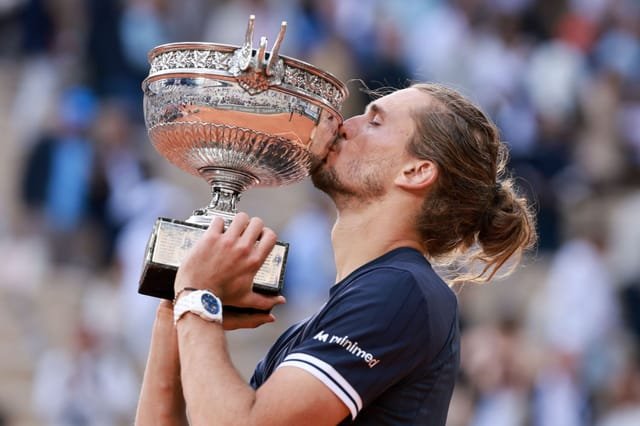
There is a particular cruelty built into the Tennis phrase “best player never to win a Grand Slam.” It is meant as a compliment. It acknowledges excellence, consistency, and the sustained ability to compete at the highest level. But embedded in it is a quiet accusation: that something is missing, that when it mattered most, the player in question found a way to fall short. For years, Alexander Zverev carried that label. After the 2026 French Open, he no longer has to.
Zverev claimed his maiden Grand Slam title at Roland Garros, defeating Flavio Cobolli in a five-set battle that finished 6-1, 4-6, 6-4, 6-7(5), 6-1. The win was the culmination of a journey that included three Grand Slam final defeats, a genuine crisis of self-belief, and the kind of sustained mental pressure that breaks many players before they ever reach a breakthrough. Zverev did not break. He endured, returned, and finally crossed the line he had been approaching for years.
And at the post-match press conference, when a journalist raised the question of whether Zverev was concerned about being considered the “worst player” to win a Grand Slam rather than the best player never to win one, the German gave an answer that was as honest as it was assured.
The Exchange That Defined the Moment
The journalist’s question was framed carefully, referencing something Zverev himself had said in the past: that he would rather be known as the worst player to win a Grand Slam than the best player never to win one. It was the kind of question designed to invite the champion to reflect, to perhaps qualify or moderate a statement made during harder times.
Zverev did not moderate anything. He doubled down, completely and without hesitation.
“If you call me the worst player to win a Grand Slam I could not care less right now. If somebody thinks that, that’s fine.”
Six words carried the weight of everything: “I could not care less right now.” Not defensiveness. Not wounded pride. Not an attempt to argue his case or point to his career statistics. Just the quiet, absolute confidence of a man who has finally gotten what he was working toward and has decided, quite reasonably, that other people’s rankings of his worthiness are irrelevant to the fact of what he has achieved.
It was one of the more genuine moments of post-match honesty in recent Grand Slam history, and it resonated precisely because it was not calculated or managed. Zverev was telling the truth about exactly how he felt.
The Road to Roland Garros: Three Finals, Three Defeats, and Years of Waiting
To fully appreciate what Zverev’s 2026 French Open win means, it is worth tracing the specific path that led him there, because the journey was neither smooth nor inevitable.
His first Grand Slam final appearance came at the 2020 US Open, where he faced Dominic Thiem in a match that entered the sport’s memory as one of the most dramatic finals of its era. Zverev led by two sets to love and appeared on the verge of claiming the title. Thiem recovered, won in five sets, and Zverev walked away from his first final having come as close as a player can come without winning.
The second defeat came at the 2024 Roland Garros final, where Carlos Alcaraz proved too strong. The third arrived at the 2025 Australian Open, where Jannik Sinner claimed the title. Three finals. Three losses. And with each one, the “best player never to win a Grand Slam” label attached itself more firmly to Zverev’s public identity, growing heavier with each passing year.
| Year | Grand Slam Final | Opponent | Result |
|---|---|---|---|
| 2020 | US Open | Dominic Thiem | Lost (led 2-0 sets) |
| 2024 | French Open (Roland Garros) | Carlos Alcaraz | Lost |
| 2025 | Australian Open | Jannik Sinner | Lost |
| 2026 | French Open (Roland Garros) | Flavio Cobolli | Won 6-1, 4-6, 6-4, 6-7(5), 6-1 |
The pattern across those three defeats is worth noting. Zverev was not blown off the court in any of them. He was competitive, he was present, and in the 2020 US Open he was actually ahead before the match turned. These were not the results of a player who could not handle major occasions. They were the results of a player who kept arriving at the right moment and finding, just barely, that someone else was slightly better that day.
That distinction matters when evaluating the “worst player to win a Grand Slam” framing, because it reveals the framing’s fundamental incoherence. A player who reaches four Grand Slam finals and wins one of them is not the worst player to win a Major. He is a player who competed at the absolute highest level of his sport on the biggest stages it offers, repeatedly, and eventually converted one of those opportunities into a title. That is what Grand Slam champions do.
What Winning Means for Zverev: Freedom, Belief, and a Calmer Mind
In the same press conference, Zverev spoke with unusual candor about the psychological weight that the title hunt had placed on him and what lifting the trophy finally meant for his relationship with that pressure.
“Now no matter what happens, I will always be a Grand Slam Champion. Nobody can take that away from me. Maybe that does give me some freedom. Maybe my mind will just be a little bit calmer when I play a final. Meaning that even if I lose it, I’ll still be a Grand Slam champion. This trophy for me is very important. If I would’ve lost this one, the self belief would’ve gone down a lot. But now that I’ve won it, I feel like I can do it again.”
This is a remarkable piece of athlete psychology laid out in plain language. Zverev is describing something that sports science and performance psychology have long recognized: the burden of an unachieved goal creates a specific kind of pressure that is qualitatively different from the pressure of defending or extending an achievement. The player who has never won a Grand Slam enters every final with the full weight of that absence on their shoulders. The player who has won one enters with a foundation.
By his own account, Zverev’s self-belief was genuinely at risk if this final had gone the other way. That is a striking admission from a player of his ranking and career accomplishment, and it speaks to how deeply the label and the repeated near-misses had embedded themselves into his mental framework around Grand Slam tennis. The title did not just add to his trophy cabinet. It restructured the psychological context in which he will compete for all future Major titles.
His statement that winning makes him feel like he can do it again is not simply post-victory confidence talking. It reflects a genuine shift in what he now believes about himself as a player in the highest-pressure moments the sport offers.
The Tennis World Responds: Nadal, King, and Alcaraz Offer Their Congratulations
The significance of Zverev’s win was not lost on the broader tennis community. Rafael Nadal, a man who won this specific tournament an almost incomprehensible fourteen times, offered his congratulations. Billie Jean King, one of the sport’s most enduring and respected voices, celebrated the achievement. Carlos Alcaraz, who had defeated Zverev at this same tournament two years earlier, also offered his recognition.
When players of that stature take the time to publicly acknowledge a victory, it carries its own signal about the significance of the win within the sport’s internal culture. These are not perfunctory gestures. They are the sport’s living legends recognizing a moment that deserved to be recognized.
Alcaraz’s congratulations carry a particular resonance given the history. He was the player who stood between Zverev and this title two years prior. The fact that he was among the first to celebrate the German’s eventual breakthrough reflects the mutual respect that operates between genuine competitors at the top of professional tennis.
Zverev at World No. 3: The Question of What Comes Next
At World No. 3, Zverev enters the post-Roland Garros portion of the season in a fundamentally different position than he has ever occupied before. He is no longer chasing. He is defending, building, and operating from a place of psychological security that he did not have access to before June 2026.
The grass season at Wimbledon now looms, a surface where Zverev has historically been competitive without reaching the very final stages. The question of whether his Roland Garros breakthrough translates into sustained Grand Slam success will begin to be answered over the next twelve months. His own statement, that he now feels he can do it again, suggests he is approaching that question with considerably more confidence than he carried into any of his previous Slam campaigns.
His comment about a “calmer mind” in finals is particularly significant here. If the psychological liberation of having won a Grand Slam genuinely reduces the specific pressure he described around Major final appearances, then the players currently ranked above him in the world have reason to take his future prospects seriously. A technically gifted, physically powerful, mentally settled Alexander Zverev competing across all four Slams is a different proposition from the version of Zverev that was carrying the weight of that unachieved ambition.
The “Worst Player to Win a Slam” Framing: Why It Misses the Point
It is worth taking a moment to examine the criticism itself, because it reveals something interesting about how tennis discourse operates around players who have been labeled in a particular way for long enough that the label becomes self-reinforcing.
The “worst player to win a Grand Slam” framing implies that Zverev’s Major victory was somehow undeserved or that it diminishes the title’s prestige. But this logic does not hold up to scrutiny. Grand Slam titles are not awarded based on cumulative career quality assessments. They are awarded to the player who wins the most matches across two weeks of high-level competition at the sport’s four most prestigious events. Zverev did exactly that at the 2026 French Open. He won the matches that needed winning, against the opponents he faced, on the surface where the tournament was played.
The comparison that the framing implicitly invites, between Zverev and other Grand Slam winners, tells its own story. His three Grand Slam final appearances before the win place him in a relatively small group of players in the modern era who have competed at that level repeatedly. Most players who are characterized as the “best of their generation never to win a Slam” never reach four finals. Zverev did, and he eventually won. That trajectory is more consistent with a legitimate Grand Slam champion than with someone who stumbled into a title they did not earn.
Zverev’s own response to the criticism, warm, unconcerned, and completely confident, is the most effective rebuttal available. He does not need to argue the point. The trophy does that for him.
Conclusion: A Champion Who Earned Every Part of the Label
Alexander Zverev spent years being defined by what he had not achieved. He absorbed the scrutiny, the comparisons, and the quiet suggestion that perhaps he was not quite built for the biggest moments. He kept showing up to those moments anyway, kept competing, and eventually found the result that changes every conversation about his career going forward.
The “worst player to win a Grand Slam” label, lobbed his way by a journalist trying to prompt a reaction, got exactly the response it deserved: complete and total indifference from a man who has nothing left to prove to the people doing the labeling.
He is a Grand Slam champion. Nobody can take that away from him. He said so himself, and for once, this is a post-match press conference quote that does not need any qualifying context. It is simply and entirely true.
For breaking news and live news updates, like us on Facebook or follow us on Twitter and Instagram. Read more on Latest Sports on thefoxdaily.com.





COMMENTS 0