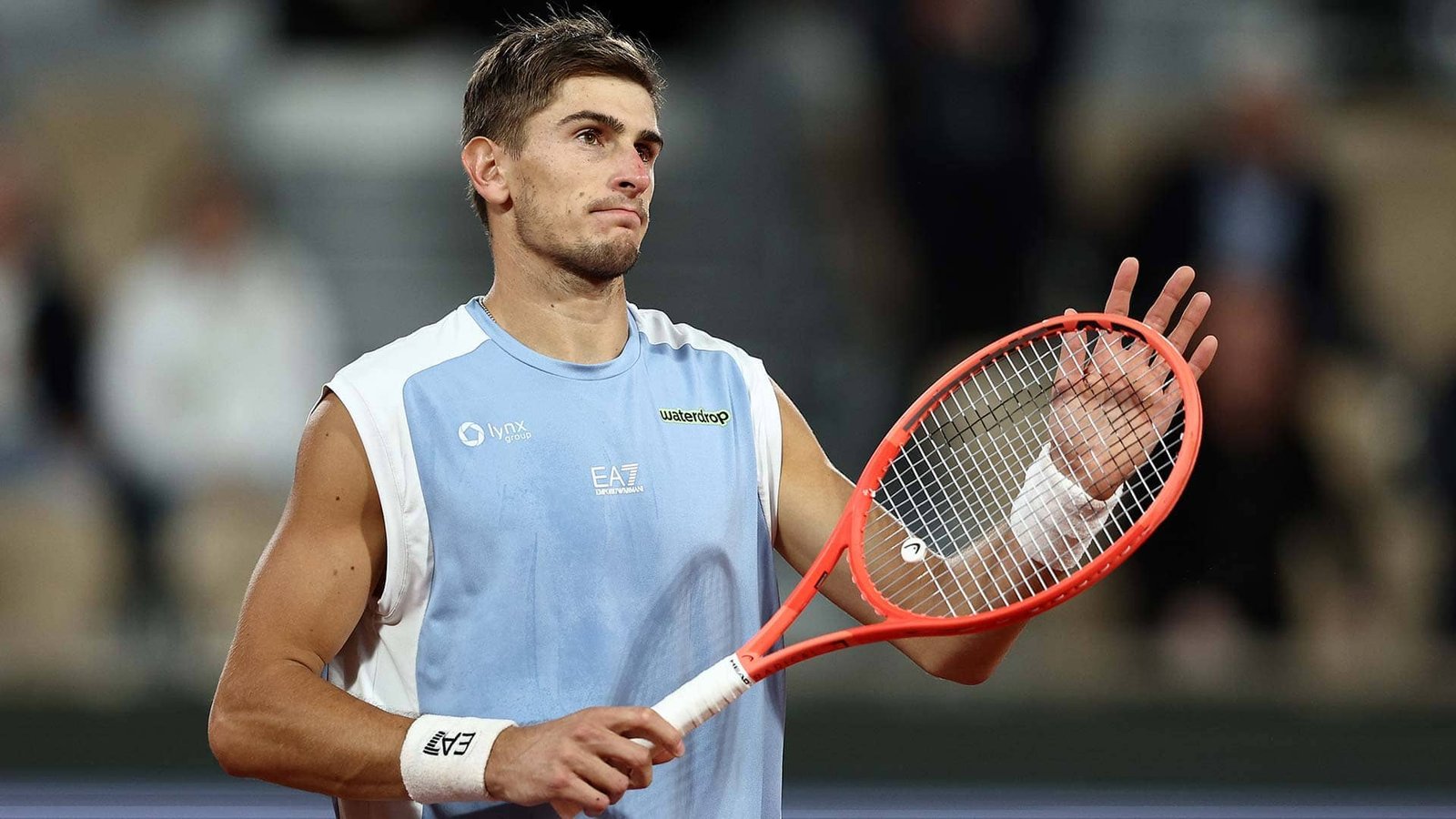
Introduction: The Match That Never Was — And the Final That Now Will Be
Friday at Roland Garros was supposed to be a celebration of Italian tennis. Matteo Arnaldi and Flavio Cobolli, two young compatriots who had carved their way through the draw with grit and skill, were set to contest a historic all-Italian semi-final on Court Philippe-Chatrier — the first time in the Open Era that two Italian men had reached the last four of the same Grand Slam. The clay of Paris, which has been an Italian hunting ground in recent years, was primed for another chapter.
Instead, what unfolded was something far more painful. Arnaldi, who had spent 17 hours and 42 minutes on court across four matches to reach his first Grand Slam semi-final, woke in the night violently ill and found himself unable to compete. At a joint press conference that carried all the emotional weight of a sporting tragedy — two friends, one ecstatic and one devastated, sitting side by side — Arnaldi announced his withdrawal. Cobolli advances to the Roland Garros final on Sunday, where he will face second-seeded Alexander Zverev for the title.
Who are these players? Two of Italy’s most promising tennis talents, ranked inside the ATP’s top 35. What happened? A viral illness stripped Arnaldi of the ability to compete. When? The illness struck overnight Thursday into Friday, worsening through the morning. Where? In his hotel room in Paris, and then in the most difficult press conference of his young career. Why does it matter? Because this is not just a sports withdrawal — it is the story of a journey that deserved a different ending, and a final that now carries the weight of two men’s dreams.
Arnaldi’s Journey: A Road Built on Exhaustion and Resilience
To fully appreciate the cruelty of this withdrawal, you have to understand what Matteo Arnaldi went through to reach that semi-final. The 25-year-old — ranked 34th in the PIF ATP Live Rankings — played 18 sets across four matches to become the first member of his family to reach a Grand Slam semi-final. That alone is a remarkable achievement for a player whose previous best run at a major had not reached this stage.
But the raw statistics go further than match count. Arnaldi’s cumulative time on court — 17 hours and 42 minutes — is a number that deserves to be read twice. According to ATP records dating back to 1991, no player in the history of Grand Slam tennis has spent more time on court while reaching a quarter-final. He surpassed the previous record by one hour and 58 minutes — almost two full additional hours of tennis. That is not just a record. That is a testament to an extraordinary physical and mental effort sustained across the entire fortnight.
His quarter-final arrival came with an asterisk — Matteo Berrettini retired due to a hip injury before the end of the second set — but the path there was hard-earned. Arnaldi had already deposited enormous physical reserves into the clay of Roland Garros. When his body finally broke down in the night, it was not without context. He had asked more of himself than almost any player in the modern era had asked to reach this point in a major tournament.
“It’s difficult to be here. It’s not what I wanted to do, but last night I started to feel not very well. Yesterday I was feeling okay. I came here to practise. I did everything I had to do, and I was feeling fine. Then I had dinner. I started to feel so-so with my stomach.”
— Matteo Arnaldi
He described waking at 1 a.m. and vomiting, then attempting to sleep, then being unable to. By 6 or 7 a.m., the situation had worsened significantly. The team doctor was called to his room and provided treatment, but throughout Friday, Arnaldi could not eat or drink without returning to the bathroom. By the time the decision needed to be made, there was no realistic path to competing at the level a Grand Slam semi-final demands.
The Ghost of Nadal’s Wimbledon Withdrawal
The last time a player withdrew at this stage of a Grand Slam was at Wimbledon in 2022, when Rafael Nadal pulled out of his semi-final against Nick Kyrgios due to an abdominal injury. That withdrawal was devastating in its own right — Nadal at the peak of a remarkable comeback season, forced off a stage he had owned for decades. The sporting world grieved alongside him.
Arnaldi’s situation carries a different but equally profound weight. Nadal withdrew with the burden of a legend — every absence felt like a potential farewell. Arnaldi withdraws as a young player experiencing something for the first time, robbed of the opportunity to find out what he was capable of on the biggest stage he had ever reached. The uncertainty of that — the unanswered question of how the match might have gone — is a particular kind of loss that follows a player through their career.
What the two withdrawals share is a reminder that professional tennis operates at the absolute boundary of what the human body can sustain. The physical demands of a Grand Slam campaign over two weeks — the travel, the heat, the hours on court, the disrupted sleep — create conditions in which illness and injury are not aberrations. They are predictable consequences of an extraordinary challenge.
| Player | Matches Played | Sets Played | Time on Court | Semi-Final Result |
|---|---|---|---|---|
| Matteo Arnaldi | 4 | 18 | 17 hrs 42 mins (Grand Slam record to QF) | Withdrew — viral illness |
| Flavio Cobolli | 5 (advances to final) | TBD | TBD | Advances to Sunday’s final vs. Zverev |
| Alexander Zverev | 5 (in final) | TBD | TBD | Awaits Cobolli in Sunday final (4th major final) |
Flavio Cobolli: The Last Man Standing From Italy’s Extraordinary Fortnight
In the most bittersweet possible circumstances, Flavio Cobolli has reached the final of a Grand Slam tournament for the first time in his career. The Italian had arrived at Roland Garros having already demonstrated significant progress at the major level — his previous best run came at Wimbledon last year, where he reached the quarter-finals — but a first Grand Slam final represents a genuine leap into elite status.
What makes Cobolli’s achievement particularly significant is the broader context of Italian tennis. Led by world number one Jannik Sinner, Italy is currently experiencing what historians of the sport will likely describe as a golden generation — a confluence of talent, coaching, and competitive culture that has produced multiple players capable of competing at the highest levels simultaneously. Sinner has broken through and dominated. Arnaldi arrived at this Roland Garros as a genuine contender. And now Cobolli stands one match from a Grand Slam title.
Sitting alongside a visibly distressed Arnaldi at the joint press conference — a scene of uncommon emotional complexity in professional tennis — Cobolli handled himself with considerable grace. There was no triumphalism in his manner. He understood, as Arnaldi understood, that what was unfolding was not a sporting contest decided on the court but a human drama decided in a hotel bathroom at 6 a.m. These are not the circumstances anyone chooses.
Zverev vs. Cobolli: The Final Breakdown
The Roland Garros final on Sunday will pit the experience and power of Alexander Zverev against the momentum and hunger of Cobolli — a contrast that makes for genuinely compelling viewing on paper.
Zverev arrives as the second seed and a man who has made Grand Slam finals before, competing in his fourth major final. His previous final appearances have taught him hard lessons about performing under the unique pressure that a championship match creates — lessons that Cobolli will be learning for the first time on the biggest stage of his career. The German is a formidable clay court player whose heavy forehand and elite serve translate well to the slower Parisian surface.
The head-to-head record between the two is instructive: Zverev leads 3-1 in their ATP Head2Head series, including a commanding 6-2, 7-6(4), 6-1 victory over Cobolli in the third round at Roland Garros last year. That result, on this very surface, at this very tournament, is the kind of historical precedent that will weigh on Cobolli’s preparation. Zverev did not just beat him — he dominated him across three sets, losing only four games in the first set and one game in the third.
But that was last year. Cobolli is a different player now — a player who has reached a Grand Slam semi-final, navigated five matches on clay against quality opposition, and demonstrated the kind of competitive resilience that does not emerge from comfortable defeats. The manner in which he has played this fortnight will matter as much as any historical head-to-head statistic when the match begins on Sunday.
The Unique Pressure of a First Grand Slam Final
There is a specific kind of pressure that attaches to a first Grand Slam final that has no equivalent anywhere else in the sport. Players who have won major titles describe the experience retrospectively — the tightness, the occasion, the sense that the moment is slightly too large for ordinary consciousness to process in real time. For players experiencing it for the first time, that pressure is almost universally described as unlike anything they have encountered before.
Cobolli will need to find a way to be present on a court where the occasion threatens to overwhelm the tennis. The best first-time finalists in Grand Slam history have typically managed this by narrowing their focus to individual points — refusing to let the score, the crowd, or the meaning of the occasion intrude on the micro-decisions that tennis requires. Whether Cobolli has the mental framework to do this on Sunday is the question that his coaches and support team will be working to answer in the 48 hours between now and the final.
Zverev, whatever his own history of near-misses at Grand Slams, will be trying to exploit precisely this vulnerability. His experience in major finals — both the victories and the defeats — gives him a tactical and psychological vocabulary for these moments that Cobolli simply cannot yet possess. That is not a criticism of Cobolli. It is the simple reality of experience versus first exposure.
What Sunday Means: A Final Written by Circumstance
The Roland Garros final that will take place on Sunday is not the one that the draw appeared to promise when the semi-final lineup was set. An all-Italian semi-final — a historic occasion that would have generated its own compelling narrative regardless of outcome — has been replaced by a final in which only one Italian flag will fly, and it flies in circumstances tinged with sadness for the other.
Arnaldi’s withdrawal changes the texture of Sunday’s match without diminishing its legitimacy. Cobolli earned his place in this final through five matches of tennis. He will need to earn the title through one more. The fact that his compatriot will be watching from the stands rather than on the other side of the net is a complication that Cobolli will carry into the match, consciously or not.
Conclusion: A Fortnight That Deserved Better — and a Final That Still Deserves Everything
Matteo Arnaldi came to Roland Garros 2026 and gave more of himself than almost any player in modern Grand Slam history has given to reach a semi-final. He played longer hours, fought through more sets, and left more of his physical reserves on the Parisian clay than any statistical record had previously captured. His withdrawal does not erase any of that. It simply means the story ends without the chapter it deserved.
Flavio Cobolli walks into a Grand Slam final carrying the weight of his own achievement and the shadow of his compatriot’s misfortune. That is not an easy combination. But tennis finals have always been complicated emotional territories, and what separates champions from finalists is often the ability to simplify what is complicated and play the next point.
On Sunday, the clay of Philippe-Chatrier will host its final match of Roland Garros 2026. Zverev brings experience and form. Cobolli brings hunger and the momentum of a career-defining fortnight. Arnaldi will watch from somewhere that is not the court, which is the wrong place for him to be — but the right place from which to witness his friend potentially making history.
Italian tennis has already won something this fortnight. On Sunday, it finds out if it wins everything.
For breaking news and live news updates, like us on Facebook or follow us on Twitter and Instagram. Read more on Latest Sports on thefoxdaily.com.




COMMENTS 0