The Match Within the Match
Great sporting occasions deserve great broadcasting. When the circumstances align correctly, the commentary team becomes part of the experience: their descriptions, analysis, and emotional engagement adding texture to moments that the pictures alone cannot fully convey. Tennis commentary at its best is a genuinely skilled art form, requiring the ability to describe fast-moving action accurately, provide tactical insight that enhances understanding, and keep the broadcast moving without either filling silence unnecessarily or talking over the points that require no narration.
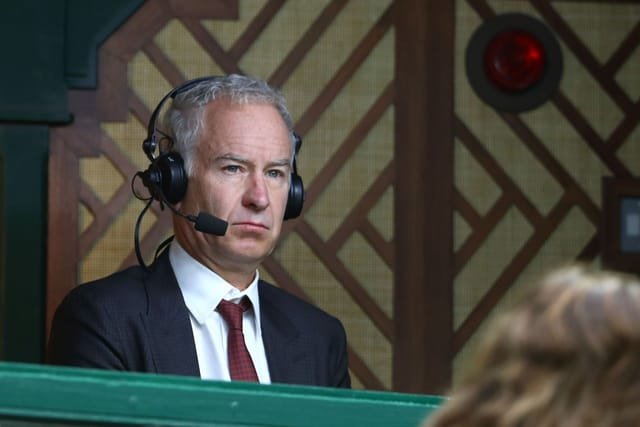
On Sunday, as Alexander Zverev and Flavio Cobolli contested the men’s French Open final at Court Philippe-Chatrier in what was for both players a first Grand Slam championship match, a significant portion of the viewing audience across America and the United Kingdom found themselves focused on a different competition entirely: the battle between their patience and John McEnroe‘s commentary.
TNT Sports, broadcasting the final for both American and British audiences, had positioned the former American tennis great in the commentary box. The moment the match began, social media received a steady stream of complaints about two specific issues: McEnroe’s pronunciation of the players’ names, and his tendency to fill the broadcast with conversation during points. The reaction was not gentle. Words like “painful,” “malpractice,” and “charade” appeared repeatedly, alongside pointed suggestions that the network had missed an obvious opportunity to put genuinely superior options in the chair.
The Pronunciation Problem: Zverev and Cobolli
At the heart of the commentary complaints were two names. Both players in the final have names that require specific phonetic attention from English-language broadcasters. Alexander Zverev is a German-Russian name whose pronunciation has been a persistent source of broadcaster inconsistency: the correct Russian pronunciation approximates “Zveh-rev” rather than the more commonly heard anglicized versions. Flavio Cobolli is an Italian name that, while not especially complex, requires accurate vowel placement that casual mispronunciation disrupts.
For fans watching a final of this significance, these pronunciation errors are not trivial grievances. Both players were competing for the first Grand Slam title of their careers. Both deserved to have their names spoken correctly across hours of broadcasting that reached millions of viewers. The player’s name is the most personal element of their identity in a broadcast: getting it wrong, repeatedly and across an entire final, signals a level of preparation and care that reflects on the broadcaster as much as the individual commentator.
The specific complaint about Zverev’s name captured the cumulative frustration of a long match spent hearing the mispronunciation repeat:
“I don’t think I can take 3+ hours for John McEnroe saying Za-ver-ev. Why?? @TNTSportsUS you could have had Jim Courier and Andre Agassi in your booth today. That’s malpractice. Zverev is likely to win his first slam today, he deserves to have his name pronounced correctly.”
The word “malpractice” in this context is deliberately extreme for rhetorical effect, but the underlying point is serious: a network broadcasting a Grand Slam final has both the resources and the responsibility to ensure its commentary team can pronounce the competitors’ names accurately. This is not an unreasonable expectation. It is a minimum baseline.
The Cobolli-specific complaint was equally direct:
“2+ hours of listening to john mcenroe pronounce cobolli wrong just kill me now.”
The dark humor barely disguises genuine exasperation. The final went the distance, as major finals often do. Two hours or more of persistent name mispronunciation is a specific and sustained irritant that accumulates across the broadcast in a way that a single error would not.
The “Talking During Play” Complaint: A Separate but Related Issue
Distinct from the pronunciation problem but equally present in the fan complaints was a criticism of McEnroe’s tendency to speak during points, rather than allowing the action to breathe and providing analysis in the natural pauses that tennis provides between points and games:
“Does John McEnroe know he doesn’t have to speak the whole time.”
“Please! Please! Someone tell McEnroe that he is NOT to talk during play. PLUS! Someone tell him how to properly pronounce Zverev’s name. It’s painful listening to him.”
This is a long-standing criticism of certain commentary styles that prioritizes maintaining verbal output over respecting the moments of silence that allow viewers to watch sport as sport. Great commentary understands when to speak and when to be quiet. A point in a Grand Slam final, particularly at the most intense junctures, requires visual attention from the viewer rather than narration. The commentator who talks through every point, rather than letting the point itself carry the moment and providing context in the natural pauses, creates a broadcast that competes with the tennis rather than enhancing it.
McEnroe has faced this criticism across his commentary career. His instinct as a performer, honed across decades of on-court presence in some of the sport’s most intense moments, appears to translate into a broadcasting style that values presence and conversation over the strategic deployment of silence. For fans who want to watch the tennis, the result can feel exhausting.
The Alternatives Named: Courier and Agassi
The specific names offered by fans as alternatives to McEnroe were not random. Both Jim Courier and Andre Agassi represent a specific standard of tennis commentary that their advocates clearly feel TNT Sports chose not to deploy for reasons that are either commercial, contractual, or both.
Courier, a former world number one and four-time Grand Slam champion, has built a commentary reputation for specific and insightful analysis: he speaks from genuine technical knowledge, can identify tactical patterns in real time, and has developed the kind of broadcasting clarity and pace that allows his commentary to enhance the viewing experience without dominating it. The fan who described him as “the best in the business” was expressing a widely held view among dedicated tennis viewers who have listened to him across multiple major broadcasts.
The most pointed formulation of the Courier case came from the fan who also addressed the presence of Mary Joe Fernandez on the commentary team:
“McEnroe and Mary Joe Fernandez calling the men’s finals makes you a completely unserious network. Every one knows Courier is the best in the business. When is this McEnroe charade going to end? And Mary Joe gets to call two finals? Mary Joe Fernandez?!”
The repetition of “Mary Joe Fernandez?!” captures a specific frustration with what the fan perceives as inadequate quality across the entire commentary team rather than a single problematic appointment. The exclamatory repetition, while ungenerous to a commentator who has a legitimate record in tennis broadcasting, reflects the cumulative frustration of an audience that feels the broadcast of one of tennis’s biggest annual occasions has been under-resourced in terms of commentary quality.
McEnroe’s Legacy as Commentator: The Complicated Truth
The reaction to McEnroe’s commentary on Sunday needs to be placed within the context of his broadcasting career, which is considerably more complicated than the social media reaction might suggest. He has been part of Grand Slam broadcasting for decades, and there are genuinely enthusiastic defenders of his work who value the passion, the personality, and the occasionally brilliant tactical insight that his commentary provides.
McEnroe’s broadcasting strength has always been his authenticity: he speaks from the perspective of someone who has competed at the highest levels of the sport, who understands the pressure of a Grand Slam final from the inside, and who brings a genuine emotional investment to what he watches. When he is moved by a moment on court, that emotion is real and communicates itself to the audience. When he identifies a tactical problem or a strategic opportunity, his instinct is often correct and his articulation is informed by experience that pure broadcasting professionals do not have.
The weaknesses his critics identify, the pronunciation inconsistencies, the tendency to fill silence with conversation, the occasional sense that the broadcast is about McEnroe’s reaction to the tennis as much as the tennis itself, are the other side of those same qualities. The authenticity can become self-indulgence. The passion can become noise. The insider perspective can become a conversation that the viewer watches from the outside rather than being invited into.
Whether the goods outweigh the costs is a viewer-by-viewer judgment. But the volume and consistency of the complaints on Sunday suggests that for a significant portion of TNT’s audience, the costs of this particular appointment outweighed its benefits during a final of this magnitude.
What the French Open Final Deserved
The specific context of the Zverev-Cobolli final makes the commentary stakes higher than a routine match would require. Both players were competing for the first Grand Slam title of their careers. For Zverev, who has reached Grand Slam finals before and knows the specific weight of the occasion, this was another attempt to convert that experience into achievement. For Cobolli, arriving as a qualifier at his first major final, the broadcast was the primary means through which the global audience would understand who he was, where he had come from, and what this moment meant.
The commentary team at such a match carries the responsibility of providing that context: telling the stories of both players with accuracy and insight, pronouncing their names correctly as a basic expression of respect, and stepping back from the tennis enough to let the match’s own drama communicate itself without excessive narration. It is not an easy job. It requires preparation, restraint, and the ability to subordinate the commentator’s presence to the occasion itself.
Whether Sunday’s commentary team achieved that standard is, as of the fan reaction documented on social media, a contested question. The answers depend partly on what the individual viewer values in a broadcast. But the volume of complaints about specific, correctable issues, such as name pronunciation, suggests that at minimum, the preparation invested in this final did not meet the expectations of a substantial portion of the audience.
Conclusion: The Broadcast Conversation That Overshadowed the Tennis Conversation
Court Philippe-Chatrier hosted one of the more compelling men’s French Open finals in recent memory on Sunday. Two players competing for their first Grand Slam title, on the sport’s most distinctive surface, with the full weight of Roland Garros history behind every point. This is the kind of final that, discussed ten years from now, will be remembered for what happened on the court.
But in real time, on Sunday afternoon and evening, the conversation that dominated social media alongside the match itself was about the commentary. John McEnroe’s pronunciation. John McEnroe’s tendency to talk during play. The choice to have him in the booth rather than Jim Courier or Andre Agassi. Mary Joe Fernandez’s presence alongside him.
None of these are as important as who won the French Open. The match result is permanent. The commentary discourse will fade before the week is out. But the fact that it arose at all, and at the volume it did, during one of the biggest matches of the tennis calendar, is a note worth TNT Sports reading carefully before the next major final arrives.
The tennis was worth watching. Some of the fans were watching something else. The broadcaster might want to think about why.
“`
For breaking news and live news updates, like us on Facebook or follow us on Twitter and Instagram. Read more on Latest Sports on thefoxdaily.com.



COMMENTS 0