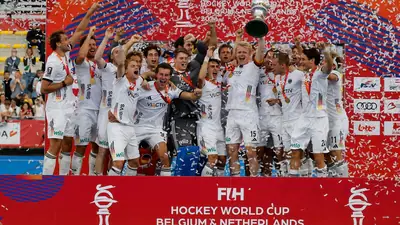
Germany’s fourth Hockey World Cup title has changed the shape of the tournament’s record books. The defending champions defeated Spain 1-0 in the final at the Belfius Hockey Arena in Wavre, Belgium, securing another world crown in a match decided by a single moment of attacking quality and outstanding defensive discipline.
The decisive goal arrived in the 44th minute when Michel Struthoff finished a well-coordinated German attack from open play. Spain had several opportunities to respond, particularly after the interval, but Germany’s defensive structure remained intact through sustained pressure and a tense final phase.
The victory means Germany now has four men’s Hockey World Cup titles, moving level with Pakistan as the joint-most successful nation in tournament history. Germany previously lifted the trophy in 2002, 2006 and 2023, while Pakistan’s four championships came in 1971, 1978, 1982 and 1994.
Germany’s Fourth World Cup Title Is More Than Another Trophy
Germany’s latest triumph is significant because it confirms the country’s ability to remain competitive across different generations of international hockey. The 2023 title had already restored Germany to the summit, and defending that status in 2026 adds another layer to their modern legacy.
Rather than relying on an attacking shootout, Germany demonstrated why tournament finals are often decided by defensive organisation. Spain enjoyed periods of possession and generated repeated attacks, but the Germans consistently disrupted the final pass and protected their goal when the pressure intensified.
That balance between controlled possession, structured defending and efficient attacking became the central theme of the final. Germany did not need numerous scoring chances. One successful attack was enough because the defence ensured Spain could not convert its opportunities at the other end.
Spain’s Historic Run Ends Without a First World Cup Title
Spain entered the final with history already on its side. The team had reached the championship match for the first time since 1998 and was competing in only its third men’s Hockey World Cup final.
A victory would have delivered Spain its maiden men’s World Cup title. Instead, the team was forced to settle for silver after struggling to find the final touch against a German defence that repeatedly absorbed pressure.
Spain’s performance nevertheless showed that it belongs among the leading teams in international hockey. Its route to the final included a thrilling 4-3 semi-final victory over co-hosts the Netherlands in Amstelveen, demonstrating the attacking ability that made the Spanish side such a dangerous opponent.
How Germany Won the Final
First Quarter: Germany Start on the Front Foot
Germany began the final with greater possession and quickly tested the Spanish defence. The Germans earned the first penalty corner in the second minute, but Benedikt Schwarzhaupt’s attempt was saved by the Spanish goalkeeper.
Spain also created an opportunity during the opening period, but neither side could break the deadlock. The early exchanges established the pattern of the match: Germany attempted to control possession while Spain looked to create opportunities through quick combinations and short passing.
Second Quarter: Defensive Battle Continues
The second quarter remained goalless despite promising attacks from both teams. Spain improved its passing and coordination, but Germany continued to limit the quality of chances inside the circle.
Germany came close to taking the lead shortly before half-time. A move involving Johannes Grobe, Teo Hinrichs and Justus Weigand created a dangerous opportunity, but the Spanish defence managed to prevent the ball from reaching the net.
At the interval, the score remained 0-0, leaving the final delicately balanced.
Third Quarter: Spain Apply Pressure Before Germany Strike
Spain came out strongly after the break and controlled much of the possession. The Spanish attack began creating more pressure around the German circle, and another penalty corner arrived in the 39th minute.
Captain Marc Miralles took responsibility for the drag flick, but the effort went wide. It was a costly missed opportunity because Germany soon produced the moment that decided the championship.
In the 44th minute, Germany constructed an excellent attack involving movement from both flanks. Struthoff received the ball from the right and finished the move with the Spanish goalkeeper out of position.
The goal gave Germany a 1-0 advantage and transformed the final. Spain now had to chase the match, while Germany could concentrate on protecting its narrow lead.
Germany’s Defence Becomes the Difference
Spain did not stop attacking after falling behind. In fact, the Spanish side immediately attempted to respond and earned another penalty corner in the 45th minute.
Miralles’ flick, however, struck Germany’s first rusher, Thies Prinz, who was forced to leave the field after the impact.
The final minutes became a test of Germany’s defensive resilience. Spain pushed players forward and searched for an equaliser, but Germany repeatedly managed to clear dangerous situations.
Spain coach Max Caldas eventually replaced goalkeeper Luiz Calzado with four minutes remaining, allowing the team to adopt an even more attacking approach. The tactical gamble created additional pressure but failed to produce the equalising goal.
Germany’s ability to preserve its one-goal advantage ultimately proved decisive. The final whistle confirmed another world championship for the defending champions.
Germany vs Spain: What Decided the Final?
| Factor | Germany | Spain |
|---|---|---|
| Final result | 1-0 win | 1-0 defeat |
| Key moment | Michel Struthoff’s 44th-minute goal | Missed chances during pressure spells |
| Penalty-corner impact | Defended effectively | Unable to convert opportunities |
| Defensive approach | Highly disciplined | Strong but eventually exposed |
| Late strategy | Protected the lead | Full attacking push |
Why Struthoff’s Goal Was So Important
Struthoff’s goal was not simply the only goal of the final; it was also an example of how small tactical details can decide a championship match.
Germany created the opening through coordinated movement from both sides of the pitch. The attack stretched the Spanish defensive structure before Struthoff found the space needed to finish.
In a match where both teams had spent long periods cancelling each other out, Germany’s ability to turn one well-executed attacking sequence into a goal provided the crucial advantage.
Argentina Complete the Podium With Bronze
Argentina secured the bronze medal after defeating the Netherlands 2-1 in a closely fought third-place match.
Tomás Domene opened the scoring for Argentina by converting a penalty corner in the 41st minute. The Netherlands responded through midfielder Floris Middendorp, who levelled the contest in the 49th minute.
With the match approaching its conclusion, Argentina captain Mathias Rey produced the decisive moment. Playing in his sixth World Cup, Rey converted a penalty corner in the 59th minute to secure the bronze medal.
The Netherlands had opportunities to force another twist, including three consecutive penalty corners shortly before the final hooter, but Argentina’s defence survived the late pressure.
Germany’s Title in Historical Perspective
| Germany’s World Cup Triumphs | Year |
|---|---|
| First title | 2002 |
| Second title | 2006 |
| Third title | 2023 |
| Fourth title | 2026 |
The 2026 championship also highlights the changing balance of power in men’s international hockey. Germany has now collected four titles, matching Pakistan’s historic total.
Pakistan’s four championships remain a cornerstone of World Cup history, with triumphs spread across 1971, 1978, 1982 and 1994. Germany’s titles, meanwhile, have come in different eras, underlining the country’s long-term presence at the highest level.
The Bigger Insight: Germany Win With Control, Not Chaos
The most interesting lesson from the final is that Germany did not need to dominate every attacking statistic to win the championship. Their success came from controlling the moments that mattered most.
Spain had a strong spell after half-time and launched repeated attacks, but Germany avoided allowing that pressure to become a goal. Once Struthoff scored, the Germans shifted the emphasis from creating chances to protecting the result.
This is particularly important in knockout hockey, where one goal can completely change the tactical demands of a match. Germany showed the value of remaining composed when the opposition has momentum.
For Spain, the final provides an equally important lesson. Reaching the championship match confirms that the team can compete with the world’s best, but converting pressure into goals remains the final step between being a finalist and becoming a champion.
What Germany’s Victory Means for Future World Cups
Germany’s fourth title sets up an intriguing future for the competition. With the country now level with Pakistan, the historical race at the top of the World Cup record books has become even more competitive.
The result also reinforces Germany’s status as a team capable of performing under the unique pressure of a World Cup final. Winning in 2023 and successfully defending the crown in 2026 suggests that Germany has developed a strong tournament mentality.
For Spain, the disappointment should not overshadow the progress represented by reaching the final. A first World Cup title remains out of reach, but the team’s run provides a platform from which to build for the next major international tournament.
Conclusion
Germany are world champions again. Their 1-0 victory over Spain secured a record-equalling fourth men’s Hockey World Cup title and moved them level with Pakistan in the tournament’s historical standings.
Michel Struthoff provided the decisive goal in the 44th minute, but Germany’s defence was ultimately the foundation of the victory. Spain created pressure and pushed aggressively in the closing stages, yet the German backline refused to surrender its advantage.
Germany now have four World Cup crowns, while Spain leave the tournament with a historic silver medal and evidence that their men’s programme can challenge for the biggest prize. Argentina’s bronze completed the podium after their victory over the Netherlands.
The final offered a simple reminder of championship hockey: attacking brilliance can create the breakthrough, but defensive discipline is often what delivers the trophy. Germany had both at the crucial moments—and that combination has made them world champions once again.
For breaking news and live news updates, like us on Facebook or follow us on Twitter and Instagram. Read more on Latest Hockey on thefoxdaily.com.






COMMENTS 0