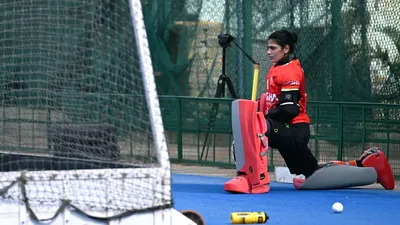
Indian women’s Hockey team heads into the FIH Women’s Hockey World Cup with renewed belief after a major Nations Cup triumph. Veteran goalkeeper Savita Punia has backed India to compete against the world’s strongest teams, pointing to the squad’s recent performances, improved fitness and growing mental confidence.
The Women’s Hockey World Cup is scheduled to take place from August 14 to 30 in Belgium and the Netherlands. India have been drawn in Pool D alongside China, England and South Africa, with their campaign beginning against China on August 16 in Amstelveen.
India’s best-ever World Cup finish remains fourth place in the 1974 edition. Their recent results have been less encouraging, with the team finishing eighth in 2018 and ninth in 2022. The latest Nations Cup success, however, has changed the mood around the squad and given the players a stronger belief heading into the tournament.
Why the Nations Cup win has changed India’s mindset
India’s Nations Cup victory was more than another trophy for the women’s hockey programme. It provided the team with evidence that their recent development can translate into success against strong international opposition.
India defeated hosts New Zealand 2-0 in the final of the FIH Hockey Women’s Nations Cup New Zealand 2025-26 in Auckland in June. The victory also continued India’s perfect record in the Nations Cup, with the team having won both editions of the competition.
For a squad preparing for a World Cup, that kind of success can be particularly valuable. Confidence in elite sport is often built through competitive experiences rather than simply through training sessions.
The Nations Cup gave India an opportunity to deal with pressure, manage knockout matches and finish a major tournament as champions. Those experiences can become important when the World Cup reaches its decisive stages.
Savita Punia believes India can compete with the best
Savita has highlighted India’s performances in the FIH Pro League as another reason for the team’s confidence.
India have played closely contested matches against major hockey nations such as Argentina, the Netherlands and Germany in recent years. Even when results have not always gone India’s way, those encounters have demonstrated that the gap between India and the world’s leading teams can be competitive.
That experience is now feeding into the team’s mindset.
For India, the significance is clear: a World Cup campaign requires the ability to handle different styles, maintain concentration for long periods and remain competitive when facing higher-ranked opponents.
The team’s recent exposure to elite opposition means they are not entering the World Cup without experience against the highest level of international hockey.
India’s Pool D challenge at the World Cup
India’s World Cup campaign begins in Pool D, where they will face China, England and South Africa.
| Team | India’s World Cup Pool | Key challenge |
|---|---|---|
| India | Pool D | Convert recent confidence into consistent tournament performances |
| China | Pool D | India’s opening opponent and an immediate test of preparation |
| England | Pool D | Experience and quality in a high-pressure group match |
| South Africa | Pool D | Physical intensity and the need to avoid complacency |
The group provides India with little room for complacency. The players have already emphasized that there are no easy matches at a World Cup, making consistency particularly important.
A strong opening can establish momentum, while mistakes early in the competition can create unnecessary pressure later in the group stage.
Why Savita Punia’s experience could be crucial
The upcoming tournament will be particularly meaningful for Savita, who is set to participate in her third World Cup.
For a senior goalkeeper, tournament experience can be invaluable. Goalkeepers operate in one of the most pressure-filled positions in hockey, where a single save can change the momentum of a match.
Savita has emphasized the importance of staying calm and leading by example. Her role is therefore not limited to stopping shots. She also has to communicate with defenders, organize the defensive structure and help the team remain composed when opponents create pressure.
Her experience from previous World Cups gives India an additional source of stability as the younger members of the squad face one of international hockey’s biggest stages.
Leadership under Salima Tete
Savita has also praised India captain Salima Tete, describing her as a phenomenal player and an aggressive midfielder.
Tete’s speed is one of her biggest strengths. Her ability to move quickly and apply pressure can be particularly important during defensive situations, including penalty-corner defence.
Leadership in modern hockey is not restricted to the captain delivering instructions. It also involves maintaining communication, managing emotions and ensuring that players remain connected during difficult phases.
According to Savita, Tete has developed a strong relationship with the senior players and seeks advice when required. That combination of youthful energy and senior guidance could help India maintain balance during the tournament.
Navneet Kaur adds another leadership layer
Vice-captain Navneet Kaur is another important figure in India’s leadership structure.
Having multiple experienced players around the captain can help distribute responsibility throughout a squad. This becomes especially useful during a long tournament when players must recover quickly between matches and adapt to different opponents.
The leadership group can also help younger players manage the psychological demands of World Cup hockey.
India’s objective will not simply be to produce one outstanding performance. The challenge is to maintain the same level of intensity throughout the competition.
Fitness and recovery have become bigger priorities
One of the most important developments highlighted by the team is the changing approach toward fitness and recovery.
Players are increasingly taking greater ownership of their preparation rather than relying entirely on instructions from coaching staff. Diet, injury prevention, recovery and additional training have become important parts of the team’s routine.
This shift reflects a broader development in elite sport. Modern international tournaments demand athletes who can perform repeatedly at a high level rather than peak for one individual match.
For goalkeepers, the preparation can be even more demanding. Additional sessions allow them to work specifically on positioning, reaction speed, penalty corners and match situations.
Why goalkeeper preparation could make the difference
Goalkeeping can become one of the decisive factors in a knockout tournament.
A team may dominate possession and create opportunities, but opponents can still remain in a match if their goalkeeper performs exceptionally. The reverse is also true: a goalkeeper who produces key saves can protect a narrow lead and change the psychological balance of a contest.
India’s preparation in this area therefore carries significant importance.
Additional goalkeeper sessions, combined with attention to recovery and injury prevention, can help ensure that India’s last line of defence is prepared for the intensity of World Cup hockey.
India’s biggest opportunity: turning belief into results
The Nations Cup victory has given India something that statistics alone cannot provide: belief.
However, confidence can only become valuable if it translates into execution.
The World Cup will test India’s ability to maintain defensive discipline, make the most of attacking opportunities and remain composed when matches become unpredictable.
Recent close games against leading teams provide encouragement, but a World Cup demands more than competitiveness. India will need to convert competitive performances into victories.
What India must do to reach the podium
- Start strongly: A positive opening match against China can establish momentum and reduce early pressure.
- Stay consistent: World Cup campaigns reward teams that avoid major drops in performance.
- Use leadership effectively: Savita, Salima Tete and Navneet Kaur can help maintain composure in difficult moments.
- Maximise penalty corners: Set-piece opportunities can become decisive in tightly contested matches.
- Maintain fitness: Recovery and injury prevention will be essential throughout the tournament.
India’s World Cup history shows the size of the challenge
India’s best result at the Women’s Hockey World Cup remains fourth place in 1974. The team finished eighth in 2018 and ninth in 2022, showing how difficult it has been to consistently reach the latter stages of the competition.
That history makes the current campaign particularly important.
India are not simply trying to improve on one previous result. They are attempting to establish themselves as a consistent contender in women’s international hockey.
The Nations Cup triumph offers an encouraging starting point, but the World Cup represents a significantly larger test.
The unique advantage of recent competitive exposure
One of India’s strongest assets could be the experience gained from playing against top opposition in recent years.
Regular encounters with teams such as Argentina, the Netherlands and Germany expose players to different tactical systems and playing styles.
That exposure can help reduce the surprise factor at a World Cup. Instead of entering matches intimidated by an opponent’s reputation, Indian players can draw on previous experiences of competing against elite teams.
This could become particularly valuable if India progress to the knockout stages and encounter familiar opponents.
What makes this World Cup different for Savita Punia
For Savita, the tournament represents both experience and responsibility.
Her third World Cup appearance means she can provide the team with knowledge of the unique pressures surrounding the competition. At the same time, she understands that senior players must help create an environment in which younger teammates can perform without being overwhelmed by the occasion.
Her approach of leading by example reflects that responsibility.
For a goalkeeper, staying calm is particularly important because defensive mistakes can immediately translate into goals. Savita’s experience could therefore become an important asset when India face high-pressure moments.
Can India finally make another deep World Cup run?
It would be premature to predict a specific finishing position, but the ingredients for a stronger campaign are clearly present.
India have won the Nations Cup, competed closely with leading international teams and developed a stronger focus on individual responsibility, fitness and recovery.
The next step is consistency.
If India can reproduce their best performances across the entire tournament, they have an opportunity to challenge teams that have traditionally occupied the upper levels of women’s hockey.
The key will be avoiding the difference between playing well and winning important matches. At World Cup level, small details can decide the outcome.
Conclusion: India enter the World Cup with renewed belief
The Indian women’s hockey team enters the FIH Women’s Hockey World Cup with a stronger sense of confidence after winning the Nations Cup and gaining valuable experience against some of the world’s leading sides.
Savita Punia’s confidence is rooted in those experiences. The veteran goalkeeper believes India have the skill, fitness and mindset to compete with any opponent on their day.
The tournament will provide the ultimate test of that belief. With China, England and South Africa waiting in Pool D, India must combine attacking ambition with defensive discipline and tournament-long consistency.
For Savita, her third World Cup is another opportunity to lead from the back and help a new generation of Indian hockey players handle the biggest stage.
The Nations Cup has already provided the confidence. The World Cup will determine whether India can turn that confidence into a historic run.
For breaking news and live news updates, like us on Facebook or follow us on Twitter and Instagram. Read more on Latest Hockey on thefoxdaily.com.






COMMENTS 0