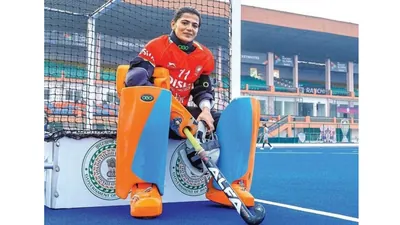
India goalkeeper Savita Punia became the country’s most-capped women’s hockey player with 321 internationals, but her focus remains firmly on team success and an Asian Games gold medal.
Savita Punia added another landmark to an already remarkable international career on Monday, becoming the most-capped Indian women’s hockey player during India’s emphatic 17-1 victory over indonesia at the 2026 Asian Games.
The experienced goalkeeper reached 321 international appearances, moving past former teammate and Indian hockey great Vandana Katariya’s previous record of 320 caps. The milestone came in a match where India produced another dominant attacking display after opening their Asian Games campaign with a 19-0 win over Uzbekistan.
Yet Savita’s reaction reflected the leadership qualities that have defined her career. Rather than treating the record purely as a personal achievement, the 36-year-old described it as an honour connected to the players and generations that helped shape Indian women’s hockey.
Savita Punia Overtakes Vandana Katariya
Savita’s record-breaking appearance in Kakamigahara, Japan, placed her at the top of India’s women’s international appearance list. Her 321st cap moved her beyond Katariya, whose 320 internationals had previously stood as the benchmark.
For Savita, surpassing Katariya carried particular significance because she considers the former forward one of the role models who helped define Indian women’s hockey.
Katariya’s career was known not only for her performances but also for her durability and determination. Savita highlighted the qualities that made her former teammate an example for younger players, making it clear that breaking the record was not about replacing a legend but acknowledging the legacy she left behind.
The achievement also underlines the remarkable longevity required to accumulate more than 300 international appearances. Savita made her India debut in 2009 and has remained a key presence through multiple generations of the national team.
Why 321 Caps Are Significant in Modern Hockey
Savita also placed her record in the wider context of international hockey. The modern international calendar provides players with significantly more opportunities to represent their countries than previous generations had.
She pointed to the example of former India men’s hockey captain Dilip Tirkey, whose more than 400 international appearances came during a period when official international matches were less frequent.
Today, competitions such as the FIH Pro League have increased the number of international fixtures available to leading players. Savita acknowledged that greater match exposure has helped modern players accumulate appearances at a faster rate.
That does not diminish the achievement. Staying fit, maintaining selection and performing consistently across many seasons are demanding challenges in themselves. Savita’s record combines longevity with the ability to remain trusted by successive India teams.
India’s Asian Games Campaign Starts With Statement Wins
Savita’s individual milestone arrived during another commanding team performance. India defeated Indonesia 17-1 after beginning the competition with an extraordinary 19-0 victory against Uzbekistan.
The two results have provided India with a strong attacking start, but the squad is not treating the early scorelines as evidence that the rest of the tournament will be straightforward.
India’s preparation has focused on improving one of the areas that became important during their recent World Cup campaign: converting attacking opportunities more efficiently.
The team arrived in Japan early to adapt to the conditions and went through an extended preparation period. After an initial recovery phase following the World Cup, the squad played around 12 to 13 practice matches as part of its build-up to the Asian Games.
From World Cup Progress to Asian Games Ambition
India entered the Asian Games after recording a fifth-place finish at the World Cup, their best result at the tournament since finishing fourth in the inaugural edition in 1974.
The result represented progress, but Savita stressed that the team does not want to become satisfied with a respectable tournament finish. The message within the squad is to move forward rather than spend too much time looking back.
That mindset is particularly important because the Asian Games carry an additional significance. Winning the women’s hockey competition would provide India with a route to qualification for the 2028 Los Angeles Olympics.
As a result, every match in Japan has consequences beyond the immediate scoreline. India’s objective is not simply to continue producing big victories but to build the consistency required to navigate the knockout stages successfully.
India Working on Circle Entries and Finishing
One of the major areas of emphasis in India’s preparation has been the conversion of circle entries. Creating opportunities inside the opposition’s defensive area is only part of the challenge; turning those opportunities into goals can determine close matches against stronger opponents.
India’s defensive organisation had already provided encouragement during the World Cup, particularly against high-quality opposition. The focus in Japan has therefore included making the attacking unit more clinical.
The team can take confidence from its World Cup victory over Germany, when India produced a strong attacking performance in a 3-1 win. The early Asian Games results have offered another opportunity to develop that attacking rhythm.
The 19-0 victory against Uzbekistan and 17-1 win over Indonesia show that India have been able to create and finish chances against their opening opponents. The real test, however, will come when the opposition is capable of applying greater pressure and restricting India’s time inside the circle.
Savita Rejects the Idea That India Depend on Two Stars
India’s current squad has also faced questions about whether it possesses individual game-changers comparable to past stars such as Rani Rampal and Vandana Katariya.
Former India chief coach Neil Hawgood recently suggested that the present team may lack players capable of changing games individually in the same way those established names once did.
Savita disagrees with that assessment. Her response highlights a different philosophy within the current Indian setup: instead of depending heavily on one or two match-winners, the team believes it can draw attacking contributions from several players.
She pointed towards players such as Deepika Sehrawat and Navneet Kaur, while also highlighting younger members of the squad including Ishika, Sakshi Rana, Lalremsiami and Neha Goyal.
This approach could be important in a tournament environment. If goals and creative moments are shared across several players, opponents have more threats to manage and India are less dependent on one individual producing a decisive performance.
Deepika and Navneet Lead a Versatile Attacking Group
India’s recent results have already demonstrated the depth available in their forward and attacking units. Deepika Sehrawat and Navneet have been among the players capable of making a significant impact, while younger members have also been given opportunities to contribute.
The 17-1 Indonesia victory underlined that depth. India repeatedly entered the attacking circle and maintained pressure for long periods, allowing several players to find the scoring touch.
For a tournament that could eventually come down to a single knockout match, having multiple routes to goal can become especially valuable.
At the same time, big wins can create a misleading sense of security. The coaching staff and players will need to ensure that the attacking confidence developed against lower-ranked opponents translates into matches where chances are harder to create.
Savita Warns India Against Looking Too Far Ahead
Despite India’s impressive start, Savita is refusing to look beyond the next match. The goalkeeper does not want the team distracted by predictions about a potential final against China or by expectations created by the opening victories.
Her approach is based on focusing on the immediate 15-minute period rather than thinking about the eventual outcome of the tournament.
This philosophy is understandable given India’s experience at the previous Asian Games. The team reached the knockout stage but ultimately finished with bronze after missing out on a place in the final.
The lesson is clear: early success does not guarantee a medal of any particular colour. Tournament brackets, individual performances and one difficult match can alter the entire competition.
India will therefore need to maintain concentration against every opponent, even after producing huge victories in the opening games.
Thailand, Japan and Singapore Await India
India’s Pool B schedule continues with Thailand on September 23, followed by hosts Japan on September 25 and Singapore on September 27.
The group format makes the final stages particularly important, with the top two teams advancing to the semi-finals.
| Date | Opponent | Stage |
|---|---|---|
| September 23 | Thailand | Pool B |
| September 25 | Japan | Pool B |
| September 27 | Singapore | Pool B |
The match against Japan could provide a particularly useful test of India’s ability to handle a more competitive opponent. Savita has already pointed to Japan’s ability to make matches difficult and force opponents to work for every goal.
South Korea, another team India have prepared for, can also pose a different tactical challenge with aerial balls and flicks. That preparation reflects the squad’s effort to avoid becoming too dependent on one style of play.
Padma Shri Recognition Adds to Savita’s Remarkable Year
Savita’s record-breaking appearance comes during a particularly memorable year for the veteran goalkeeper. She was also honoured with the Padma Shri, one of India’s major civilian honours.
The recognition reflects her contribution to Indian sport over a long international career. However, her continued selection and involvement with the national team show that she remains focused on what lies ahead rather than simply celebrating past achievements.
Her career has now stretched across multiple generations of Indian women’s hockey players. She has witnessed changes in training, international schedules, tournament structures and the overall depth of the national setup.
That experience gives her a valuable role beyond goalkeeping. As one of the senior figures in the squad, she can help younger players handle the pressure surrounding major tournaments.
The Bigger Target: Los Angeles 2028
For India, the Asian Games are connected to a larger Olympic objective. A gold medal would secure qualification for the 2028 Los Angeles Olympics, giving the tournament additional importance for the entire squad.
That target explains why Savita is emphasising discipline and match-by-match concentration rather than discussing the final before India have completed their group-stage campaign.
India’s recent performances provide plenty of encouragement. The World Cup fifth-place finish showed progress against strong international opposition, while the opening Asian Games victories demonstrated attacking confidence.
The next challenge is to combine those two elements: the defensive discipline that has served India against elite teams and the attacking efficiency displayed against their early Asian Games opponents.
Savita Punia’s Legacy Continues
Reaching 321 international appearances is a historic achievement, but Savita Punia’s story is not necessarily finished. The goalkeeper has already spent more than a decade and a half representing India, and she remains part of a squad with major ambitions.
Her record-breaking appearance also carries a symbolic message for Indian women’s hockey. Records that once appeared distant can eventually be challenged when players are able to maintain high standards over many seasons.
Passing Vandana Katariya does not erase the legacy of the former record-holder. Instead, it creates another chapter in the history of a team that has benefited from several generations of outstanding players.
Savita’s own response to the milestone captures that continuity. She has credited the players who came before her while also placing faith in the younger generation now attempting to take India forward.
Final Verdict
Savita Punia’s 321st international appearance is a landmark moment for Indian women’s hockey, making her the country’s most-capped women’s player after surpassing Vandana Katariya’s 320 appearances. But the veteran goalkeeper has made it clear that the record is only part of the bigger picture.
India’s immediate objective is to maintain their strong Asian Games start, improve their attacking conversion and handle increasingly difficult opponents without losing their discipline. With Thailand, Japan and Singapore still to come in the pool stage, the team has little reason to look beyond the next challenge.
The ultimate prize is bigger than another tournament victory. India are targeting Asian Games gold and the Olympic qualification that comes with it, while Savita Punia continues to lead from the back with a record that now stands as one of the defining milestones in Indian women’s hockey.
For breaking news and live news updates, like us on Facebook or follow us on Twitter and Instagram. Read more on Latest Hockey on thefoxdaily.com.




COMMENTS 0