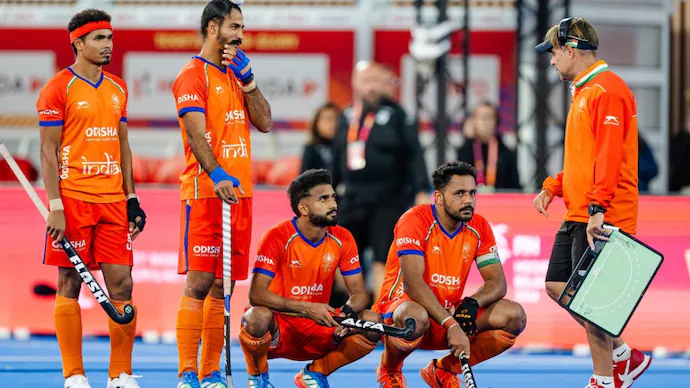
India men’s hockey team chief coach Craig Fulton has hinted at a major squad overhaul as the country begins its preparations for the 2028 Los Angeles Olympics. The transition towards the next Olympic cycle will include a fresh group of players for the home leg of the FIH Pro League in February, followed by the selection of a new core group after India’s upcoming tour of New Zealand.
The changes are part of India’s effort to build a competitive squad for Los Angeles while addressing areas that need improvement following an inconsistent year. Although the team retained its Asian Games title and secured direct qualification for the 2028 Olympics, its disappointing eighth-place finish at the World Cup highlighted shortcomings against stronger international opposition.
Fulton has made it clear that the coaching staff want to use the upcoming international assignments to assess players, introduce fresh options and establish the foundation for the 2027-28 cycle. The process will begin with India’s three-match series in New Zealand before the team moves towards the Pro League campaign.
India to select a fresh squad for February Pro League
India are scheduled to host the home leg of the FIH Pro League in February, where they will face Germany, Argentina, Great Britain and Spain. The competition will provide an important opportunity for the coaching staff to evaluate a different group of players against some of the leading teams in international hockey.
Fulton confirmed that India would select a new squad for the tournament rather than simply continue with the existing group. The decision reflects the coaching staff’s intention to begin the next Olympic cycle with a refreshed team and a longer-term development plan.
Speaking to PTI, the South African coach explained that the available preparation time would be limited because players would return to their respective franchises. Despite the scheduling challenge, the team management intends to select a new group and use the Pro League as the starting point for the next phase.
Fulton said:
“We will select a new squad for the Pro League in January (February). There is very little time to train because the players will go back to their respective franchises. We will name a new squad, which will play in the Pro League, and then start the 2027-28 cycle with that squad.”
The February competition could therefore become an important early test for players hoping to establish themselves in India’s plans for the Los Angeles Olympics. Facing Germany, Argentina, Great Britain and Spain will also give the coaching staff an opportunity to examine how the new group performs against high-quality opposition.
New Zealand tour will shape India’s next core group
Before the Pro League, India will travel to New Zealand for a three-match international Test series. The matches are scheduled to take place in Auckland on November 19, 21 and 22 as part of New Zealand hockey’s centenary celebrations.
The series marks 100 years since India’s first hockey tour to New Zealand in 1926. It will provide another international opportunity for the Indian team while allowing the coaching staff to assess available players before making decisions about the next squad.
Fulton confirmed that India’s squad for the New Zealand tour had not yet been finalised. The team announcement was expected in the coming days, with the coaching staff continuing to evaluate their options before confirming the travelling group.
The South African coach also indicated that the New Zealand assignment would play an important role in determining the composition of India’s new core group. Rather than making every decision immediately, the team management intends to review performances and available options after completing the tour.
Fulton said:
“That is what we are going to assess after New Zealand. After that tour, we will select a new core group and a new squad.”
The approach suggests that the transition will take place in stages. The New Zealand series will provide an initial assessment, while the February Pro League will offer a platform for a fresh squad to begin the next Olympic cycle.
India have already made significant changes in recent years
India’s squad transition is not entirely new. Fulton pointed out that the team has already undergone several changes over the past few years, with different groups representing the country at successive editions of the Asian Champions Trophy.
He highlighted the difference between India’s squad at the 2023 Asian Champions Trophy in Chennai and the group that competed in the 2024 edition in Hulunbuir. According to the coach, nine players have been changed since the earlier squad, illustrating the extent of the turnover already taking place within the national setup.
The latest planned overhaul is expected to continue that process as India look to identify players who can contribute throughout the next Olympic cycle. Squad selection will be important not only for immediate results but also for developing combinations, improving competition for places and creating greater depth across the team.
However, a new squad does not automatically guarantee better performances. The coaching staff will need to ensure that incoming players adapt quickly to the international level while maintaining the team’s tactical structure and understanding. The upcoming assignments against different styles of opposition will help determine how effectively the group can develop.
World Cup disappointment highlights areas India must improve
India’s recent results have presented a mixed picture. Harmanpreet Singh’s side endured a difficult World Cup campaign, finishing eighth, but responded by retaining the Asian Games title and securing direct qualification for the 2028 Los Angeles Olympics.
The contrasting results have given the coaching staff both encouragement and areas of concern. India’s performances against Asian opposition have generally demonstrated their ability to create scoring opportunities and defend effectively. However, their results against European teams and other higher-ranked opponents have shown that further improvement is required.
Fulton believes the team must become more effective in high-pressure matches, particularly when facing opponents capable of punishing defensive errors and limiting attacking opportunities. The World Cup campaign exposed problems at both ends of the pitch, with India struggling to convert important chances while also conceding goals that could have been avoided.
Explaining the issues, Fulton said:
“We didn’t score goals when we needed to in the big games (at the World Cup), and we conceded some soft goals. So, both our defence and attack need to improve.”
The comments underline the importance of improving India’s overall performance rather than concentrating exclusively on one department. Better finishing will be necessary to convert attacking pressure into goals, while greater defensive discipline will be required to prevent opponents from taking advantage of mistakes.
European opposition remains a major test for India
One of the main challenges identified by Fulton is India’s need to improve against European opposition and other higher-ranked teams. While the national side has shown strong capabilities against Asian opponents, reproducing that level of performance against leading international teams remains an important objective.
The February Pro League home leg will provide a particularly useful opportunity to work on this weakness. Germany and Great Britain are among the European opponents India will face, while Argentina will offer another demanding test against a leading international side. These fixtures should help the coaching staff assess how effectively the refreshed squad handles different tactical approaches and levels of pressure.
Fulton explained that India’s attacking and defensive performances against stronger opponents must become more consistent.
“Against Asian opposition, our ability to score goals and defend is good. But against European opposition and higher-ranked teams, we have to keep improving.”
The distinction is important for India’s Olympic ambitions. Competing successfully at the Los Angeles Games will require the team to perform against the strongest nations in the sport. Improving against higher-ranked opposition during the coming seasons will therefore be a central part of the preparation process.
The coaching staff will also have to use the Pro League to evaluate whether new players can deliver under pressure. Performing well against familiar opponents is one challenge, but maintaining composure and executing tactical plans against elite teams is another.
Fulton focuses on mindset rather than blaming individual players
Despite identifying clear problems in India’s performances, Fulton has stressed that the solution is not about blaming particular players. He believes the team must improve its collective approach, especially its mindset and mentality during important matches.
International hockey involves mistakes as well as successful moments, and the coach acknowledged that every player can make errors during a game. Instead of singling out individuals, the coaching staff want to improve the team’s overall decision-making, confidence and ability to respond when matches become difficult.
Fulton said:
“We are looking at both attack and defence. But it is not about identifying a particular player at this stage. It is about mindset and mentality in the big games. All players make mistakes, and all players make good plays.”
His comments indicate that the planned squad overhaul will be accompanied by a broader effort to improve the team’s mentality. Introducing new players may create competition and provide fresh options, but the coaching staff will also need to develop a stronger collective response in decisive moments.
Los Angeles 2028 preparation enters a new phase
India’s direct qualification for the 2028 Olympics gives the team an opportunity to focus on long-term preparation rather than relying on a last-minute qualification campaign. The coming months will be important for identifying the players who can form the foundation of the next Olympic squad.
The immediate schedule includes the New Zealand tour in November, followed by the February Pro League home leg against Germany, Argentina, Great Britain and Spain. Between these assignments, the coaching staff will assess performances and decide which players should be included in the new core group.
Fulton’s comments suggest that the next squad may look significantly different as India attempt to build a team capable of competing consistently against the world’s leading hockey nations. The emphasis will be on improving both attack and defence, developing a stronger mentality in major matches and creating a group that can sustain its performances throughout the Olympic cycle.
For Indian Hockey, the challenge is now to turn recent success at the Asian level into consistent performances against the strongest international teams. The upcoming New Zealand series and February Pro League campaign will be early opportunities to test the new direction under Fulton as preparations for Los Angeles 2028 gather momentum.
For breaking news and live news updates, like us on Facebook or follow us on Twitter and Instagram. Read more on Latest Hockey on thefoxdaily.com.






COMMENTS 0