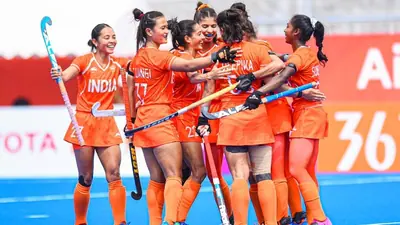
India continued their dominant Asian Games hockey campaign with another huge Pool B victory, beating Indonesia 17-1 as Savita Punia became the country’s most-capped women’s hockey player.
India’s women’s hockey team continued their impressive start to the 2026 Asian Games with a commanding 17-1 victory over Indonesia in their second Pool B match at the Gifu Prefectural Green Stadium in Kakamigahara.
After opening their campaign with a 19-0 win against Uzbekistan, the Salima Tete-led side produced another emphatic attacking display. The result also saw India surpass their previous Asian Games victory over Indonesia, an 8-0 win at the 2018 Jakarta Games.
The match was significant beyond the scoreline. India goalkeeper Savita Punia reached a major personal milestone by earning her 321st international appearance, moving past Vandana Katariya to become the most-capped Indian women’s hockey player.
Savita Punia Becomes India’s Most-Capped Women’s Hockey Player
Monday’s match provided a landmark moment for Savita Punia as she moved to the top of India’s women’s international appearance list.
With her 321st international match, Savita surpassed former India star Vandana Katariya to become the country’s most-capped women’s hockey player.
The achievement came during a match in which India’s outfield players dominated possession and repeatedly put Indonesia under pressure. While the goalkeeper did not face the same level of sustained pressure as she might in a closely contested fixture, the milestone added a historic dimension to India’s huge victory.
Savita has been an important figure in Indian women’s hockey for years, and reaching 321 internationals underlines her longevity at the highest level of the sport.
Her record was achieved on a day when India continued their pursuit of success at the Asian Games, making the occasion even more memorable.
India Start Another Goal Fest Against Indonesia
India entered the match after scoring 19 goals against Uzbekistan in their opening Pool B fixture. The attacking intent remained unchanged against Indonesia.
Indonesia goalkeeper Selly Florentina initially provided some resistance. In the fifth minute, she made an important save to deny Navneet Kaur from a rushed penalty stroke.
That moment briefly suggested that Indonesia might be able to withstand India’s early pressure. However, India’s repeated entries into the attacking circle eventually created too many opportunities for the Indonesian defence to handle.
Deepika Sehrawat opened the scoring in the eighth minute after India generated pressure through penalty corners.
Once the first goal arrived, India’s attacking momentum increased rapidly. The team continued to crowd the 23-metre area, create circle entries and move the ball quickly between players.
The structured approach allowed India to maintain pressure without losing their defensive organisation.
Deepika Sehrawat Leads India’s Scoring Parade
Deepika Sehrawat was one of India’s most influential attackers, completing a hat-trick during the match.
Her goals came in the eighth, 28th and 40th minutes, giving her a major contribution to India’s enormous total.
Deepika’s first goal established India’s early advantage, while her later strikes helped maintain the pressure as Indonesia struggled to contain India’s movement around the circle.
Her performance also highlighted India’s strength from penalty-corner situations. The team used repeated attacking opportunities to test Indonesia’s defensive structure and create chances for their specialist drag-flicker.
For India, the ability to turn penalty corners and sustained possession into goals remains an important component of their attacking game.
Rutuja Pisal Dadaso and Navneet Also Score Hat-Tricks
India’s scoring was not dependent on one player. Rutuja Pisal Dadaso and Navneet Kaur also completed hat-tricks as the Indian attack continued to find openings.
Rutuja scored in the 15th, 20th and 38th minutes, while Navneet found the net in the 35th, 56th and 57th minutes.
The spread of goals across different stages of the match demonstrated India’s ability to sustain attacking pressure for long periods rather than relying only on a strong opening quarter.
Rutuja’s early goals helped India establish a commanding advantage, while Navneet’s late strikes added to the margin during the final quarter.
Having multiple players capable of scoring in different phases gives India greater flexibility as the tournament progresses and opposition teams attempt to adjust to their attacking patterns.
Sunelita Toppo and Lalremsiami Add More Pressure
Sunelita Toppo and Lalremsiami also made significant contributions to the scoreboard.
Sunelita scored in the 11th and 30th minutes, while Lalremsiami struck twice in the 12th and 16th minutes.
The quick succession of goals during the opening half made it increasingly difficult for Indonesia to remain compact. India’s passing and movement repeatedly opened spaces around the attacking circle.
India’s ability to rotate players and maintain intensity meant Indonesia were forced to defend for extended periods, limiting their opportunities to launch counterattacks.
Indonesia Score Once but India Quickly Respond
Indonesia did manage to produce one memorable moment in the 32nd minute when Innes Aditiya converted a penalty corner.
The goal gave Indonesia a brief reward for their efforts and interrupted India’s long spell of dominance.
However, India’s response was immediate. Captain Salima Tete scored in the 34th minute, followed by goals from Navneet and Ishika Chaudhary.
The sequence restored India’s attacking momentum and demonstrated how quickly the Indian team could recover after conceding.
For Indonesia, the penalty-corner goal provided a positive moment in an otherwise difficult contest against one of the tournament’s strongest teams.
India Maintain Structure Despite Green Cards
India also had to manage periods when they were temporarily reduced in numbers.
Ishika Chaudhary received a green card in the 35th minute, while Rutuja Pisal Dadaso was shown another green card in the 43rd minute.
Despite those interruptions, India’s overall structure remained intact. Players were able to fall back collectively whenever Indonesia attempted to move forward, preventing the opposition from turning India’s temporary numerical disadvantage into sustained pressure.
This aspect of the performance was important because India’s dominance was not simply based on attacking numbers. The team also maintained enough defensive discipline to protect their advantage.
For the coaching staff, such moments provide useful match experience that cannot always be replicated during training sessions.
India’s Fitness and Intensity Stand Out
The physical difference between the two teams was evident throughout the contest. India were able to maintain high intensity while repeatedly returning to attacking positions.
The team’s conditioning work under sports scientist Wayne Lombard has been an important part of their preparation, and the match provided another opportunity to apply that physical preparation in a competitive setting.
India’s movement without the ball, repeated circle entries and ability to recover defensively allowed them to maintain pressure throughout the match.
That combination of fitness and tactical discipline becomes particularly valuable during a multi-match tournament, where teams have limited recovery time between fixtures.
Penalty Corners Provide Valuable Match Practice
The match also offered India useful competitive practice in penalty-corner situations.
India repeatedly earned opportunities inside the attacking 23-metre area, allowing their injectors, stoppers and drag-flickers to execute set-piece routines under match conditions.
Such situations are especially important in major tournaments because closely fought knockout matches can often be decided by a small number of penalty corners.
Although Indonesia were unable to provide the same level of defensive challenge as some of India’s potential later opponents, the match still gave the Indian coaching staff opportunities to test different combinations and attacking variations.
Maintaining sharpness in these situations could become increasingly important as India face stronger opponents later in the Asian Games.
Salima Tete Continues to Lead India
Captain Salima Tete also contributed to the scoreline, finding the net in the third quarter.
Her leadership has been central to India’s campaign, with the team combining attacking ambition with a structured approach.
The Indian captain’s goal was part of a third-quarter sequence in which India quickly responded to Indonesia’s only goal and restored their control of the contest.
With two consecutive large victories at the beginning of the Asian Games, India have established considerable momentum heading into their remaining Pool B fixtures.
India’s Full Goal List Against Indonesia
India’s 17 goals were shared among several players, underlining the depth of their attacking options.
| Player | Goals | Minutes |
|---|---|---|
| Deepika Sehrawat | 3 | 8, 28, 40 |
| Rutuja Pisal Dadaso | 3 | 15, 20, 38 |
| Navneet Kaur | 3 | 35, 56, 57 |
| Sunelita Toppo | 2 | 11, 30 |
| Lalremsiami | 2 | 12, 16 |
| Sakshi Rana | 2 | 25, 57 |
| Salima Tete | 1 | 34 |
| Ishika Chaudhary | 1 | 36 |
Indonesia’s only goal came from Innes Aditiya, who converted a penalty corner in the 32nd minute.
India Surpass Their 2018 Result Against Indonesia
The 17-1 victory was also significantly larger than India’s previous Asian Games meeting with Indonesia.
When the teams last met at the 2018 Jakarta Games, India won 8-0. Eight years later, the Indian team more than doubled that winning margin while continuing their strong attacking form.
The comparison also reflects the scale of India’s current performance at the tournament. After scoring 19 goals against Uzbekistan, India have now produced 36 goals across their opening two Pool B matches.
At the same time, the results need to be viewed in the context of the opposition faced so far. Stronger tests are likely to come later in the competition, where India’s ability to create chances against more organised defences will face a greater challenge.
Thailand Next for India in Pool B
India will now turn their attention to their third group fixture against Thailand on Wednesday.
The immediate objective will be to continue building momentum while using the group-stage matches to refine combinations and maintain match sharpness.
With the tournament progressing, India’s coaching staff can use these games to evaluate penalty-corner routines, passing patterns, defensive transitions and player combinations before the higher-pressure stages arrive.
The two opening victories have given India a strong start, but the team will know that the competition becomes increasingly demanding as the Asian Games move towards the knockout rounds.
Final Verdict
India’s 17-1 victory over Indonesia was another emphatic attacking performance from the Salima Tete-led side, following their 19-0 win over Uzbekistan in the opening Pool B fixture.
Deepika Sehrawat, Rutuja Pisal Dadaso and Navneet Kaur each scored hat-tricks, while several other players contributed to a 17-goal total. Indonesia briefly found a response through Innes Aditiya’s penalty corner, but India quickly regained control.
The match was also a historic occasion for Savita Punia, who earned her 321st international appearance and became India’s most-capped women’s hockey player.
India now face Thailand in their next Pool B fixture, with the focus shifting towards maintaining their momentum while continuing to sharpen the tactical and set-piece elements of their game ahead of the more demanding stages of the Asian Games.
For breaking news and live news updates, like us on Facebook or follow us on Twitter and Instagram. Read more on Latest Sports on thefoxdaily.com.




COMMENTS 0