PM Modi’s Olympic sports push has placed a broader question at the centre of India’s sporting ambitions: can the country significantly increase its medal tally by competing in more disciplines?
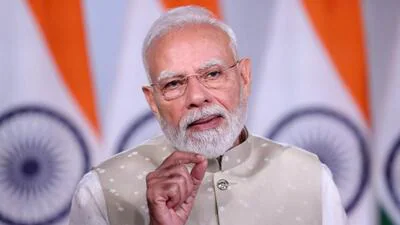
Speaking virtually at the Khelo India Samvaad on Thursday during the National Sports Day 2026 celebrations, Prime Minister Narendra Modi said India needs to expand its sporting base instead of concentrating primarily on a limited number of Olympic events.
Modi addressed young people and athletes connected from more than 5,000 institutes across the country. His message focused not only on winning medals but also on identifying talent, creating sporting ecosystems at the district level and preparing a new generation for the 2036 Olympics.
The central idea is straightforward: if Indian athletes do not participate in a large number of Olympic disciplines, the country automatically has fewer opportunities to compete for medals.
Why India Needs a Wider Olympic Sporting Base
India has produced Olympic success in sports such as shooting, athletics, badminton, wrestling, boxing and hockey. However, Modi argued that the country needs to look beyond the disciplines in which it already has an established presence.
His argument is based on opportunity. Olympic medal tables are built across a huge range of sports and events, meaning a country’s medal prospects depend not only on excellence in existing disciplines but also on how broadly it develops sporting talent.
Modi pointed to the fact that several nations win medals in sports where India has traditionally had little or no participation.
This creates a potential growth area for Indian sport. Rather than viewing the Olympic programme as a fixed list of sports dominated by established countries, India can identify disciplines where its geography, population and young talent provide a natural starting point.
Modi Highlights Surfing and Sport Climbing
Two sports specifically highlighted by Modi were surfing and sport climbing.
His reasoning was connected to India’s geography. The country has a coastline stretching across multiple states and union territories, while its northern and northeastern regions contain extensive mountainous terrain.
That combination could provide opportunities for developing athletes in water and climbing sports if appropriate training systems are established.
Modi also mentioned winter sports and watersports as areas where India could potentially develop a stronger presence.
The important point is that geography alone does not produce Olympic athletes. Access to facilities, trained coaches, competitions, equipment, sports science and long-term financial support is required to convert geographical advantages into international performance.
From Geography to District-Level Sporting Ecosystems
One of the more significant parts of Modi’s message was his emphasis on districts.
Instead of expecting every promising athlete to move immediately to a major sporting centre, the approach would involve identifying sports that can be developed within particular regions.
A coastal district, for example, could potentially become a centre for aquatic or surfing-related talent, while mountainous areas could focus on climbing or winter sports.
This approach could make India’s sports development more decentralised.
It also addresses one of the biggest challenges in identifying young athletes: talent can exist far beyond traditional sporting hubs, but without local infrastructure, it may never be discovered or developed.
The 2036 Olympics Are Central to the Long-Term Vision
Modi connected the expansion of Indian Sports participation directly with preparations for the 2036 Olympics.
He said the objective should be to prepare athletes who can qualify and compete across different sports when that edition of the Games arrives.
This is important because Olympic success cannot be built in a single four-year cycle. Athletes need years of technical training, competition experience and physical development before reaching the international level.
That makes early identification particularly important.
Talent Hunt for Children Aged 5 to 15
Modi also referred to a proposed talent-hunt programme focused on children between the ages of five and 15.
The objective is to introduce young people to different sports rather than allowing sporting choices to be restricted by limited exposure.
This could be particularly useful for disciplines that are not traditionally popular in Indian schools or communities.
A child who has never seen or tried a particular sport is unlikely to identify it as a potential career. Early exposure can therefore expand the pool from which future athletes emerge.
However, talent identification at a young age needs to be handled carefully. Children should have opportunities to explore different sports without excessive pressure to specialise or win immediately.
Why Early Exposure Could Change India’s Sporting Pipeline
India has a huge youth population, but population size alone does not guarantee Olympic success.
The real challenge is converting participation into a structured pathway.
A successful system would need several stages: introduction to sport, basic coaching, identification of promising athletes, competitive opportunities, specialist training and eventually international exposure.
That means a district-level talent programme would need to connect with schools, academies, state associations and national sporting bodies.
| Development Stage | Key Requirement |
|---|---|
| Early exposure | Introduce children to a wide range of sports |
| Talent identification | Recognise physical and technical potential |
| Grassroots training | Provide qualified local coaching |
| Competitive development | Create regular district and state-level events |
| Elite pathway | Provide specialist coaching, sports science and international exposure |
The stronger the connections between these stages, the greater the chance of turning participation into elite performance.
India Cannot Chase Medals Without Building Infrastructure
Modi’s call to participate in more sports raises an important practical question: what happens after India enters a new Olympic discipline?
Simply sending athletes to compete is not enough.
Sports such as surfing, climbing and winter disciplines require specialised facilities, equipment and coaching. Some also require athletes to train in particular natural environments.
India would therefore need to identify locations where sustainable training ecosystems can be created.
This could include district-level facilities, partnerships with established academies, specialist coaching programmes and competitions that allow athletes to gain experience before reaching the international stage.
The Biggest Opportunity May Be Outside Traditional Sports Hubs
A major strength of a district-based approach would be its ability to uncover athletes outside India’s traditional sporting centres.
Many elite athletes have emerged from smaller towns and rural areas, often after overcoming significant barriers to access. A wider national system could make that pathway more systematic rather than dependent on individual circumstances.
For example, coastal regions could potentially become centres for water sports, while hill regions could develop climbing and winter-sport programmes.
The long-term objective would be to create clusters of expertise rather than attempting to build every sport everywhere.
Sports Development Is About More Than the Medal Table
Modi also stressed that sport should not be viewed only through medal counts.
He described sport as part of nation-building and linked sporting participation with youth development and the broader vision of a developed India.
“Those who play will blossom.”
This broader approach matters because a strong sporting culture can produce benefits even when an athlete does not reach the Olympics.
Regular participation can encourage discipline, teamwork, fitness and confidence among young people. A larger sporting ecosystem can also create opportunities for coaches, officials, trainers, physiotherapists and other professionals.
How India’s Olympic Strategy Could Become More Competitive
India’s future Olympic strategy could benefit from shifting the emphasis from isolated medal-winning performances to a broader pipeline of athletes.
A country that has only a handful of realistic medal contenders in each Games has a much smaller margin for error. Injuries, poor form or a difficult draw can quickly reduce its medal prospects.
A deeper pool across multiple disciplines provides greater resilience.
This is where the Prime Minister’s focus on participation becomes strategically important. More athletes competing across more sports creates more opportunities for breakthrough performances.
The Challenge of Turning Ambition Into Results
The most difficult part will be implementation.
Expanding participation requires sustained investment rather than short-term campaigns. Coaches need to be trained, facilities maintained and athletes supported over many years.
There is also a need for regular domestic competition. An athlete cannot develop to Olympic standard by training alone. Competition provides the pressure and experience required to understand where an athlete stands.
Sports science will also become increasingly important as India attempts to compete with countries that have sophisticated systems for performance analysis, nutrition, recovery and injury prevention.
Therefore, the expansion of Olympic participation should ideally happen alongside improvements in the quality of athlete development.
What the 2036 Target Means for Young Athletes
The proposed 5-to-15 talent identification focus could have its greatest impact on athletes who are currently too young to be considered immediate Olympic contenders.
For those children, the 2036 Games are far enough away to allow long-term development.
Instead of rushing young athletes towards elite competition, the system can focus on building fundamental skills and allowing children to discover the sports in which they are most comfortable.
The strongest programmes will need to balance ambition with education and healthy development. Young athletes should have room to grow without being defined entirely by early results.
India’s Geographic Diversity Could Become a Sporting Asset
India’s geographic diversity gives the country a potentially unusual advantage.
The coastline offers opportunities for aquatic sports, while the Himalayan and other mountainous regions create possibilities for climbing and winter disciplines.
At the same time, India’s cities provide large populations, existing sporting infrastructure and access to specialist services.
The challenge is connecting these advantages into a national system.
If successful, India could move from a model where sporting excellence is concentrated in a small number of disciplines and locations to one where different regions specialise in different sports.
Conclusion: A Bigger Sporting Footprint Could Mean a Bigger Olympic Future
PM Modi’s call for India to compete in more Olympic sports reflects a long-term attempt to expand the country’s sporting ambitions beyond its traditional strengths.
The focus on surfing, sport climbing, watersports and winter sports highlights the possibility of using India’s geography to identify new areas of excellence. The proposed talent hunt for children aged five to 15 could also broaden the country’s future athlete pool by giving youngsters exposure to sports they may otherwise never encounter.
But participation must be followed by development. New Olympic entries will only translate into medals if athletes receive sustained coaching, facilities, competition, sports science and financial support.
The 2036 Olympics therefore provide a useful long-term deadline, but the foundation has to be built much earlier.
If India can successfully connect grassroots participation with elite development, its Olympic ambitions could become broader and more sustainable. The biggest opportunity may not simply be winning more medals in familiar sports, but discovering champions in sports where India has barely begun its journey.
For breaking news and live news updates, like us on Facebook or follow us on Twitter and Instagram. Read more on Latest Sports on thefoxdaily.com.






COMMENTS 0