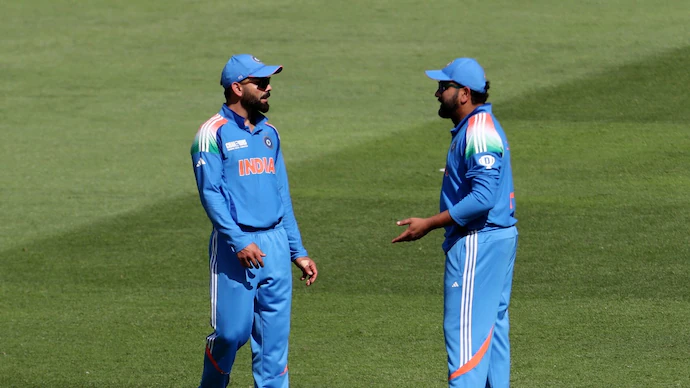
Virat Kohli and Rohit Sharma’s experience is giving India an advantage as the team adjusts to New Zealand’s short-boundary fielding challenge on the ongoing tour. India’s fielding coach Subhadeep Ghosh believes the two senior players stand out because of their ability to anticipate the ball, a skill developed through years of fielding in familiar positions.
New Zealand’s compact grounds leave fielders with limited time to react, making anticipation, positioning and stability particularly important. Kohli and Rohit have demonstrated those qualities during the tour, with their contributions in the opening ODI in Auckland highlighting the value of experience in difficult fielding conditions.
India produced a sharp fielding display in the first match. Kohli took an impressive catch, while Rohit Sharma made a quick pick-up and throw to run out Daryl Mitchell. India went on to win the match by five wickets, taking a 1-0 lead in the five-match series.
Speaking ahead of the second ODI, Ghosh explained how Kohli’s familiarity with positions such as cover and point helps him read the ball earlier than other players. He also pointed to Rohit’s awareness during the run-out, saying that experience, natural ability and repetition contribute to their fielding skills.
Experience Gives Kohli and Rohit an Edge
According to Ghosh, anticipation is one of the most important qualities in fielding. Players who understand the movement and trajectory of the ball can prepare their bodies and make decisions before the ball reaches them. Kohli’s years of fielding in the covers and at point have helped him develop that instinct.
“In fielding, one thing that is important is anticipation. Virat has fielded in covers, and point for lakhs of time. He knows the trajectory of the ball, the path of the ball, impact of the ball. He reads the situation earlier than other guys,” Ghosh said.
That familiarity allows Kohli to judge where the ball is likely to travel and respond quickly. Rather than relying only on reaction speed, he can use his understanding of the position and the batter’s shot to prepare for the next movement.
Ghosh also referred to Rohit’s run-out of Mitchell in Auckland as an example of anticipation. The Indian captain’s quick pick-up and accurate throw demonstrated how awareness can create a dismissal when the opportunity appears briefly.
“Same for the Rohit run out, he was anticipating the ball. Experience as well as natural talent (goes into making a great fielder) and doing the same thing again and again,” he added.
Ghosh’s explanation highlights the role of repetition in developing reliable fielding habits. Kohli and Rohit have spent years performing similar duties, allowing them to recognise situations and react with greater awareness. Their experience complements their natural ability and helps them remain effective when the time available to make a decision is limited.
New Zealand’s Short Boundaries Create a Different Challenge
New Zealand’s smaller grounds present a specific challenge for visiting fielders. With boundaries closer to the playing area, teams have less room to position traditional outfielders. More players are required to operate inside the circle, where the ball can reach them quickly and leave little time for a response.
Ghosh explained that the reduced distance between the fielders and the boundary changes the demands of fielding. Players must judge the ball early, maintain balance and make their first movement quickly. A delayed reaction can make it difficult to stop the ball or prevent the opposition from scoring.
“The lighter ball moves away from you and requires stability,” Ghosh said.
He also described how the compact grounds affect fielding positions and reaction time.
“These aspects we always talk about in the dressing room. If you play in (grounds with) small boundaries, there is no outfielder, everyone is infielder. The reaction time is less, the boundary is so close,” he added.
The comments underline why India are focusing on quick decision-making and controlled movement during their preparations. Fielders need to be ready for the ball from the moment it leaves the bat, particularly when the playing area offers less time to adjust their positions.
India Use Lighter Balls in Fielding Practice
India have been using lighter balls during training sessions to prepare for the conditions in New Zealand. The drills are intended to improve stability, early judgement and the first movement towards the ball.
Working with lighter balls helps players focus on controlling their body movements and responding when the ball moves away from them. Ghosh stressed that stability is an important part of the process, particularly when players have to react quickly in grounds with shorter boundaries.
The coaching approach also reflects the importance of preparation beyond physical reaction speed. Players must understand where to position themselves, assess the likely direction of the ball and move efficiently. These skills become especially valuable when most fielders are operating closer to the batter rather than spread across a larger outfield.
India’s fielding performance in Auckland offered an example of how those preparations can translate into match situations. Kohli’s catch and Rohit’s run-out of Mitchell showed two different ways in which awareness and quick execution can influence a game.
India Aim to Maintain Fielding Intensity in Wellington
India will look to maintain their fielding intensity when they face New Zealand in the second ODI at Hagley Stadium in Wellington on Saturday, November 7. Shubman Gill’s side lead the five-match series 1-0 following their five-wicket victory in Auckland.
New Zealand will be aiming to respond on home soil and level the series. For India, maintaining discipline in the field will remain an important part of the challenge, particularly on grounds where shorter boundaries reduce the time available to react.
Kohli and Rohit’s experience provides India with players who understand the demands of their familiar fielding positions. As Ghosh explained, their anticipation is built on years of repetition, natural ability and an understanding of how the ball is likely to move. India will hope those qualities continue to make a difference in the remaining matches of the tour.
For breaking news and live news updates, like us on Facebook or follow us on Twitter and Instagram. Read more on Latest Cricket on thefoxdaily.com.






COMMENTS 0