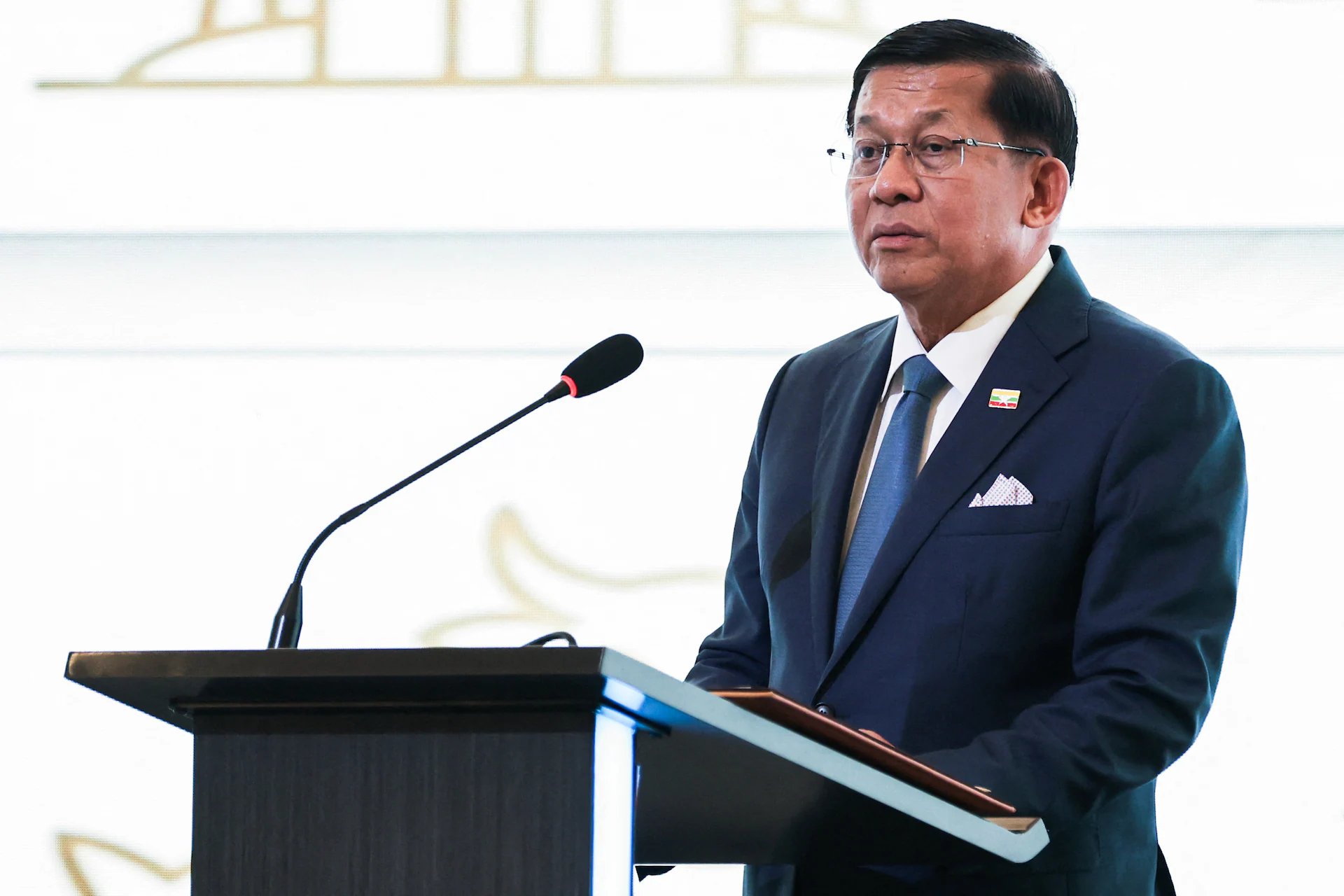
Japanese philanthropist Yohei Sasakawa, Japan’s special envoy for national reconciliation in Myanmar, met President Min Aung Hlaing on Tuesday, October 20, in the Myanmar capital of Naypyitaw, according to state media. The meeting comes as international contacts with the Southeast Asian country increase following years of diplomatic isolation after the military coup in 2021.
The state-run Global New Light of Myanmar newspaper reported the meeting on Wednesday, October 21. Sasakawa, who is also the honorary chair of the Nippon Foundation, discussed plans to assist Myanmar’s internal peace process and support human resource development through the foundation, the newspaper said.
The meeting takes place as Myanmar continues to face a nationwide conflict that began after the military seized power from an elected civilian government in February 2021. The coup triggered widespread resistance and fighting involving the military, pro-democracy forces and ethnic armed groups.
The conflict has caused a severe humanitarian crisis, with more than 100,000 people killed and over 3.5 million displaced, according to the figures cited in the report. Against this backdrop, Sasakawa’s engagement with Min Aung Hlaing brings renewed attention to mediation efforts and the prospects for dialogue in a country where previous ceasefires have failed to deliver lasting peace.
Japan’s foreign ministry did not immediately respond to a request for comment on Sasakawa’s visit, Reuters reported. The state media report did not provide details about the scale of the proposed assistance, specific projects or a timeline for implementation.
Who Is Yohei Sasakawa and What Is His Role in Myanmar?
Yohei Sasakawa is a Japanese philanthropist who serves as the honorary chair of the Nippon Foundation and Japan’s special envoy for national reconciliation in Myanmar. He has long been involved in efforts to facilitate communication between Myanmar’s military and armed groups opposing it.
His role as a special envoy focuses on reconciliation, an important issue in a country where long-standing ethnic conflicts have been compounded by the political and security crisis that followed the 2021 coup.
Mediation efforts can provide channels for opposing parties to discuss ceasefires, conflict reduction and possible paths towards negotiations. However, their effectiveness depends on the willingness of the parties involved to engage in dialogue and maintain any agreements reached.
Sasakawa’s latest meeting with Min Aung Hlaing was reported as a discussion about possible assistance for the internal peace process and human resource development. The available report did not indicate that a new peace agreement had been concluded or that the meeting had produced an immediate change in the country’s security situation.
His previous involvement in mediation provides context for the meeting, particularly his role in efforts to secure a truce between Myanmar’s military and the Arakan Army in 2022. That agreement was subsequently followed by renewed fighting after the ceasefire collapsed.
Myanmar Peace Process: The 2022 Truce and Its Collapse
One of Sasakawa’s notable mediation efforts came in 2022, when he helped broker a truce between Myanmar’s military and the Arakan Army, according to the Nippon Foundation.
The Arakan Army is an ethnic armed organisation active in Rakhine State, where fighting has been part of a broader pattern of conflict between the military and armed groups seeking greater autonomy or challenging central military authority.
The truce offered an opportunity to reduce hostilities between the two sides. However, the ceasefire later collapsed, leading to renewed fighting. The breakdown highlights the challenges involved in sustaining peace agreements in Myanmar, where disputes over territory, political authority and security remain difficult to resolve.
A ceasefire can temporarily reduce violence without resolving the underlying disagreements that led to conflict. Maintaining such an arrangement requires continued cooperation between the parties, as well as a willingness to avoid actions that could trigger renewed hostilities.
The collapse of the earlier truce also demonstrates the limitations of mediation when agreements do not develop into more durable arrangements. Although individual initiatives may create opportunities for dialogue, they cannot guarantee lasting peace in the absence of sustained engagement.
Sasakawa’s latest meeting with Min Aung Hlaing therefore comes against a background of both previous mediation efforts and setbacks. Whether the new discussions will lead to further initiatives remains unclear, as the state media report did not outline specific commitments or new agreements.
What Did Sasakawa and Min Aung Hlaing Discuss?
According to the Global New Light of Myanmar, the discussions covered two principal areas: assistance for Myanmar’s internal peace process and support for the country’s human resource development through the Nippon Foundation.
The proposed peace-related assistance could provide a channel for further reconciliation efforts. However, the report did not specify which groups or communities would be involved, what activities would be supported or how the proposed assistance would be delivered.
Human resource development was the other subject mentioned in the report. Such initiatives can focus on strengthening skills and capabilities, although the newspaper did not identify particular training programmes, sectors or beneficiaries connected to the discussions.
The two areas address different aspects of Myanmar’s challenges. Peacebuilding efforts concern the country’s conflict and the possibility of dialogue, while human resource development relates to people’s skills and capacity. Both can be relevant to longer-term stability, but the impact of any programme depends on its scope, implementation and ability to reach intended beneficiaries.
For now, the reported discussions should not be interpreted as confirmation that new programmes have already been launched. No specific funding figures, project schedules or implementation arrangements were included in the available account.
Further announcements from the Nippon Foundation or Japanese officials could clarify whether the meeting leads to concrete initiatives and how any proposed assistance will be organised.
Japan Steps Up Contacts With Myanmar’s Authorities
Sasakawa’s visit is part of a series of recent contacts involving Japanese representatives and Myanmar’s authorities. These engagements have taken place despite the diplomatic isolation that followed the military coup.
Japan’s acting envoy to Myanmar met the country’s foreign minister in October in their first known public engagement, according to the report. The meeting followed a September visit to Naypyitaw by Hiromichi Watanabe, a lawmaker from Japan’s ruling party.
These contacts indicate that Japanese representatives have continued to engage with Myanmar through different channels. Sasakawa’s role is distinct because his work centres on national reconciliation and his longstanding involvement in mediation between the military and armed groups.
Diplomatic engagement can create opportunities to discuss bilateral relations, development assistance and conflict-related issues. However, meetings between representatives and government officials do not necessarily indicate agreement on broader political questions or a change in official policy.
Japan’s foreign ministry had not immediately commented on Sasakawa’s visit when Reuters reported the meeting. The available information also did not establish whether the discussions would result in a new Japanese government initiative or a change in Tokyo’s approach to Myanmar.
The sequence of recent contacts nevertheless places Sasakawa’s meeting within a broader pattern of engagement. The practical significance of that pattern will depend on whether discussions result in sustained cooperation or measurable progress on issues such as peace and development.
United States Also Re-engages With Myanmar
Japan is not the only country to have resumed contact with Myanmar. The United States and Myanmar held talks in Tokyo this month, according to the information reported by Reuters.
The discussions provide additional context for the recent diplomatic activity surrounding Myanmar. Following years of isolation after the 2021 coup, contacts involving foreign representatives have become an important development in the country’s International Relations.
However, the available information does not establish that the US talks and Japan’s engagement are part of a coordinated diplomatic initiative. The objectives, scope and outcomes of the separate contacts may differ.
International engagement can offer opportunities to communicate concerns, discuss possible cooperation and explore approaches to regional stability. Yet renewed diplomatic contact alone does not resolve Myanmar’s conflict or settle questions about its political future.
The country continues to face widespread fighting, displacement and uncertainty. Any assessment of the impact of international engagement will therefore depend on the substance of the discussions and whether they lead to practical follow-up measures.
The US talks in Tokyo, Japan’s recent meetings with Myanmar officials and Sasakawa’s reconciliation efforts collectively illustrate the range of channels through which international contacts are taking place. The reported information, however, does not indicate that these developments have produced a common peace plan or a comprehensive settlement.
Myanmar’s Crisis Continues After the 2021 Military Coup
Myanmar’s current conflict followed the military coup in February 2021, when the armed forces removed the elected civilian government. The takeover triggered widespread opposition and escalated into fighting involving the military, pro-democracy resistance groups and established ethnic armed organisations.
The conflict has affected communities across the country, contributing to large-scale displacement and the loss of life. More than 100,000 people have been killed and over 3.5 million displaced, according to the figures included in the Reuters report.
The crisis is complex because the different groups involved do not necessarily share identical political goals or military priorities. Some ethnic armed organisations have longstanding demands for autonomy, while resistance movements emerged or expanded following the coup.
These differences complicate efforts to achieve a nationwide settlement. A ceasefire involving one armed group may reduce fighting in a particular area but may not affect other fronts or resolve wider disputes over governance and political authority.
For peace initiatives to have a lasting impact, agreements must be maintained and the parties must be willing to address the issues driving the conflict. The collapse of the 2022 truce involving the Arakan Army illustrates the difficulty of sustaining local arrangements amid broader instability.
In this context, the discussion between Sasakawa and Min Aung Hlaing represents a reported effort to address peace and development-related issues. It remains uncertain whether the meeting will lead to further negotiations or concrete changes on the ground.
What Happens Next After the Sasakawa Meeting?
The next important development will be whether the discussions in Naypyitaw lead to specific assistance programmes or further engagement on Myanmar’s peace process.
The state media report identified internal peace and human resource development as areas of discussion but did not provide details about implementation. Information about funding, programme objectives, participating groups and timelines would help clarify the practical implications of the meeting.
Developments involving Myanmar’s military and armed groups will also remain central to the prospects for reconciliation. Sasakawa’s previous mediation experience shows that ceasefires can be negotiated, but the collapse of the earlier truce with the Arakan Army demonstrates that maintaining them can be difficult.
Japan’s wider diplomatic contacts and the recent US-Myanmar talks may offer additional indications of how international engagement develops. However, there is currently no reported evidence in the supplied account that these contacts have produced a comprehensive diplomatic initiative or a new nationwide peace agreement.
The immediate outcome of Sasakawa’s meeting is therefore a reported discussion about assistance for peace and development rather than a confirmed breakthrough in Myanmar’s conflict. Its longer-term significance will depend on whether the proposed cooperation moves forward and whether dialogue can contribute to sustained reductions in violence.
For Myanmar, the central challenge remains turning diplomatic contacts and mediation efforts into durable progress amid a prolonged conflict. Sasakawa’s meeting adds another point of engagement, but the path towards lasting peace remains uncertain.
For breaking news and live news updates, like us on Facebook or follow us on Twitter and Instagram. Read more on Latest World on thefoxdaily.com.






COMMENTS 0