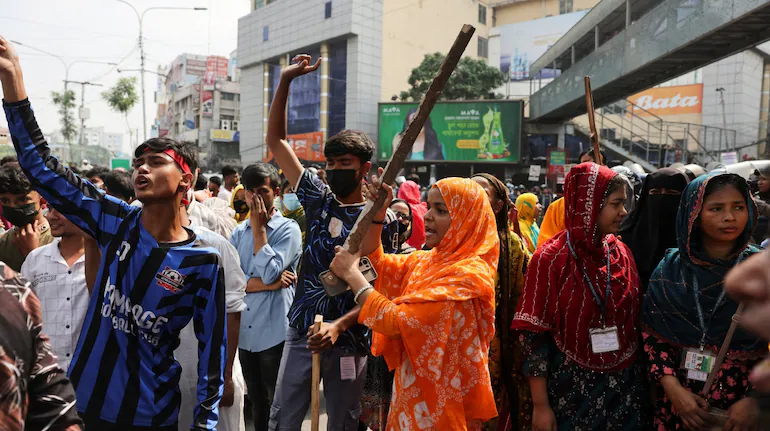
Bangladesh’s Garment Industry is facing renewed disruption as thousands of workers protest for higher wages, forcing factories to suspend operations across several major industrial zones. Police used tear gas and sound grenades to disperse demonstrators on Sunday as tensions escalated ahead of a key meeting of the country’s Minimum Wage Board.
The protests have affected industrial areas in Gazipur, Savar and Ashulia, where workers say their existing salaries are no longer sufficient to cover the rising cost of everyday essentials. Factory owners and industry representatives, meanwhile, are concerned that prolonged unrest could disrupt production schedules and threaten export orders.
Workers are demanding that the minimum monthly wage increase from 12,500 taka to 30,000 taka, representing a proposed rise of approximately 140%. The demand has become the central issue in a labour dispute that has continued for nearly three weeks.
The timing is significant. The Minimum Wage Board is scheduled to meet on Monday, November 16, with employers expected to present their recommendations for a revised salary structure. Workers’ representatives have proposed an even higher minimum wage of 32,000 taka.
More than 50 garment factories affected by protests
Gazipur has emerged as one of the main centres of the latest disruption. Factory owners said around 50 units in the industrial zone were closed, including establishments affected by Sunday’s demonstrations.
At least 13 garment factories in Gazipur were reportedly shut indefinitely, while another five announced a one-day holiday following protests in the Konabari and Mouchak areas. The closures reflect growing concern among factory management over the possibility of demonstrations spreading to more production facilities.
Workers gathered near factories in Konabari on Sunday morning and attempted to block the Dhaka-Tangail highway. Police personnel reached the area and used tear gas and sound grenades at around 8:30 am local time to disperse the demonstrators.
Protests subsequently spread to neighbouring Mouchak, where workers from other factories also took to the streets. The demonstrations created further pressure on an industrial zone that plays an important role in Bangladesh’s export-oriented manufacturing sector.
Gazipur Industrial Police Superintendent Amzad Hossain said security personnel had prevented workers from gathering at several locations. Police remained deployed at important points across the industrial area to prevent further escalation.
Despite the closures, officials said production was continuing at most factories in Gazipur’s industrial belt. The situation, however, remained sensitive as workers continued to press their wage demands.
Security tightened across industrial areas
Authorities increased security deployments in response to the protests, particularly around factory clusters, highways and other locations where demonstrations could disrupt traffic or production.
The Border Guard Bangladesh deployed 13 platoons of paramilitary personnel. Police in riot gear, the Special Response Battalion and Ansar personnel were also assigned to maintain order.
In addition, 25 executive magistrates were deployed to oversee security arrangements. The expanded presence reflects the government’s concern about the potential for further clashes and disruption as wage negotiations approach a critical stage.
Police face the challenge of keeping industrial areas operational while allowing workers to express their demands. Any further confrontation could deepen tensions between employees, factory management and law enforcement agencies.
More than 50 factories closed in Savar and Ashulia
The unrest has also affected the Savar-Ashulia industrial belt, another major centre of Bangladesh’s garment manufacturing industry. Local reports indicated that more than 50 factories in the wider area remained closed amid the labour dispute.
However, officials described the overall situation across Savar, Ashulia and Dhamrai as calm, with most factories operating normally. Mohammad Mominul Islam Bhuiyan, superintendent of Ashulia Industrial Police-1, said workers at only five factories in the area had not started work.
The difference between reported factory closures and the number of establishments where workers did not begin their shifts highlights the uneven impact of the unrest. Some factories have suspended operations as a precaution, while others have continued production despite tensions in nearby locations.
Khairul Mamun Mintoo, legal affairs secretary of the Bangladesh Garments and Sweaters Workers Trade Union Centre, said the situation had improved but warned that factory closures could create further resentment among workers.
He particularly criticised the use of Section 13(1) of the Bangladesh Labour Act to suspend factory operations without paying workers for the closure period. According to Mintoo, the measure could increase financial pressure on employees who are already demanding higher wages.
Why factory closures under Section 13(1) are controversial
Section 13(1) of the Bangladesh Labour Act allows employers to close an establishment or part of it when workers resort to illegal strikes or certain forms of collective action that disrupt operations. When the provision is invoked, workers may not receive wages for the period covered by the closure, subject to the applicable legal conditions.
Garment industry leaders have authorised factory owners to use the provision if labour unrest continues to affect production. Employers view temporary closures as a way to protect facilities and prevent disruption from spreading.
Workers’ representatives, however, argue that unpaid closures can make an already difficult situation worse. Employees who depend on regular monthly wages may struggle to meet household expenses if factories stop operating for several days.
The disagreement illustrates one of the central challenges in Bangladesh’s garment sector: employers want uninterrupted production, while workers are seeking higher wages and better financial security. If closures become widespread, the measure intended to contain unrest could instead increase dissatisfaction.
Mintoo has called for urgent discussions involving the government, factory owners, workers and labour representatives. He argues that negotiations are necessary to restore normal operations while addressing the wage demands driving the protests.
Minimum Wage Board meeting scheduled for November 16
The next major development is expected on Monday, November 16, when the Minimum Wage Board meets to discuss a revised salary structure for garment workers.
The government formed the board on November 1 after weeks of demonstrations over wages. During its first meeting, members agreed to complete their recommendations by the end of November.
The proposed timetable envisages the revised pay structure taking effect from December 1. If the schedule is followed, workers are expected to receive their first salaries under the new scale in January.
Workers’ representatives on the board have proposed a minimum monthly wage of 32,000 taka. Their demand is higher than the 30,000 taka figure being raised in the demonstrations and substantially above the current minimum of 12,500 taka.
Employers are expected to submit their own proposal during Monday’s meeting. The difference between the workers’ demand and the industry’s assessment of what factories can afford is likely to be a major point of discussion.
The Bangladesh Garment Manufacturers and Exporters Association (BGMEA) has confirmed that its representatives will attend the meeting and submit recommendations. However, the association has warned that its participation in subsequent meetings could depend on developments in the industrial areas.
The board’s task will be to consider workers’ living costs, the financial position of manufacturers and the industry’s ability to remain competitive in international markets. Reaching an agreement will be important not only for resolving the immediate dispute but also for preventing further production disruptions.
Why garment workers are demanding a 140% wage increase
Workers say the existing minimum wage of 12,500 taka has become increasingly inadequate as the cost of living rises. Food, housing, transport and healthcare expenses have placed pressure on household budgets, leaving many employees struggling to manage basic necessities.
For workers earning close to the minimum wage, even relatively small increases in food or rental costs can consume a significant share of monthly income. Transport expenses and medical costs add further pressure, particularly for employees supporting families.
The proposed increase to 30,000 taka would more than double the current minimum wage. Workers argue that a substantial adjustment is necessary to improve living standards rather than merely provide a limited revision that could quickly be eroded by inflation.
Employers face a different set of concerns. Garment manufacturers operate in a highly competitive international market, where production costs, delivery schedules and pricing influence whether global buyers place orders with Bangladeshi factories.
A large wage increase could raise operating expenses, particularly for smaller manufacturers with limited financial flexibility. However, keeping wages too low can also create problems through labour turnover, worker dissatisfaction and repeated industrial disputes.
The wage negotiations therefore involve a difficult balance between improving workers’ incomes and ensuring that manufacturers can continue operating profitably.
Bangladesh garment unrest threatens global supply chains
Bangladesh is the world’s second-largest garment exporter after China, making the current labour dispute important beyond the country’s domestic economy. Its ready-made garment industry employs more than four million people and generates over 80% of national export earnings.
The sector supplies major international fashion brands, including H&M, Zara and Gap. Thousands of factories and businesses are connected to the industry through manufacturing, transport, packaging, logistics and other services.
Any prolonged shutdown in major production centres can therefore affect more than factory workers and owners. It can also disrupt the delivery schedules of international retailers that rely on Bangladeshi suppliers for large volumes of clothing.
Factory owners have warned that continued disruption during the peak production period for spring and summer orders could delay shipments and damage confidence among overseas buyers. If factories cannot meet delivery deadlines, brands may consider shifting orders to suppliers in other countries.
Such a shift would not necessarily happen immediately, but repeated disruptions could influence future sourcing decisions. International retailers typically assess suppliers on price, product quality, compliance standards and their ability to deliver orders on time.
Bangladesh has built a strong position in global apparel manufacturing through its large workforce, established factory network and export infrastructure. Protecting that position requires stable industrial relations as well as competitive production costs.
Political tensions add another layer to the labour dispute
The wage protests have also taken place against a politically sensitive backdrop. Bangladesh’s garment industry is a major source of employment, and labour disputes can quickly become part of wider political arguments about economic management and stability.
Bangladesh Nationalist Party (BNP) activists have organised campaigns opposing the demonstrations, accusing some protesters of being infiltrators seeking to create instability.
BNP leaders have alleged that former prime minister Sheikh Hasina and her supporters are attempting to destabilise the government by exploiting industrial unrest. Hasina has rejected allegations against her.
Such claims have added political tension to a dispute that began with workers’ demands for higher pay. However, allegations about political involvement should be distinguished from the economic grievances raised by garment employees.
Workers’ concerns over wages, inflation and living expenses remain central to the negotiations. A durable solution will depend on addressing those concerns rather than allowing the dispute to become entirely defined by competing political accusations.
What happens next for Bangladesh’s garment industry?
The November 16 Minimum Wage Board meeting could become a turning point in the current dispute. Employers’ recommendations will provide a clearer indication of the increase manufacturers consider financially manageable, while workers’ representatives are expected to press for a substantial revision.
The board’s target of completing recommendations by the end of November gives both sides a limited period to narrow their differences. The proposed December 1 implementation date also means that negotiations will need to progress quickly if the timetable is to be maintained.
But the immediate challenge is restoring normal operations across Gazipur, Savar and Ashulia. Factory closures, unpaid shutdowns and confrontations with police could deepen distrust if workers feel their concerns are not being addressed.
For manufacturers, the priority is to prevent further disruption and reassure international buyers that production and delivery schedules can be maintained. For workers, the priority is securing a wage structure that reflects the cost of living and provides greater financial stability.
The government and the Minimum Wage Board will need to bridge those competing interests. A negotiated settlement could help stabilise the industrial zones and protect Bangladesh’s position in the global garment market. Failure to reach an acceptable agreement, however, could prolong protests and increase the risk of further factory shutdowns.
For breaking news and live news updates, like us on Facebook or follow us on Twitter and Instagram. Read more on Latest World on thefoxdaily.com.






COMMENTS 0