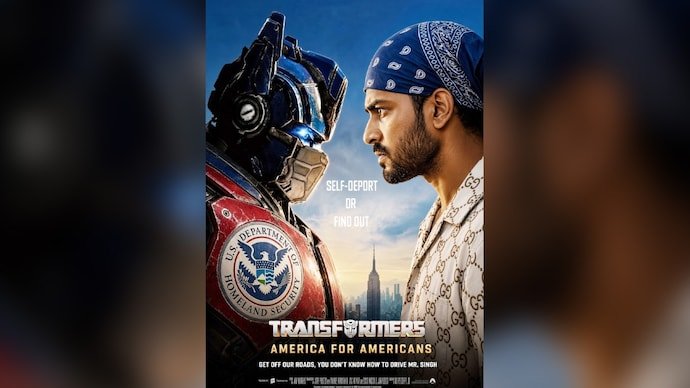
The US Department of Homeland Security (DHS) is facing intense criticism over an AI-generated poster targeting an Indian-origin truck driver identified as “Mr Singh”, as the Trump administration expands its Immigration crackdown and increases scrutiny of immigrant commercial drivers.
The graphic, posted by the official DHS account on X, was designed as a movie-style poster titled “Transformers: Age of Deportations”. It showed a large Transformer carrying a DHS insignia facing a Sikh-looking man wearing a head covering.
Across the image was the message: “America for Americans. Get off our roads; you don’t know how to drive, Mr Singh.” The post also urged people to “self-deport” and encouraged the public to report what DHS described as “illegal aliens on American roads”.
The post quickly became controversial because “Singh” is an extremely common surname among Sikhs and is particularly associated with the Punjabi community, which has a substantial presence in the US trucking industry.
Critics said the campaign went beyond targeting alleged immigration violations and instead used a racial and religious stereotype to portray an entire community of truck drivers as a problem. Supporters of the administration, meanwhile, have framed the campaign as part of a broader effort to enforce immigration law and address road-safety concerns involving drivers who are in the United States illegally.
What does the DHS “Transformers” poster say?
The DHS graphic deliberately imitates the visual style and language of the Transformers franchise.
At its centre is a giant robot bearing a DHS badge, positioned opposite a Sikh man. The text addresses the man by the surname “Singh” and tells him to leave American roads.
The campaign uses the phrase “America for Americans” before adding the message that “Mr Singh” does not know how to drive. It then calls on people to “self-deport”.
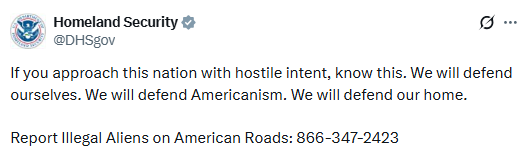
The design also borrows the tone of the franchise’s famous Optimus Prime speeches, replacing its language about defending Earth and humanity with references to defending the United States and “Americanism”.
DHS wrote that if someone approached the country with “hostile intent”, the department would defend itself, Americanism and its home.
That combination of a fictional robot, an immigration-enforcement message and a specific ethnic surname is what made the post unusually provocative.
Why “Singh” became the focus of the controversy
The central criticism is not simply that DHS produced an aggressive immigration poster. It is that the department selected a surname strongly associated with a specific religious and ethnic community and placed it alongside a message about supposedly dangerous or incompetent truck drivers.
Singh is one of the most recognizable Sikh surnames, and Sikh and Punjabi Americans have a particularly strong presence in trucking.
Educational material produced in collaboration with the Sikh Coalition estimates that Sikhs account for about 20% of the US trucking workforce. Other industry estimates similarly place Punjabi/Sikh participation at around one-fifth of American truckers, although there is no comprehensive federal database recording the religion of all drivers.
The trucking connection makes the DHS choice even more significant. Using “Mr Singh” in a campaign about allegedly unlawful immigrant truck drivers can easily be interpreted as using a racial shorthand for an entire occupational community.
Critics argue that individual violations should be addressed against individual drivers rather than attaching a negative stereotype to a surname shared by millions of people worldwide.
Sikh truckers have become a visible part of America’s transportation economy
Punjabi and Sikh immigrants have developed a substantial presence in the US trucking industry over several decades.
The profession has attracted members of the community because trucking can provide relatively accessible routes into business ownership and employment, particularly for immigrants seeking independent work and a path into entrepreneurship.
Many Sikh truckers operate as owner-operators or run small transportation companies, while others work for larger carriers.
Their contribution extends across the national supply chain. Trucks transport food, consumer goods, industrial materials, agricultural products and countless other items across the country.
That makes the community’s relationship with trucking more complicated than the DHS poster suggests. Sikh Americans are not merely a group of foreign-born drivers entering the industry; they include long-established US citizens, permanent residents, business owners and multiple generations of American families.
Alec Nolan says the poster targets more than illegal immigration
One of the sharpest responses came from Alec Nolan, a Sikh-American television news anchor at Fox 7 Austin.
Nolan said the post was racist and demeaning toward people with the surname Singh and shared his family’s own history in the United States.
He said his grandfather, Dan Singh, came to America from India and that his great-grandfather, Katha Singh, had arrived decades earlier before becoming a raisin farmer in California.
Nolan said his grandfather later continued the family business and also worked as a truck driver.
His response illustrates why the wording of the DHS post resonated so strongly within the Sikh-American community. The name “Singh” does not identify someone’s immigration status, citizenship or driving record.
A person named Singh could be an undocumented immigrant, a naturalized US citizen, a second-generation American, a military veteran or someone whose family has lived in the country for generations.
Critics say DHS turned an immigration campaign into a racial stereotype
Several social media users argued that DHS could have focused on alleged violations involving commercial driving licenses without attaching the campaign to a recognizable Sikh identity.
One user asked why a department responsible for homeland security was producing AI movie posters targeting Sikhs. Another criticized the focus on “Mr Singh” instead of individual cases of alleged fraud or illegal driving.
Others challenged the slogan “America for Americans”, pointing out that the United States is a nation shaped by successive waves of immigration while Native Americans are the country’s Indigenous peoples.
These criticisms reflect a central tension in immigration messaging: government agencies can emphasize enforcement without necessarily suggesting that ethnicity itself is evidence of illegal status.
The DHS graphic became controversial because, in the eyes of critics, those two ideas were blurred together.
Why the trucking issue is particularly sensitive
The DHS campaign comes after a series of policy and enforcement actions targeting commercial drivers who are not legally authorized to work in the United States or who allegedly do not meet federal safety requirements.
The administration has increased scrutiny of non-domiciled commercial driver’s licenses and immigration status among truckers after high-profile crashes involving foreign-born drivers.
Those cases have generated a fierce national debate over whether states have issued commercial licenses to drivers who do not meet federal requirements and whether immigration enforcement should be connected more directly to trucking regulation.
The legitimate policy questions are significant. Commercial truck drivers operate heavy vehicles capable of causing severe harm when safety standards are ignored. English-language proficiency, training, licensing, drug testing, hours-of-service compliance and immigration status can all become part of a wider regulatory discussion.
But none of those issues makes the surname Singh an indicator of unsafe driving or unlawful immigration status.
DHS has previously highlighted Indian-origin truckers in enforcement messaging
The controversy did not emerge in isolation.
In March 2026, DHS announced the arrest of Sukhdev Singh, an Indian national it described as being unlawfully present in the United States and holding a commercial driver’s license issued by New York. DHS said he was accused of a crash in Indianapolis that critically injured a pedestrian.
The department used that individual case to argue that undocumented immigrants should not be operating heavy commercial vehicles on US roads.
Such cases have intensified political attention on foreign-born truck drivers, particularly Punjabi and Sikh drivers, because the community is heavily represented in the industry.
Community advocates have repeatedly warned that enforcement aimed at individual violations must not become collective suspicion of Sikh or Punjabi drivers.
Sikh organizations have already raised concerns about targeting truckers
The Sikh Coalition has developed specific resources for Sikh truck drivers because of increasing immigration and regulatory concerns.
Its 2026 guidance includes information on immigration stops, police encounters, workplace accommodations and new English-language-proficiency rules affecting commercial drivers.
The organization has also warned about potential discrimination against Sikh and Punjabi truckers as immigration and trucking regulations change.
That context is important because the community was already navigating heightened scrutiny before the DHS poster appeared.
Advocacy groups say enforcement should be based on documentation, licensing, conduct and evidence rather than assumptions connected to religion, ethnicity, language or surname.
“Illegal alien” and “illegal trucker” are not interchangeable concepts
The DHS campaign also raises an issue of terminology.
An immigration violation and a trucking violation are separate legal questions.
A driver can be legally present but hold an invalid commercial license. A driver can be lawfully licensed but violate traffic regulations. An undocumented immigrant can also have a driving record that is otherwise free of traffic offenses.
Similarly, being foreign-born does not mean a person is undocumented.
That distinction is especially important when discussing large occupational communities. Treating immigration status, nationality, religion and driving competence as interchangeable categories can create misleading impressions.
The DHS poster compresses all those ideas into one character: a Sikh-looking man named Singh who is told to leave American roads. That simplification is precisely what critics say makes the image discriminatory.
The “America for Americans” slogan has its own history
The phrase “America for Americans” is especially politically charged because immigration debates in the United States have repeatedly used similar ideas to argue for restrictions on newcomers.
Supporters of aggressive immigration enforcement use such language to emphasize national sovereignty and the principle that American jobs and public resources should prioritize citizens.
Critics argue that it can imply that immigrants are inherently outsiders even when they are legally authorized workers, long-term residents or naturalized citizens.
In the DHS poster, the phrase is placed directly alongside “Mr Singh” and a demand that he get off American roads. That combination makes the message appear less like a neutral immigration-enforcement announcement and more like a warning aimed at a recognizable ethnic group.
Social media users also turned the Transformers reference against DHS
The choice of Transformers created another layer of online mockery.
Some users pointed out the irony of using a franchise in which giant robots from another world arrive on Earth as part of an anti-immigration campaign.
One sarcastic response suggested that the Transformers themselves could be described as “illegal aliens” because they arrived on another planet without immigration documents.
Others simply joked that the characters were immigrants themselves.
These responses are not serious policy arguments, but they illustrate how quickly the visual framing backfired online. Once an official government graphic adopts a recognizable pop-culture format, audiences can reinterpret it using the same cultural references.
Instead of controlling the narrative, DHS ended up becoming part of the meme.
The poster appeared shortly after Peter Cullen’s death
The timing generated another unusual detail.
Peter Cullen, the Canadian-American voice actor best known for playing Optimus Prime in the Transformers franchise, died on August 26, 2026, at the age of 85.
Cullen’s death had been widely reported shortly before the DHS graphic appeared, adding an uncomfortable coincidence for Transformers fans.
Cullen voiced Optimus Prime for decades, including the original animated franchise and later live-action films. His interpretation of the character became one of the most recognizable voices in popular animation.
The DHS poster did not directly comment on Cullen’s death, but its appearance shortly afterward added another reason the graphic attracted attention beyond immigration Politics.
Is the DHS poster an official government message?
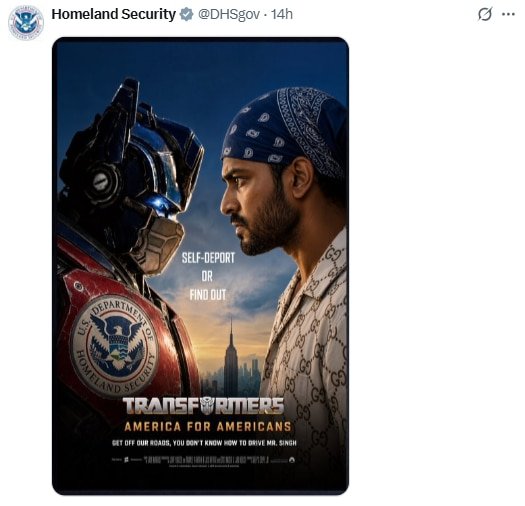
Yes. The graphic was shared through the official US Department of Homeland Security account on X.
That makes the controversy different from an AI-generated meme created by an ordinary social-media user.
Government communication carries institutional authority and can shape public perceptions of the communities being discussed. Critics therefore argue that DHS should apply a higher standard to its use of racial imagery and stereotypes than an anonymous meme creator would.
DHS, on the other hand, appears to be using increasingly aggressive digital content as part of its broader public campaign for immigration enforcement.
The episode illustrates how government agencies are adapting their messaging to social-media culture, where traditional press releases are increasingly supplemented by memes, video clips, AI-generated imagery and highly emotional political content.
Why the use of AI makes the controversy different
The poster is also notable because it uses generative Artificial Intelligence rather than conventional graphic design.
AI makes it faster and easier for government communications teams to produce stylized images that resemble movie posters, advertisements or memes.
But it also creates new risks.
AI-generated imagery can exaggerate stereotypes, create unrealistic depictions and make provocative messages appear more dramatic than conventional government artwork.
There is also a transparency question. When government agencies use AI to produce political content, citizens may reasonably ask how the image was created, whether humans reviewed it and whether appropriate standards were applied before publication.
In this case, the problem for critics is not necessarily the use of AI itself. It is what the technology was used to depict.
The underlying immigration enforcement policy is separate from the controversy
It is important to distinguish the debate over the poster from the underlying policy issue.
The Trump administration has made immigration enforcement a central priority and has specifically emphasized removing people it considers unlawfully present in the United States.
Commercial trucking has become one of the sectors receiving heightened attention because of concerns over non-domiciled commercial driver’s licenses, English-language proficiency and safety compliance.
Those are real policy issues that can be debated independently of whether DHS’s communications are appropriate.
The controversy surrounding the poster is instead about the method used to communicate that policy specifically, whether a common Sikh surname was used as shorthand for an allegedly illegal and unsafe driver.
Why “Singh” does not identify immigration status
A surname can tell us little about a person’s legal status.
Singh is used by millions of people, particularly Sikhs in India and around the world. It is also common among Sikh Americans who are US citizens or lawful residents.
Some Sikh women use Singh as well, while others use Kaur or family surnames. Many people of Sikh heritage have American-born children and grandchildren who have never had an immigration case.
That is why associating “Singh” with deportation can be especially problematic.
A government message designed to identify immigration offenders should ideally rely on actual legal status or conduct. A surname provides neither.
Critics question whether the poster could fuel discrimination
Sikh Americans have faced discrimination and mistaken identity in the United States for decades, particularly because turbans and beards have sometimes led uninformed people to associate Sikh men with other ethnic or religious groups.
The Sikh Coalition has documented employment discrimination and hate crimes affecting Sikh truck drivers and other members of the community.
That history makes public imagery depicting a Sikh man as an unwanted or dangerous immigrant particularly sensitive.
Community concerns are not necessarily limited to hurt feelings. Advocates argue that repeated stereotypes can normalize suspicion toward people who look or sound different, potentially affecting how they are treated at workplaces, roadside inspections, border crossings and everyday interactions.
The economic reality is more complicated than the poster suggests
America’s trucking industry depends heavily on immigrant workers and entrepreneurs.
Punjabi and Sikh drivers are particularly visible in parts of California and other states, where they have built transportation companies and related businesses.
The sector has historically faced driver shortages and high turnover, making immigrant labour an important part of the industry’s workforce.
That creates another contradiction in the public debate. The same workers who are portrayed as unwanted outsiders can also be deeply integrated into the supply chains that move food, fuel, machinery and consumer products across the country.
For many Sikh truckers, the industry is not a temporary way station before leaving the country. It is a long-term profession and, in many cases, a family business passed from one generation to another.
Safety enforcement can be strict without being ethnic
Nothing prevents the US government from aggressively enforcing trucking safety laws.
Authorities can test commercial drivers, inspect vehicles, investigate fraudulent licenses, remove unqualified drivers from the road and prosecute people who commit crimes.
Those measures can be applied based on documentation and conduct rather than ethnicity.
That distinction is at the heart of much of the criticism directed at DHS.
A government agency does not need to soften its enforcement message to avoid discrimination. It needs to make clear that the target is illegal conduct or unlawful immigration status rather than a community identified through a surname.
Could the controversy affect the Sikh trucking community?
The immediate impact is difficult to measure, but the concern is that highly visible government messaging could reinforce the perception that Sikh truck drivers are under collective suspicion.
That could make an already anxious community more cautious around immigration enforcement officers and roadside inspections.
The Sikh Coalition has already developed Punjabi-language “know your rights” resources covering immigration stops and interactions with law enforcement, suggesting that such concerns are not hypothetical within the community.
The larger question will be whether the administration continues using ethnic or religiously recognizable imagery in future campaigns involving trucking.
Repeated use could deepen tensions even when the underlying enforcement action is directed at specific documented violations.
The debate is also about government communication standards
Government communications traditionally aim for clarity, authority and credibility.
Social-media campaigns have changed that equation. Agencies increasingly compete for attention with political influencers, memes and viral Entertainment content.
The DHS poster represents that new style: it is bright, confrontational, culturally recognizable and designed to be shared.
That may be effective at generating attention, but attention itself is not the same thing as effective public communication.
A post that generates millions of views because people are angry about it can spread an agency’s message while simultaneously damaging its credibility among the communities it is addressing.
For DHS, the question is therefore whether the viral effect outweighs the reputational cost.
What the controversy reveals about Trump’s immigration strategy
The poster fits into a broader Trump administration strategy that emphasizes highly visible immigration enforcement.
Rather than treating deportation primarily as a legal-administrative process, the administration increasingly presents it as a public campaign built around deterrence, warning messages and direct appeals to Americans.
“Self-deport” is part of that strategy. The term is intended to encourage people who are unlawfully present to leave voluntarily rather than wait for formal removal proceedings.
The poster adds popular culture to that message.
The use of Transformers, exaggerated imagery and a fictional robot gives immigration enforcement a distinctly entertainment-driven presentation.
That may appeal to online audiences already supportive of the administration, but it also makes the government’s communications more vulnerable to mockery and accusations that serious policy is being reduced to meme politics.
The central question: enforcement or stereotyping?
There is a legitimate government interest in ensuring that commercial vehicles are operated safely and that immigration laws are enforced.
The dispute begins when enforcement messaging uses a recognizable ethnic or religious identity as shorthand for the problem.
The DHS poster does not identify an individual by a case number, court record or documented violation. Instead, it uses “Mr Singh” alongside a Sikh appearance and a statement that he does not know how to drive.
Critics therefore argue that the poster turns an enforcement issue into a stereotype.
Supporters can argue that the department was referring to a specific policy concern involving immigrant truck drivers rather than attacking all Sikhs. But the visual symbolism is precisely what has caused many viewers to reach a different conclusion.
What a more neutral enforcement message would look like
A government campaign could communicate essentially the same policy without identifying a religious or ethnic group.
It could show a commercial truck, a federal enforcement vehicle and a driver alongside language about fraudulent commercial licenses, unsafe driving or unlawful immigration status.
Such a campaign could remain forceful while making the target clear: a violation of the law.
That would also avoid the problem of treating a surname as a proxy for immigration status.
The criticism of the DHS poster is therefore not necessarily an argument against immigration enforcement. It is an argument about how enforcement is communicated.
The bigger issue for Sikh Americans is collective identity
For Sikh Americans, the poster touches on a longstanding concern: being treated as representatives of a group before being treated as individual Americans.
A Sikh man wearing a turban may be a citizen, an immigrant, a veteran, a business owner, a truck driver or none of those things. His religious appearance tells an observer something about his identity but nothing about whether he is legally present or has violated traffic laws.
Using that appearance in a deportation campaign risks collapsing those distinctions.
That is why reactions from Sikh-American commentators have been so personal. The issue is not simply whether the image is offensive. It raises the question of what kind of assumptions government agencies are encouraging Americans to make about their fellow citizens.
What happens next?
DHS has not indicated that it plans to withdraw the poster or apologize for the imagery.
The department is likely to continue using social media as a major platform for immigration-enforcement messaging, particularly as the Trump administration seeks to demonstrate that deportations and enforcement actions are increasing.
For Sikh and Punjabi truckers, the practical priority will remain navigating changing immigration and commercial-driving rules while avoiding being singled out because of ethnic or religious identity.
For policymakers, the controversy offers a clear lesson: enforcement credibility depends partly on being precise about who is being targeted and why.
Why the “Mr Singh” poster has become more than a meme
The DHS “Transformers: Age of Deportations” graphic was designed to be provocative, and it succeeded in attracting attention. But the backlash shows why government agencies face a higher bar when using race, religion and immigration status together in public messaging.
The poster’s message combines a Sikh-looking man, the common surname Singh, a claim that he does not know how to drive, a call for self-deportation and the slogan “America for Americans”. That combination has led Sikh-American commentators and other users to accuse DHS of stereotyping and demeaning the community.
At the same time, the controversy cannot be separated entirely from the genuine policy issues that prompted the administration’s trucking crackdown. The United States has legitimate interests in ensuring that commercial drivers are properly licensed, qualified and legally authorized to work.
The question is whether those goals can be pursued without making a community’s name or appearance part of the enforcement target.
Bottom line: the immigration debate has collided with Sikh American identity
The DHS poster has turned a policy campaign about deportation and commercial drivers into a much wider argument about race, religion and belonging in America.
“Singh” is a surname, not an immigration category. Sikh and Punjabi Americans have built a substantial presence in the US trucking industry, and many are citizens or long-established residents rather than undocumented immigrants.
That is why the phrase “Get off our roads, Mr Singh” struck critics as more than tough immigration rhetoric. They saw it as a message that singled out a recognizable ethnic and religious identity and linked it to incompetence and illegality.
The Trump administration is unlikely to soften its broader immigration strategy because of one controversial graphic. But the episode demonstrates the risk of turning enforcement into viral political entertainment: the policy message can quickly become secondary to the debate over the stereotype being used to deliver it.
For DHS, the challenge is straightforward. It can continue to pursue undocumented immigrants and unsafe or improperly licensed truck drivers. But the most defensible enforcement message is one that identifies illegal status and unlawful conduct through evidence, not one that asks Americans to associate a particular surname, turban or community with those violations.
The backlash over “Mr Singh” shows just how quickly that distinction can disappear when government power meets AI-generated political imagery.
For breaking news and live news updates, like us on Facebook or follow us on Twitter and Instagram. Read more on Latest World on thefoxdaily.com.






COMMENTS 0