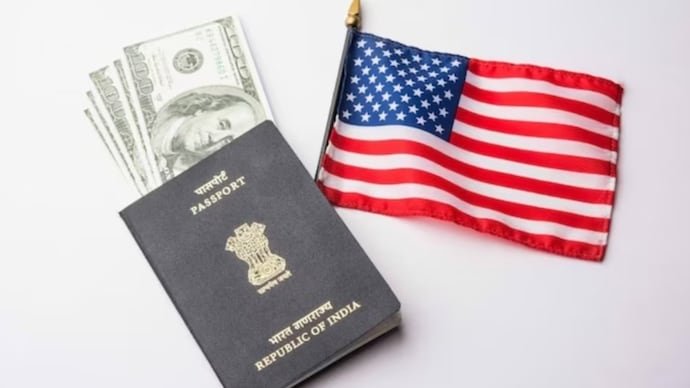
A proposed change to US immigration rules could remove one of the most important safety nets available to foreign workers who suddenly lose their jobs. The Department of Homeland Security (DHS) has proposed eliminating the discretionary 60-day grace period that currently gives certain nonimmigrant workers time to find a new employer, change status or prepare to leave the United States after employment ends.
The proposal is particularly significant for Indian professionals because Indian-born beneficiaries accounted for 71% of H-1B petitions approved in fiscal year 2024, according to US Citizenship and Immigration Services data. That makes Indian Workers disproportionately exposed to any policy change affecting the H-1B employment system.
The White House has now completed its review of the proposal, but that does not mean the 60-day grace period has already been abolished. The proposal, identified as RIN 1615-AD22 and titled “Eliminating the Discretionary 60-day Grace Period”, remains a proposed rule and its full text has not yet been publicly released. Federal regulatory records show the proposal entered review in August and is still listed in the regulatory process.
That distinction matters. Until a final rule takes effect, eligible workers remain subject to the existing rules. The next major step is publication of the proposal, which will reveal exactly which workers and situations are covered and will open a formal public-comment process.
What is the H-1B 60-day grace period?
The 60-day grace period was created to give certain nonimmigrant workers a limited window to deal with an unexpected end to employment without immediately falling out of lawful status.
Under the existing framework, eligible workers can generally remain in the United States for up to 60 days after employment ends, or until the end of their authorised stay, whichever comes first. The period can be used to look for another qualifying job, pursue a change of status or make arrangements to leave the country.
The protection is therefore more than simply an extra two months of employment. It creates a short transition period between one immigration status arrangement and the next.
For someone on an H-1B visa, losing a job can trigger several problems at once. The worker needs to find a new employer willing and able to sponsor the required immigration filing, while also dealing with housing, family arrangements, schooling and other commitments built around living in the United States.
The existing grace period gives the worker some time to coordinate those decisions rather than having the employment termination immediately become an immigration crisis.
What exactly is the US proposing?
The DHS proposal is titled “Eliminating the Discretionary 60-day Grace Period.” It was submitted for federal regulatory review before being considered for publication.
Federal regulatory records identify the measure as a proposed rule under DHS and USCIS, with the RIN number 1615-AD22. The record currently classifies it as a proposed rule and indicates that it is not economically significant under the applicable review criteria.
The most important limitation at this stage is that the proposal’s full provisions are not yet public. That means it would be premature to assume precisely how every H-1B worker, employer or dependent would be affected.
The eventual Federal Register notice should provide the details needed to understand the proposed changes, including the precise scope, implementation provisions and any exceptions or transition arrangements.
Why the proposal matters so much to Indian H-1B workers
The H-1B program has long been an important route for US employers seeking specialised foreign talent, particularly in technology, engineering and other professional fields. Indian professionals make up the largest national group among H-1B beneficiaries.
USCIS reported that people born in India accounted for 71% of approved H-1B petitions in fiscal year 2024. People born in China were the second-largest group at approximately 12%.
That concentration means an immigration rule affecting H-1B workers can have an outsized impact on Indian professionals compared with many other immigrant groups.
The risk is especially relevant to workers who have spent years establishing careers and families in the US. A job termination can affect not just the employee but also spouses and children whose housing, education and daily lives are tied to the principal worker’s immigration status.
The proposed change is therefore not simply an employment-policy issue. It could also affect the timing of immigration decisions, family relocation and employers’ ability to recruit experienced workers already living in the country.
What happens if the H-1B grace period is removed?
If the proposal ultimately becomes a final rule in the form currently described, the biggest change would be the removal of the existing buffer after employment termination.
A worker whose employment ends before the authorised period expires could no longer automatically rely on the existing 60-day window. Instead, the worker could face a much more immediate need to secure another lawful immigration option or leave the United States.
That would fundamentally change the practical consequences of a layoff.
Under the current system, a worker can use the grace period to:
- Search for a new qualifying employer.
- Work through the process of changing employers or immigration status.
- Discuss available immigration options with an attorney.
- Make arrangements for a departure from the United States if another option is unavailable.
- Manage housing, schooling and other family arrangements following an unexpected job loss.
Removing that period would compress these decisions into a much shorter timeframe.
Could workers still change employers or status?
This is one of the areas where the final regulatory text will matter most.
The current proposal’s precise provisions are not public, but reporting on the measure indicates that workers could lose the ability to rely on the existing grace period to transition to another employer or immigration status after termination.
There may still be circumstances in which US Citizenship and Immigration Services can exercise discretion to excuse a lapse in status. However, discretionary relief is different from an automatic period that workers can plan around.
That distinction could make timing considerably more important. A worker who learns that a job is ending would have less certainty about how much time is available to secure a new immigration pathway.
For employers, that uncertainty could also complicate hiring. A company considering an H-1B worker who has just lost another job may need to move more quickly if the worker’s ability to remain lawfully in the country becomes more time-sensitive.
The rule could affect more than H-1B workers
Although the proposal has attracted particular attention because of its potential impact on H-1B professionals, the existing 60-day provision covers several categories of nonimmigrant workers.
These include E-1, E-2, E-3, H-1B, H-1B1, L-1, O-1 and TN classifications, along with eligible dependants.
That makes the proposal broader than a change aimed exclusively at Indian technology workers.
However, the H-1B category is likely to receive the greatest attention because of its size, its importance to US employers and the unusually large share of beneficiaries born in India.
Why losing a job is different for an H-1B worker
For a US citizen or permanent resident, losing a job is primarily an employment and financial problem. For a temporary nonimmigrant worker, the consequences can be more complicated because employment and immigration status are closely connected.
An H-1B employee cannot simply treat a job search as an ordinary period of unemployment. The worker must consider whether a prospective employer can support the necessary immigration filing and whether the worker can maintain lawful status while the transition takes place.
That makes the 60-day period valuable even when a worker finds another position relatively quickly.
The worker may need time to interview, receive an offer, complete employment and immigration paperwork and coordinate the transition. Meanwhile, the family may need to decide what happens to a lease, school enrolment, healthcare arrangements and other commitments.
The practical value of the grace period therefore lies in time and certainty, not simply the number 60.
Former White House adviser calls the proposal “inhumane and unworkable”
Former White House adviser Ajay Jain Bhutoria has criticised the proposal and argued that the existing 60-day period is already difficult for workers facing an unexpected termination.
“Eliminating the 60-day grace period is both inhumane and unworkable,” Bhutoria said.
Bhutoria has argued for an alternative approach: extending the grace period to 180 days rather than eliminating it. He has pointed to the practical difficulties families can face after a sudden job loss, including finding new employment, dealing with housing and managing children’s schooling.
His criticism reflects the broader argument from opponents of the proposed change: a sudden termination is not always followed by an immediately available replacement job, particularly in a specialised labour market where interviews, offers and immigration paperwork can take time.
Bhutoria also previously advocated a longer transition period, arguing that technical hiring processes and visa transfers can take months.
The proposal is not yet law
One of the most important facts for H-1B workers to understand is that the proposal has not yet become a final rule.
The Federal Register publication is the next important milestone. Once the proposed rule is published, the public will be able to examine the government’s actual language rather than relying on descriptions of the proposal.
Publication would also begin the formal public-comment process. The exact length of that period will be specified in the Federal Register notice, rather than assumed in advance.
After comments are reviewed, DHS would have to determine whether and how to proceed with a final regulation. The final version could retain the proposal, modify it or potentially change its scope.
| Stage | Status | Why it matters |
|---|---|---|
| DHS proposal | Submitted | The agency proposed eliminating the discretionary 60-day grace period. |
| Federal regulatory review | Under review / recently cleared for publication process | The proposal must move through the federal rulemaking process. |
| Federal Register publication | Pending | The full proposal and its exact provisions will become public. |
| Public comments | Pending | Workers, employers and other interested parties can respond to the proposal. |
| Final rule | Not yet issued | Only a final rule can establish the proposed change as binding law, subject to applicable legal requirements and challenges. |
What Indian workers should watch for next
The most useful document to watch is not another summary of the proposal but the actual Federal Register notice.
That document should answer several questions that remain unresolved:
- Exactly which nonimmigrant categories would lose the grace period.
- Whether any exceptions would apply.
- How the rule would treat workers whose employment ends during an existing authorised stay.
- Whether there would be transition provisions for people already in the United States.
- When any final rule would take effect.
- How the government intends to address situations involving a change of employer or immigration status.
Until those details are published, broad claims that every H-1B worker would have to leave the US immediately after losing a job should be treated cautiously.
A second H-1B policy change is already moving forward
The grace-period proposal is arriving alongside several other changes affecting the US skilled-immigration system.
For example, DHS recently published a separate proposal that would establish a $103,265 fee for certain H-1B cap-subject petitions. That proposal was published in the Federal Register on August 25, 2026, and has its own rulemaking process.
That fee proposal is separate from the 60-day grace-period issue, but the two developments illustrate why H-1B employers and foreign professionals are paying close attention to the administration’s broader immigration agenda.
It would be inaccurate, however, to treat all of these proposals as one rule. Each has its own legal basis, timeline and potential implementation requirements.
What the H-1B grace-period change could mean for employers
The effects would not necessarily be limited to workers.
Employers could face greater pressure to move quickly when hiring foreign workers who have recently lost their jobs. A candidate who once had weeks to organise a transition could potentially have a much narrower window under a new system.
That could change hiring decisions, particularly for companies seeking specialised employees who are already in the United States.
It could also affect workers’ willingness to change jobs. A temporary immigration worker who knows that a failed job transition could immediately threaten their ability to remain in the country may become more cautious about moving between employers.
In that sense, the policy could influence the labour market beyond the moment when someone actually loses a job.
Why the final rule will matter more than the headline
The phrase “scrap the 60-day H-1B grace period” captures the central concern, but it does not yet provide the complete legal picture.
The proposal’s actual language, exceptions, effective date and treatment of existing workers will determine how disruptive the change would be. Until those details are public, workers and employers should distinguish between what has been proposed and what has actually become law.
What is already clear is the scale of potential exposure for Indian professionals. With Indian-born beneficiaries accounting for 71% of approved H-1B petitions in fiscal 2024, any major change to the post-employment rules for H-1B workers would have particular relevance for the Indian community.
The next key development will therefore be publication of the proposed rule in the Federal Register. That will shift the debate from a policy proposal whose details are still unavailable to a formal regulatory text that workers, employers, immigration lawyers and community organisations can examine and comment on.
For now, the 60-day grace period has not simply vanished because the White House completed its review. The proposal still has to move through the rulemaking process. But if DHS ultimately succeeds in eliminating the protection, an unexpected layoff could become a far more immediate immigration problem for H-1B professionals and their families, with Indian workers likely to feel a particularly large share of the impact.
For breaking news and live news updates, like us on Facebook or follow us on Twitter and Instagram. Read more on Latest World on thefoxdaily.com.






COMMENTS 0