Spain has begun three days of mourning following a devastating train crash that killed at least 69 people and injured dozens more, triggering public anger over railway safety and the handling of the emergency. The tragedy has prompted questions about the country’s transport system, while protests outside the Transportation Ministry in Madrid escalated into clashes between demonstrators and riot police.
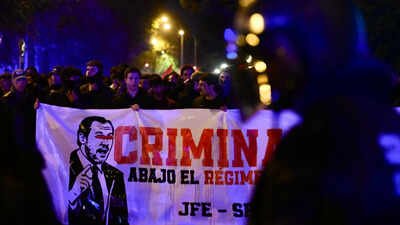
The demonstrations took place late Wednesday, when far-right protesters gathered outside the ministry to demand the resignation of Prime Minister Pedro Sánchez and Transportation Minister Óscar Puente. Some demonstrators pushed against a police cordon, threw flares and other objects, and chanted slogans directed at the government. Riot police responded with tear gas.
The crash has renewed concerns about the safety of Spain’s high-speed railway network, which had long been regarded as one of the country’s major infrastructure achievements. The latest disaster came after another deadly train accident earlier in the year, intensifying scrutiny of railway operations, safety systems and the decisions made before the collision.
Spain Mourns Victims as Death Toll Reaches 69
Regional leader Emiliano García-Page said the death toll had risen to 69 as rescue teams continued searching the crash site. Human remains were also discovered during the recovery operation, which involved crane operations to reach damaged carriages, including one that remained overturned.
The collision occurred on a stretch of railway in Spain’s central province of Toledo, where a train crashed into another train that was stationary on the line. The impact left several carriages overturned or severely damaged, with debris scattered around the tracks.
Photographs from the scene showed carriages lying on their sides, twisted metal and wheels that had been torn away from the trains. The wreckage illustrated the scale of the collision and the difficulties facing emergency workers as they searched for survivors and recovered victims.
More than 800 military and police personnel were deployed to assist with the rescue operation, according to Spain’s Interior Ministry. The response also involved more than 200 vehicles, three helicopters, a mobile command post, drones, mounted units and search dogs.
Authorities established a restricted zone around the crash site to allow emergency services and investigators to work. A judge in Toledo prohibited access to anyone not involved in emergency response, security, healthcare or judicial proceedings, establishing an exclusion zone extending approximately one mile around the site.
Foreign Nationals Among Those Involved in the Crash
Spain’s Foreign Ministry said Thursday that 42 foreign citizens from seven countries were involved in the accident. One foreign national was killed, while at least seven others were injured.
Authorities reported that 57 injured people remained in hospital as rescue and recovery operations continued. The United States State Department also confirmed that several American citizens had been hurt, although it did not provide further details.
Among those aboard one of the trains was Jacksonville, Florida, firefighter Josue Garcia-Otero, who was travelling with seven members of his family. Garcia-Otero said he and his relatives first moved to safety before helping other injured passengers.
“We got to safety first, then began treating other patients that were critically injured,” Garcia-Otero said in a news release issued by the Jacksonville Fire and Rescue Department. “My wife is a nurse, and she was helping too.”
His account highlighted how passengers and people with medical training helped others in the immediate aftermath of the collision, even as emergency teams worked to reach those trapped in the wreckage.
Survivors Describe the Terrifying Impact
Passengers who survived the crash described a sudden impact that sent people and belongings flying inside the train. Tangui Binier, a 22-year-old Madrid resident who was travelling with his father, told NBC News that their train stopped before being struck.
“We just felt this heavy like impact from the back,” Binier said. “Everything flew forward.”
Passengers were initially unsure how to respond, he explained. The presence of visible live electrical wires near the damaged carriages added to their fear and made the situation more dangerous.
Binier’s father managed to open an emergency door, allowing them to leave the train. Once outside, they saw the extent of the destruction behind them.
“When we got out of the train, we just looked backwards and just saw the complete mess and destruction that was behind us,” Binier said.
Still in shock, Binier and his father began helping other passengers get off the train. He described seeing severely injured people lying on the ground and struggling to find words for what he had witnessed.
“A lot of people laying on the ground, kind of disfigured. A lot of things that are, that are really, really hard to share and… describe,” he said.
“I really don’t think it’s something you can prepare for,” he added.
The accounts from survivors have added a human dimension to the growing investigation into the collision, illustrating the confusion passengers faced as they attempted to escape the wreckage and assist others.
Transport Minister Says Safety System Failure Preceded Collision
Transportation Minister Óscar Puente has faced mounting criticism over the circumstances leading to the crash. He described the sequence of decisions before the collision as “inexplicable” and said the train engineers were not responsible for the accident.
According to Puente, a computer malfunction caused a security system to stop working, forcing trains on the affected line to halt at approximately 8:30 a.m. local time, or 5:30 a.m. Eastern Time.
He said the central command centre subsequently instructed the Renfe train to resume operations without speed restrictions. Puente argued that the decision should never have been made, adding that the train later collided with the stationary IRYO train at 8:53 a.m.
The minister’s account has placed the decisions made by railway control personnel and the handling of the failed security system at the centre of questions surrounding the disaster.
However, the circumstances described by Puente form part of the developing account of the crash. The investigation will need to establish how the system failure occurred, why the train was instructed to resume its journey and how that decision contributed to the collision.
Puente has faced calls to resign as anger over the tragedy has spread. The government has pledged to investigate the incident and introduce improvements intended to prevent a similar disaster.
Pedro Sánchez Promises Railway Safety Improvements
Prime Minister Pedro Sánchez visited the crash site in Toledo on Wednesday, where he saw the damaged railway carriages and the extensive debris left by the collision.
Sánchez acknowledged the need to strengthen railway safety and rebuild public confidence in the country’s high-speed rail services.
“It was clear that we need to reinforce the safety of our train service to rebuild the trust in our high-speed rail,” the prime minister said, pledging an investigation and measures to reduce the risk of another tragedy.
He also criticised the recurrence of deadly accidents involving the country’s high-speed rail network. “It is not acceptable for a country like Spain to endure two high-speed train accidents in the same year,” Sánchez said.
The government now faces pressure to explain the circumstances surrounding the collision, establish responsibility where appropriate and demonstrate that safety procedures are adequate to protect passengers.
Second Deadly Train Accident Raises Questions About Rail Network
The latest crash has intensified concerns because it followed another fatal train accident in January. In that incident, 46 people died in southern Spain after one train derailed and struck the side of a train travelling in the opposite direction.
Both accidents involved trains operated by Renfe, Spain’s state-owned railway company, and IRYO, a privately owned rail operator. The incidents have renewed scrutiny of railway safety arrangements and the coordination required when multiple operators use the network.
Spain’s high-speed railway system had been regarded as a major national achievement since it entered service more than three decades ago. The absence of a deadly crash during that period had contributed to its reputation as a reliable transport network.
The latest disaster has challenged that confidence. With two deadly accidents occurring in the same year, passengers and political leaders are seeking answers about the causes of the crashes and whether existing safety systems are sufficient.
Determining whether the two incidents share any underlying causes will require evidence from the respective investigations. The available details do not establish that the accidents resulted from the same technical or operational failures.
Protests Add to Pressure on Sánchez Government
The train disaster has unfolded against a backdrop of wider public discontent in Spain. Weeks of demonstrations over rising living costs and a housing shortage have already placed pressure on Sánchez’s government, with some protests turning violent.
The latest demonstrations outside the Transportation Ministry brought those broader tensions into the debate over railway safety. Far-right protesters demanded the resignations of Sánchez and Puente, directing their anger at the government’s handling of the crisis.
The political consequences of the accident remain uncertain. Sánchez called a snap election for the following month after his Socialist Party suffered several defeats on legislation intended to address the country’s housing crisis.
Opposition to the government’s housing policies has been fuelled by rising rents, limited housing availability and concerns about the protection of tenants. The issue has become a significant source of public frustration and a challenge for the governing party ahead of the election.
Housing Crisis Deepens Political Challenges
Sánchez’s minority government had proposed two decree laws aimed at protecting tenants in the rental market. The measures followed nationwide protests after the eviction of an 87-year-old woman, Maricarmen Abascal, from her Madrid apartment.
Abascal, who used a wheelchair, was eventually permitted to return to her home but died in hospital before she could do so. Her case became a focus of public concern over housing insecurity and the difficulties faced by vulnerable tenants.
The housing dispute has added to the challenges facing the government as it prepares for the election. The train crash has introduced another major issue into the political debate, with questions about public safety, accountability and government oversight now competing for attention.
Sánchez, who took office in 2018, has previously governed through several major crises, including the COVID-19 pandemic and a global rise in inflation. He has also faced criticism from right-wing parties over his liberal migration policies and allegations of corruption involving members of his party and his wife. They have denied the allegations.
Polling cited in the report indicates that Sánchez faces a difficult electoral contest, although the political impact of the train crash remains unclear. The response to the disaster, the progress of the investigation and the government’s proposed safety reforms could all influence public debate in the run-up to the vote.
Investigation and Accountability Remain Central Issues
As Spain continues its period of mourning, the immediate priorities remain the recovery of victims, care for the injured and the investigation into the circumstances that led to the collision.
The reported failure of a security system and the subsequent instruction to resume train operations have raised serious questions about railway control procedures. Investigators will need to establish the precise sequence of events and determine whether technical faults, operational decisions or other factors contributed to the crash.
The tragedy has also placed the government’s commitment to improving rail safety under scrutiny. Sánchez has pledged to strengthen protections and restore public confidence, while Puente faces calls to resign over his handling of the crisis.
With at least 69 people dead, dozens injured and public anger growing, the disaster has become both a national tragedy and a major test for Spain’s railway authorities and political leadership. The findings of the investigation will be crucial in explaining how the collision occurred and what changes may be needed to prevent another deadly accident.
For breaking news and live news updates, like us on Facebook or follow us on Twitter and Instagram. Read more on Latest World on thefoxdaily.com.



COMMENTS 0