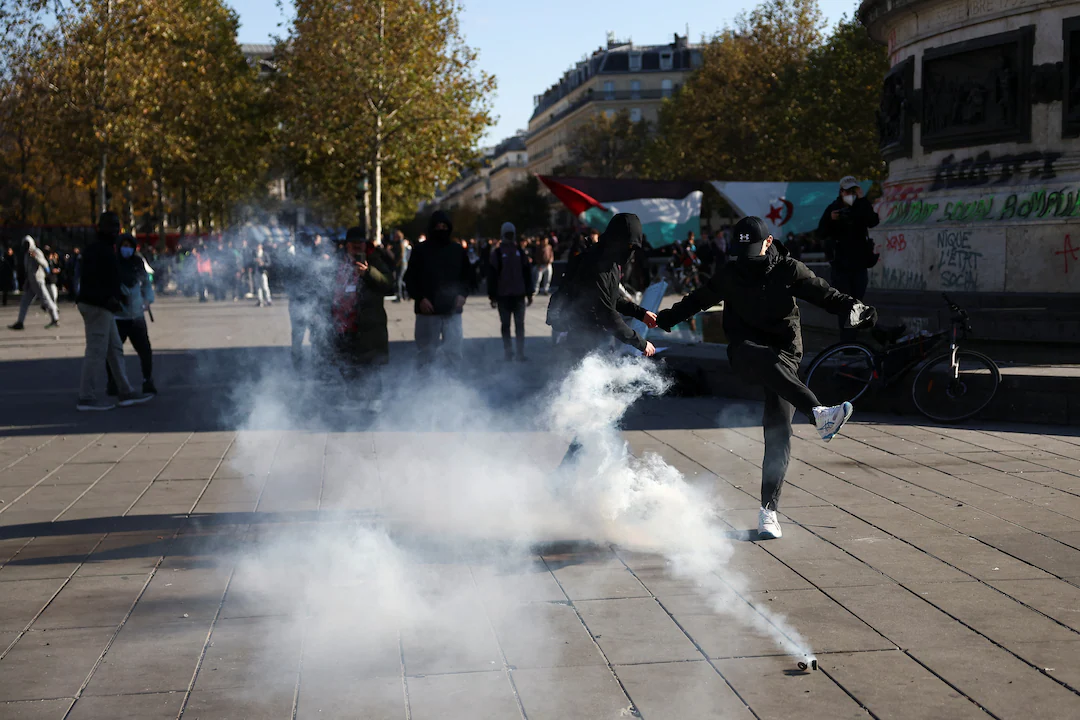
French Prime Minister Sebastien Lecornu has called on local authorities to introduce partial curfews following a weekend of violent protests, rioting and looting across France. The move comes as the government faces mounting pressure to restore public order, address concerns over security preparedness and contain unrest that has followed weeks of student demonstrations.
Speaking to reporters on Monday, October 19, Lecornu said he had asked local authorities to impose partial curfews that evening. He stressed that the restrictions should be limited to specific areas rather than imposed across entire cities, ruling out a blanket curfew covering all of Paris.
The prime minister also left open the possibility of declaring a state of emergency if the security situation required stronger intervention. However, he indicated that targeted curfews were more appropriate at the current stage.
The unrest has intensified political pressure on the French government six months before the country’s next presidential election. Alongside public safety concerns, the demonstrations are unfolding amid economic weakness and rising public debt, adding to the challenges facing the administration.
Meanwhile, mayors of France’s largest cities have demanded explanations from the government over what they described as inadequate preparation by security forces. Interior Minister Laurent Nunez, however, said there were no plans to cancel Tuesday evening’s Paris Saint-Germain versus Barcelona football match.
Why Has the French Prime Minister Called for Partial Curfews?
The decision to seek partial curfews follows violent demonstrations that spread across France during the weekend, with incidents of rioting and looting raising concerns about public safety and the authorities’ ability to maintain order.
According to Lecornu, local authorities had been asked to introduce restrictions on Monday evening as part of the government’s response. The prime minister did not identify the cities that would implement the measures or specify the precise form they would take.
His announcement indicates that the government is seeking a geographically targeted response rather than a nationwide restriction on movement. By limiting curfews to particular locations, authorities could focus on areas where they consider additional public-order measures necessary.
However, the details remain important. Without a confirmed list of affected locations, start and end times, or information about exemptions, it is not yet possible to determine exactly how the restrictions would affect residents and businesses.
The immediate objective is to prevent further violence while allowing daily life to continue in areas not subject to restrictions. The effectiveness of that approach will depend on local assessments, the scale of the unrest and the ability of security forces to respond to incidents as they develop.
Lecornu Rules Out a Blanket Curfew Across Paris
Lecornu made clear that the government did not intend to place the entire French capital under curfew. He said the restrictions should be local and partial, distinguishing the proposed measures from a citywide prohibition on movement.
The distinction is significant because Paris is a major centre of transport, commerce, tourism, cultural activity and public events. A blanket curfew could have consequences for a much wider population than restrictions limited to selected neighbourhoods or locations.
By rejecting a full curfew across Paris, the prime minister signalled that the government preferred a narrower approach at this stage. Local authorities would be expected to determine where restrictions were necessary rather than treating the entire capital as an area requiring the same response.
Nevertheless, Lecornu did not explain how the local curfews would be enforced or which criteria would determine the areas covered. Those decisions could shape how disruptive the measures become for residents, workers and businesses.
The approach also leaves open the possibility that restrictions could differ between cities depending on local circumstances. The prime minister’s announcement did not establish that every major French city would impose identical measures.
French Government Leaves State of Emergency as an Option
Although Lecornu said partial curfews appeared more appropriate for the moment, he did not rule out a state of emergency if the situation deteriorated or authorities concluded that stronger measures were necessary.
He told reporters that he was fully determined to restore public order and indicated that a state of emergency could be declared if deemed necessary.
The statement reflects the government’s effort to balance a firm response to violence with a more limited initial set of restrictions. Partial curfews can target specific locations, while a state of emergency would represent a more significant escalation in the government’s response.
However, Lecornu did not announce that a state of emergency had been declared. His remarks presented it as a possible future option rather than an immediate decision.
The distinction matters because the government’s next steps will depend on how the security situation develops and whether local measures are considered sufficient to contain further disorder.
For now, the announced approach centres on partial curfews, with the possibility of additional action remaining open. The government has not provided enough detail to establish what further restrictions might be considered or under what precise circumstances they would be introduced.
Weekend Riots Follow Weeks of Student Demonstrations
The latest unrest comes after weeks of student demonstrations in France, some of which have been accompanied by episodes of street violence. The weekend’s rioting and looting have added a more serious public-order dimension to the continuing protests.
The sequence of events has increased pressure on the government to explain how it plans to prevent further violence and protect public spaces. The latest announcement also raises questions about whether the authorities can contain disorder without resorting to broader restrictions.
The source information does not specify the original demands behind the student demonstrations or identify the particular events that triggered the weekend violence. It is therefore not possible to attribute the unrest to one specific policy dispute based on the available details.
What is clear is that the protests have become a growing political concern. The government must respond to public-order incidents while dealing with wider pressures linked to the economy and public finances.
That combination can complicate the government’s response. Security measures may be necessary to prevent violence, but they do not automatically resolve the grievances that motivate demonstrations. The authorities must therefore distinguish between addressing immediate threats to public safety and responding to the broader political and economic issues surrounding the unrest.
Mayors Demand Answers Over Security Preparedness
The mayors of France’s largest cities called on the government on Monday to explain what they described as a lack of preparation by security forces ahead of the weekend’s violence.
Their intervention adds pressure to an already difficult situation for the national administration. While the government is seeking to restore public order, local leaders are questioning whether the authorities were adequately prepared to deal with the scale of the disturbances.
The concerns raise several questions about coordination between national and local authorities, the deployment of security personnel and the preparation required when demonstrations carry a risk of violence.
However, the available report does not provide a detailed account of the security arrangements in place before the weekend or establish whether specific operational failures occurred. The mayors’ criticism represents their assessment of the response, rather than a confirmed finding that particular security procedures failed.
Further explanations from the government could help clarify how authorities assessed the risks, what preparations were made and whether changes are needed to prevent similar incidents.
The issue is politically sensitive because local leaders are responsible for their communities’ day-to-day concerns, while national authorities oversee broader security policy. Disagreement over preparedness can become a significant source of pressure when violent incidents expose weaknesses or raise questions about the division of responsibilities.
Will the PSG vs Barcelona Football Match Go Ahead?
Despite the unrest, France’s Interior Minister Laurent Nunez said there were no plans to cancel Tuesday evening’s Paris Saint-Germain versus Barcelona football match.
The announcement suggests that the government was not planning to suspend the high-profile fixture as part of its immediate response to the weekend’s violence. However, the absence of cancellation plans does not establish what specific security arrangements would be used for the match.
Large football fixtures can require coordination between event organisers, local authorities and security services, particularly when concerns about public order are elevated. Any operational decisions would need to reflect the circumstances at the time and the arrangements made by the relevant authorities.
The government has not provided details in the supplied report about additional policing, stadium access measures or transport arrangements for the match.
For supporters and visitors, the key distinction is between the decision not to cancel the event and the separate question of whether local restrictions could affect movement in particular areas. Because Lecornu had not identified the locations covered by the proposed curfews, their possible effect on travel plans remained unclear.
The fixture therefore remained scheduled according to the interior minister’s statement, while the broader security response continued to develop.
Economic Weakness and Rising Debt Add to Political Pressure
The unrest is unfolding at a sensitive moment for French politics, with the next presidential election six months away, according to the report. The government is facing immediate pressure over public safety alongside concerns about a weak economy and rising public debt.
Economic conditions can shape the wider political environment in which protests occur. Questions about employment, living standards, public spending and the government’s handling of national finances can contribute to public dissatisfaction, although the supplied information does not establish that any one economic issue directly caused the latest demonstrations.
France’s rising debt adds another challenge for policymakers. Decisions about public spending and economic policy must be made within a broader debate about the country’s financial position, while the government is also expected to maintain public services and respond to demands from different parts of society.
At the same time, public-order incidents create immediate responsibilities that cannot simply be postponed until wider economic questions are resolved. The government must protect residents and prevent violence while ensuring that its response remains proportionate to the circumstances.
The proximity of the next presidential election increases the political significance of the government’s handling of the crisis. Its decisions on security, restrictions and communication with local leaders could become part of the broader debate about public confidence in the authorities.
However, the available information does not establish how the unrest will affect the election or whether it will alter support for any particular political party or candidate.
What Happens Next After France’s Weekend Riots?
The immediate focus is on whether local authorities implement partial curfews on Monday evening and how the restrictions are applied. Lecornu did not name the affected cities or specify the measures in detail, leaving important practical questions unanswered.
Several developments will determine the next phase of the response.
- Details of local curfews: Authorities will need to clarify which areas are affected, when restrictions begin and end, and whether exceptions apply to particular activities or groups.
- Further security measures: The government has left open the possibility of a state of emergency if stronger action is considered necessary. No such declaration was announced in the supplied report.
- Government response to mayors: Local leaders are seeking answers about security preparedness. Further explanations could clarify how authorities handled the weekend’s demonstrations and whether changes are planned.
- Continuation of public events: Nunez said there were no plans to cancel the PSG versus Barcelona match scheduled for Tuesday evening. The details of any related security arrangements were not provided.
- Development of the protests: The authorities will need to assess whether the unrest continues, subsides or spreads to additional locations.
The government’s decisions in the coming days will show whether targeted restrictions are sufficient to address immediate public-order concerns or whether officials believe additional intervention is required.
Why the Curfew Decision Matters for France
The decision to pursue partial curfews illustrates the challenge of responding to widespread disorder without imposing the same restrictions on every location. A targeted approach allows authorities to focus on areas where they consider controls necessary, but its practical impact depends on how the measures are designed and enforced.
For residents, the immediate questions concern movement, access to public spaces and the effect of restrictions on daily routines. For businesses and event organisers, uncertainty about local measures can complicate planning until authorities provide clearer information.
The dispute over security preparedness adds another layer to the crisis. Mayors want the government to explain what happened during the weekend, while national officials are under pressure to demonstrate that they can restore order.
At the same time, the broader political context cannot be ignored. The protests follow weeks of student demonstrations and are taking place amid economic weakness and rising debt. Even if the immediate violence is contained, the government may continue to face pressure over the concerns surrounding the demonstrations.
The government’s challenge is therefore twofold: prevent further disorder in the short term and manage the wider political pressures that have made the unrest a national concern.
Conclusion
French Prime Minister Sebastien Lecornu has asked local authorities to impose partial curfews following a weekend of violent protests, rioting and looting across France. While he has not ruled out a state of emergency, he said targeted restrictions were more appropriate at this stage and explicitly rejected placing all of Paris under curfew.
The announcement comes as mayors of France’s largest cities demand explanations about security preparedness and the government faces questions about its handling of the unrest. Interior Minister Laurent Nunez has said there are no plans to cancel Tuesday evening’s PSG versus Barcelona football match.
The immediate outcome will depend on how local authorities implement the proposed restrictions and whether the measures help prevent further violence. The government must also respond to criticism from local leaders while managing a broader political environment shaped by student demonstrations, economic weakness and rising public debt.
Although the proposed curfews are intended to restore public order, they do not by themselves resolve the wider issues surrounding the protests. The coming days will reveal whether targeted restrictions are sufficient to contain the unrest and how the government responds to demands for greater clarity about security preparations.
For breaking news and live news updates, like us on Facebook or follow us on Twitter and Instagram. Read more on Latest World on thefoxdaily.com.




COMMENTS 0