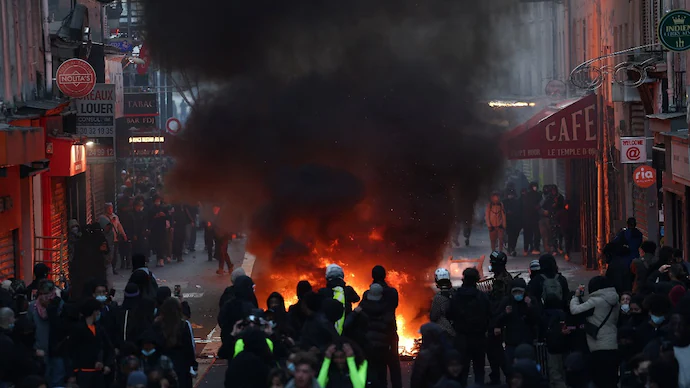
More than four lakh people took to the streets across France on Saturday to protest against rising living costs, economic inequality and deteriorating public services, as clashes between demonstrators and police erupted in several major cities. Security forces fired tear gas and deployed water cannon to disperse crowds, despite a large-scale security operation intended to prevent a repeat of the violence witnessed the previous weekend.
The French Interior Ministry estimated the nationwide turnout at approximately 4.1 lakh, while trade unions put the figure at nearly 8 lakh, according to Reuters and AFP. The demonstrations reflected growing public discontent over living expenses, school conditions, public services and the government’s handling of the country’s social and economic challenges.
Although several marches remained largely peaceful, confrontations occurred in Paris, Lyon, Marseille, Bordeaux, Lille, Nantes and other cities. Police used tear gas and other crowd-control measures as tensions escalated, while some protesters reportedly threw stones and bottles, set rubbish bins on fire and obstructed streets.
Authorities deployed 70,000 police officers and gendarmes nationwide, underlining concerns about possible violence and property damage. French Interior Minister Laurent Nunez said 135 people had been arrested across the country by early afternoon.
Over 4 Lakh People Join Protests Across France
The demonstrations brought together people protesting against the rising cost of living, economic inequality and what they described as the deterioration of essential public services. The movement initially emerged from student protests over school conditions in the suburbs of Paris last month before expanding into a wider expression of dissatisfaction with the government.
The difference between the official turnout estimate and the unions’ assessment highlighted the scale of disagreement over participation in the demonstrations. While the Interior Ministry reported approximately 410,000 participants, trade unions estimated that close to 800,000 people had joined marches across France.
The protests took place amid wider concerns about the affordability of everyday life and the quality of public services. Demonstrators also objected to government decisions affecting education and public spending, bringing different grievances together under a broader challenge to the administration’s handling of social issues.
The movement’s expansion from school-related demonstrations into a nationwide protest campaign illustrated how concerns over individual public services can become connected to wider economic dissatisfaction. However, the supplied reports do not establish that all participants shared the same political demands or belonged to a single organised movement.
Clashes Erupt in Paris as Police Use Tear Gas and Water Cannon
In Paris, police estimated that approximately 110,000 people participated in the march. The demonstration was largely peaceful for much of its course, but clashes broke out towards the end, prompting police to use batons and tear gas to push back groups of protesters.
Water cannon was also deployed as security personnel attempted to disperse crowds, AFP reported. The confrontations came despite preparations designed to prevent a recurrence of the looting and vandalism that had damaged businesses during the previous weekend.
Other major cities also witnessed tensions. Clashes were reported in Lyon, Marseille, Bordeaux, Lille and Nantes, with police firing tear gas at several locations as confrontations intensified.
In Marseille, protesters reportedly blocked a street using metal sheets, set rubbish bins on fire and threw stones and bottles at riot police, Reuters reported. The incidents added to concerns about maintaining public order during a nationwide protest involving hundreds of thousands of people.
The developments demonstrated the challenges authorities faced in managing large demonstrations across multiple cities simultaneously. While the scale of the turnout was substantial, the reported confrontations occurred at particular locations and should not be taken to mean that every march or participant was involved in violence.
France Deploys 70,000 Police Officers and Gendarmes
French authorities deployed 70,000 police officers and gendarmes across the country, around 10,000 more than during the previous weekend. The expanded deployment followed widespread looting and vandalism that had damaged thousands of shops and businesses.
Interior Minister Laurent Nunez said 135 people had been arrested nationwide by early afternoon on Saturday. Police searches also uncovered fireworks, metal balls and other objects that authorities said could be used as weapons.
The increased security presence reflected the government’s determination to prevent further damage and control confrontations during the demonstrations. Police and gendarmes were deployed across cities to monitor marches, respond to incidents and protect public spaces and businesses.
However, the security arrangements themselves became part of the controversy. Protest organisers and union representatives criticised restrictions imposed on demonstrations, arguing that the authorities’ approach had limited the ability of people to exercise their right to protest.
The competing priorities of maintaining public order and allowing peaceful demonstrations remained central to the dispute. Authorities sought to prevent violence and property damage, while unions argued that security decisions should not unnecessarily restrict public participation.
Paris Takes Precautions as Shops and Museums Close
Paris adopted extensive precautionary measures ahead of the demonstrations. Shopkeepers boarded up storefronts to protect their premises, while major cultural institutions, including the Louvre and the Musée d’Orsay, closed their doors.
More than 20 metro stations were also closed as a precaution, adding to the disruption across parts of the capital. The measures reflected concerns about the possibility of violence in busy commercial and tourist areas.
The closures affected access to cultural attractions and public transport, while boarded-up shopfronts changed the appearance of parts of the city. Businesses faced the possibility of lost trade, while residents and visitors had to contend with transport restrictions and security arrangements.
The precautions followed the previous weekend’s violence, when widespread looting and vandalism damaged thousands of shops and businesses. Authorities increased the security deployment for Saturday’s protests in an effort to avoid similar scenes.
However, the scale of the precautionary measures also illustrated the wider disruption that large demonstrations can cause, even in areas where marches remain peaceful. The supplied reports do not provide a final estimate of the economic losses or the total number of businesses affected by Saturday’s events.
Unions Criticise Last-Minute Change to Paris March Route
The Paris demonstration was moved at the last minute from Bastille, in the city centre, to Porte d’Italie on the southeastern edge of the capital. The change drew criticism from trade unions, which argued that the authorities were restricting the right to demonstrate.
One union representative described the decision as “scandalous”, reflecting organisers’ objections to the altered route. The change became a significant point of tension between protest organisers and authorities, even as police prepared for the possibility of clashes.
For unions, the route decision raised questions about the conditions under which large public demonstrations could take place. They argued that restrictions should not prevent people from making their concerns visible in central public spaces.
Authorities, meanwhile, were operating against the backdrop of the previous weekend’s violence and the need to manage security risks. The supplied account does not provide a detailed official explanation for the last-minute change, so the precise reasons for the decision cannot be established from the available information.
The disagreement illustrates the broader challenge facing French authorities: balancing the management of large crowds and potential violence with demonstrators’ ability to assemble and express opposition to government policies.
How School Protests Expanded Into a Wider Anti-Government Movement
The demonstrations began last month with student protests over school conditions in suburban Paris. Those concerns subsequently became part of a broader movement addressing the cost of living, economic inequality and the government’s handling of public services.
Education-related grievances included concerns about staffing shortages, overcrowded schools and deteriorating facilities. The protests also reflected dissatisfaction with the availability of university places and the way access to higher education is managed.
As the demonstrations expanded, wider economic concerns became more prominent. Rising living costs and dissatisfaction with public services brought additional participants into the protest movement, turning what began as a series of student demonstrations into a nationwide campaign.
The breadth of the issues involved means that the protests cannot be reduced to a single demand. Participants may have different reasons for taking part, ranging from education and public spending to household expenses and broader dissatisfaction with the government’s direction.
The turnout figures reported by the Interior Ministry and trade unions show that the demonstrations drew substantial participation, although the competing estimates differ considerably. The supplied information does not establish how much support each individual demand received among those attending.
Jean-Luc Mélenchon Calls for Macron to Address Social Discontent
Left-wing leader Jean-Luc Mélenchon joined the Paris march and praised demonstrators for their restraint. He also warned that protests would continue until President Emmanuel Macron addressed what he described as growing social discontent.
Mélenchon’s remarks linked the street demonstrations to the wider political debate over the government’s response to economic pressures and public-service concerns. His participation added a prominent political voice to the protests, although the demonstrations included people raising a range of grievances.
His warning suggested that the immediate marches might not bring the movement to an end. The possibility of further demonstrations would depend on how organisers and participants assess the government’s response to their concerns.
The supplied account does not indicate that Macron announced any new measures in response to Saturday’s protests. It also does not establish whether the government planned negotiations with the unions or changes to the policies criticised by demonstrators.
Yellow Vests Movement Plans Further Demonstrations for October 31
The Yellow Vests movement has called for another round of demonstrations on October 31. The planned actions are expected to include rallies and a sit-in outside parliament and city halls across France.
The movement takes its name from the bright yellow jackets worn by participants. It began in 2018 in response to rising fuel prices and living costs before developing into a wider protest movement against economic inequality and President Emmanuel Macron’s policies.
The latest call for demonstrations indicates that discontent over living expenses and government policy remains a recurring feature of French public life. The planned rallies could provide another opportunity for people to express concerns that extend beyond the immediate issues driving Saturday’s protests.
However, the announcement of further demonstrations does not establish how many people will participate or whether the events will involve confrontations. Attendance, security arrangements and the scale of disruption will depend on developments closer to the planned date.
The Yellow Vests movement’s earlier emergence over fuel prices and household costs also provides historical context for the current protests. Both episodes have involved concerns about the financial pressures facing ordinary households, although the latest demonstrations have also focused on school conditions and public services.
What the Protests Mean for France’s Government
Saturday’s demonstrations presented the French government with a combination of public dissatisfaction, security challenges and criticism over restrictions on protest routes. The turnout estimates, which ranged from approximately 410,000 according to the Interior Ministry to nearly 800,000 according to trade unions, showed the scale of participation while highlighting differences in how the event was measured.
The reported clashes in several cities underscored the difficulty of maintaining public order during large demonstrations. At the same time, the decision to move the Paris march and the extensive precautionary closures drew criticism from unions concerned about the right to demonstrate.
The protest movement has grown from concerns about education and school conditions into a broader expression of dissatisfaction with living costs, inequality and public services. Mélenchon’s call for Macron to address social discontent and the Yellow Vests movement’s planned October 31 demonstrations suggest that the political debate may continue beyond Saturday’s events.
For now, the immediate picture is one of substantial nationwide mobilisation accompanied by isolated but serious confrontations. Authorities have emphasised security, while protesters and unions have continued to press their grievances and challenge restrictions on demonstrations.
The next phase will depend on whether the government responds to the concerns raised, how protest organisers proceed with planned actions and whether future demonstrations can take place without the violence and disruption reported during the latest unrest.
For breaking news and live news updates, like us on Facebook or follow us on Twitter and Instagram. Read more on Latest World on thefoxdaily.com.





COMMENTS 0