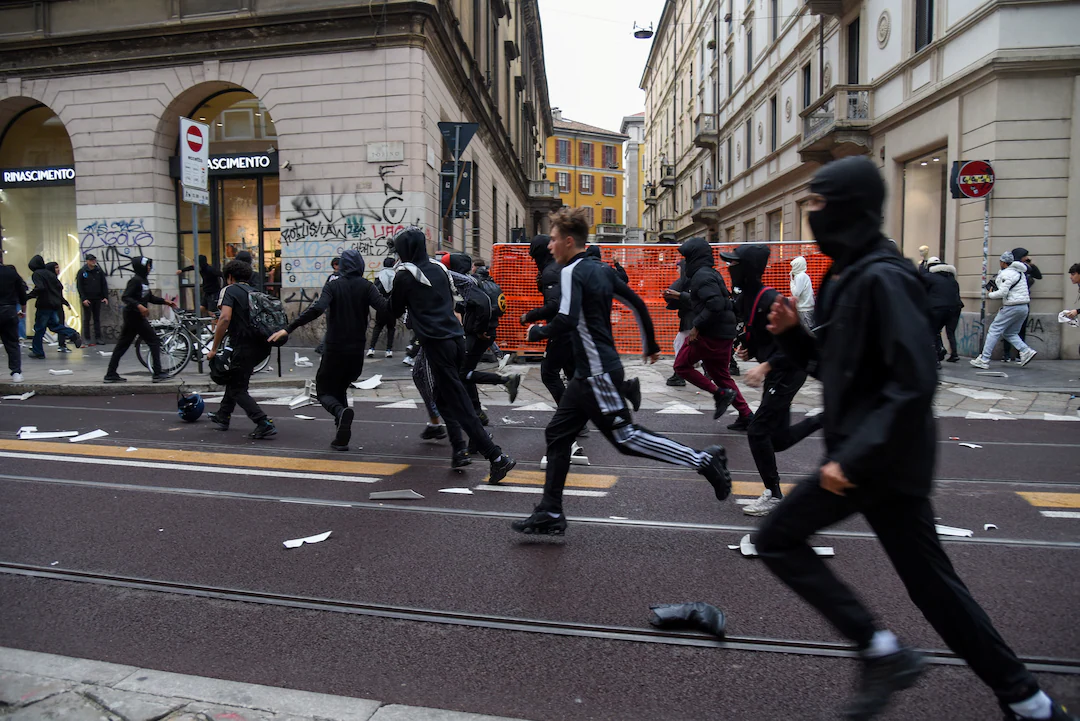
Police clashed with protesters in Milan on Sunday, October 18, after demonstrations over poor public services and the rising cost of living turned violent for a second consecutive day in Italy. Officers in riot gear used tear gas and water cannons after groups of hooded demonstrators reportedly threw stones, smashed shop windows and set rubbish bins on fire near the city’s central Piazza Duomo.
Several hundred protesters were involved in the disturbances, according to sources familiar with the investigation who spoke to Reuters. More than 60 people were taken to a police station for further checks, the sources said, as authorities sought to establish the circumstances surrounding the violence.
The unrest followed similar clashes on Saturday in several Italian cities, including Milan, Bologna, Brescia, Bergamo and Turin. A police report issued on Sunday said 28 protesters had been arrested following Saturday’s disturbances.
The demonstrations have put pressure on Prime Minister Giorgia Meloni’s government as public frustration over living costs and the quality of public services fuels unrest. Meloni condemned the violence and announced a government meeting for Monday to discuss how to respond to the situation.
Police use tear gas and water cannons in Milan
The latest clashes took place near Piazza Duomo, one of Milan’s best-known public squares and a major gathering point in the city centre. According to sources with knowledge of the investigation, several hundred hooded protesters broke shop windows and set rubbish bins on fire during Sunday’s demonstrations.
Police in riot gear responded with tear gas and water cannons as confrontations escalated. The use of these crowd-control measures marked a sharp turn in demonstrations that centred on dissatisfaction with public services and the rising cost of living.
More than 60 protesters were taken to a police station for further checks, the sources told Reuters. This figure refers to people taken in for checks and should not be confused with a confirmed arrest total for Sunday’s clashes.
The available reports did not establish how many people were injured or provide a complete account of damage to businesses and public property. Authorities were continuing to examine the events surrounding the confrontation.
The location of the unrest also brought the demonstrations into a prominent commercial and tourist area. Damage to shopfronts and fires involving rubbish bins added to the disruption near the central square, while police attempted to contain the crowds.
Saturday clashes spread across several Italian cities
Sunday’s violence followed unrest on Saturday in a number of northern Italian cities. According to a police report issued on Sunday, 28 protesters were arrested after clashes in Milan, Bologna, Brescia, Bergamo and Turin.
The spread of disturbances across several urban centres indicated that the unrest was not confined to a single neighbourhood or city. However, the reported incidents do not establish that every demonstration involved violence or that all participants shared the same motivations.
The central issues cited in the demonstrations were poor public services and the increasing cost of living. These concerns can affect households through different channels, including the affordability and reliability of essential services and the pressure that everyday expenses place on family budgets.
When dissatisfaction over living standards becomes a focus of public protest, governments face pressure to demonstrate that they understand the concerns and can offer credible responses. At the same time, clashes, vandalism and looting can shift public attention away from protesters’ stated grievances and towards questions of public safety and law enforcement.
The Italian authorities now face the task of responding to the unrest while distinguishing peaceful demonstrators from those accused of criminal acts. The available reports did not identify a single organisation responsible for the demonstrations or establish that all the incidents were coordinated.
Rising living costs and public services at the centre of protests
The demonstrations were driven by concerns about the cost of living and the quality of public services, according to the Reuters report. Both issues can become politically sensitive when people feel that essential services are inadequate while household expenses continue to strain their budgets.
Public services influence daily life through areas such as transport, healthcare and other essential facilities. When services fail to meet expectations, dissatisfaction can compound wider economic anxiety, particularly among people who already feel financially stretched.
However, the report did not provide detailed economic data or identify specific services at the centre of the Italian demonstrations. It is therefore not possible to attribute the unrest to one policy, price increase or government decision based on the available information.
The protests nevertheless present a political challenge for Meloni’s administration. Demonstrations over living standards can put pressure on governments to explain their economic priorities, address shortcomings in public services and show how their policies will affect ordinary households.
Authorities must also manage the immediate consequences of violence. Damage to shops and public property can affect businesses and residents, while confrontations between police and demonstrators risk further escalation if tensions remain high.
Giorgia Meloni condemns violence and calls government meeting
Prime Minister Giorgia Meloni condemned the violence and announced a government meeting for Monday, October 19, to discuss how to address the situation. Her response came as the unrest continued into a second day and reports of clashes emerged from several cities.
Meloni is facing an election next year, adding a political dimension to the government’s handling of the demonstrations. Public dissatisfaction with living costs and public services can become an important issue for voters, while the government’s response to street violence may influence debate over public order.
The announced meeting is expected to provide an opportunity for the government to discuss its response to the unrest. The available report did not specify which measures would be considered or whether the meeting would produce new policies, security arrangements or financial commitments.
Condemning violence and addressing the concerns behind the demonstrations are separate challenges. The government must respond to property damage and public disorder while also considering the grievances cited by protesters. A response focused only on security may leave economic and service-related frustrations unresolved, while failure to contain violence could further undermine public confidence.
The developments also raise questions about how the authorities will handle future demonstrations. The reported arrests and police checks form part of the immediate response, but the longer-term outcome will depend on the government’s decisions and whether tensions surrounding living standards ease.
Italian unrest echoes protests in neighbouring France
The clashes in Italy came as France experienced major demonstrations over rising costs and declining public services. Hundreds of thousands of people took to the streets in France on Saturday, according to the Reuters report, in protests described as among the country’s most violent in years.
The comparison highlights how economic pressures and dissatisfaction with essential services can become major sources of public mobilisation in different European countries. Yet the demonstrations in Italy and France should not automatically be treated as part of a single movement: the available reporting does not establish that they shared organisers, demands or a direct connection.
Both countries have faced public debate over the affordability of everyday life and the performance of public institutions. When these concerns overlap, they can create pressure on governments to explain how they intend to protect living standards and maintain reliable services.
The reference to France also underlines the potential for demonstrations to escalate when large crowds gather amid strong public frustration. In Italy, the reported use of tear gas and water cannons, damage to shopfronts and fires involving rubbish bins show how quickly some demonstrations can turn into confrontations with police.
Still, the scale and circumstances of the protests differ. The reported turnout in France should not be used to estimate the number of people involved in Italy, where the Milan disturbances were described as involving several hundred hooded protesters near Piazza Duomo.
What happens next after two days of unrest?
The immediate focus in Italy is likely to remain on the police response, the investigation into the clashes and the government’s discussions about how to address the unrest. The meeting announced by Meloni for Monday is an important next step, although its outcome was not available in the report.
Authorities will need to establish the circumstances of the violence, including the actions that led to damage and fires and the conduct of those involved. The distinction between people detained for checks and those formally arrested is also important when assessing the scale of police action.
For the government, the challenge extends beyond restoring order. The concerns identified by protesters involve the cost of living and public services, issues that can persist even after demonstrations end. Whether the unrest leads to policy changes or further protests will depend on developments that remain uncertain.
The events in Milan demonstrate the difficulty governments face when public frustration spills into the streets. Police action may contain immediate disorder, but a lasting response will also require attention to the issues at the centre of the demonstrations.
For now, Italy faces a combination of public-order concerns and political pressure, with the next steps expected to become clearer after the government’s planned meeting. The situation remains fluid, and further developments will determine whether the weekend’s clashes mark a short-lived outbreak of unrest or the beginning of a more sustained period of protest.
For breaking news and live news updates, like us on Facebook or follow us on Twitter and Instagram. Read more on Latest World on thefoxdaily.com.




COMMENTS 0