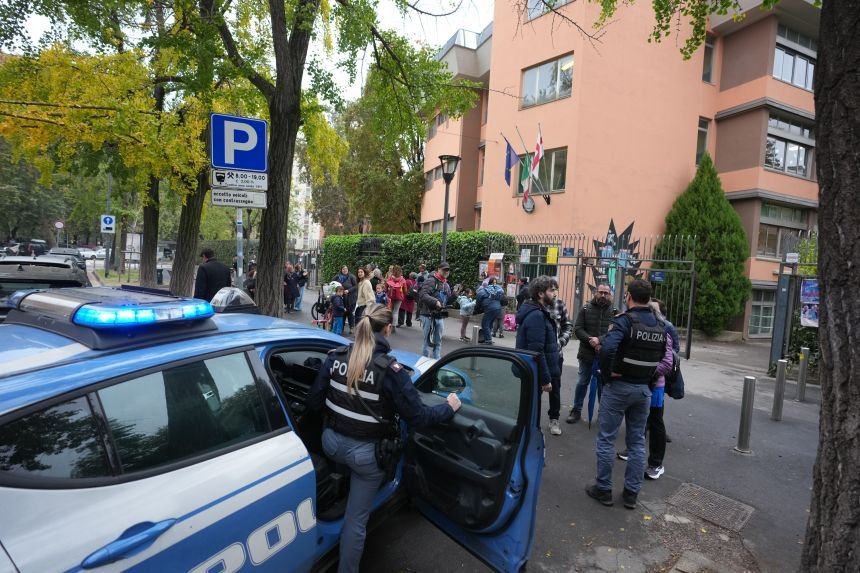
Hundreds of schools across Italy were affected by bomb threats sent through email on Wednesday, leading to precautionary evacuations as police investigated the origin of the messages. The incident also triggered concern across the United Kingdom and Ireland, where schools received similar threatening communications.
Italian authorities said there was no indication of a concrete danger at the time, although local police advised schools on how to respond. The exact number of institutions evacuated remained unclear because individual schools made decisions based on guidance from their local police departments.
In the UK and Ireland, police treated the messages as likely hoaxes and assessed the risk to the public as low. Schools in Scotland, Northern Ireland and the Republic of Ireland were not advised to evacuate solely because of the emails.
The incidents come amid a wider series of suspicious threats and cyber-related disruptions affecting organisations and infrastructure across Europe. Authorities are investigating whether the latest messages are connected to previous hoax threats reported in the region.
Italy Bomb Threats: Hundreds of Schools Receive Emails
Italian police confirmed that hundreds of schools received bomb threat emails on Wednesday. The messages prompted different responses across the country, with some institutions evacuating students and staff as a precaution.
A spokesperson for the Italian police said the exact number of affected schools had not yet been established. Because the emails were distributed to hundreds of institutions, each school decided whether to evacuate after receiving advice from its local police branch.
Education Minister Giuseppe Valditara told Italian television that approximately 300 schools had received the threatening messages. He described the incident as related to cyberattacks rather than a genuine physical security risk.
Authorities were investigating the source of the emails. The police spokesperson said inquiries were ongoing but declined to confirm the email address from which the messages had been sent.
The uncertainty surrounding the number of evacuations reflects the decentralised response. Some schools temporarily cleared their buildings, while others followed local police advice without carrying out a full evacuation.
Children Evacuated From Primary School in Central Rome
The threats also affected schools in central Rome, where the Quirinio Visconti primary school was evacuated. Dozens of kindergarten and primary school children were given time away from classes after the institution responded to the warning.
A teacher told CNN that parents were notified and asked to collect their children from the school. The evacuation disrupted the normal school day, even though Italian officials had not identified evidence of a concrete danger.
The incident illustrates how threatening communications can affect everyday activities even when authorities suspect that the warnings are false. Schools must consider the safety of students and staff while waiting for police assessments.
For parents, receiving a message asking them to collect children unexpectedly can create anxiety, particularly when the reason involves a reported bomb threat. School administrators and local authorities therefore have to communicate clearly about precautionary measures and any changes to normal operations.
Giorgia Meloni Says No Concrete Danger Has Been Identified
Italian Prime Minister Giorgia Meloni said the government was closely monitoring the reports of bomb threats directed at schools. In a statement, she said there was currently no indication that a concrete danger existed.
Meloni said the incidents appeared to be intended to generate alarm and concern. She also stressed that the government was taking the necessary steps to protect citizens.
Her comments came as police continued investigating the origin of the messages and local authorities coordinated responses with schools.
The government’s assessment did not mean that the warnings were being ignored. Rather, authorities were treating the communications as incidents requiring investigation while indicating that the available information did not point to an immediate, credible threat.
The distinction is important because bomb threat reports can trigger precautionary action even when investigators have not found evidence of an actual explosive device or a specific plan to cause harm.
Northern Ireland: More Than 300 Schools Receive Threatening Email
Similar threatening communications were reported in Northern Ireland, where police said more than 300 schools had received an email on Wednesday.
The Police Service of Northern Ireland said the message originated outside the United Kingdom and was being treated as a hoax. Investigators continued examining the communication, but the force said the risk to the public was considered low at that stage.
Assistant Chief Constable Anthony McNally said police inquiries were ongoing. He also said authorities did not consider the available information to indicate a significant public safety risk.
The Education Authority said the email had been sent to a large number of schools across Northern Ireland. It noted similarities between the latest communication and a hoax message sent to schools the previous month.
The authority said it was unaware of evidence suggesting that the latest message represented a credible threat. The assessment helped guide the response of schools and public authorities across the region.
Despite the low-risk assessment, the incident required police attention because threatening messages sent to large numbers of schools can cause widespread disruption and concern.
Republic of Ireland Police Say School Threat Is Not Credible
Police in the Republic of Ireland also reported receiving information about threatening communications sent to educational institutions on Wednesday.
The Gardaí said a generic communication had been sent to a number of educational establishments. After assessing the information, police described the threat as not credible.
Authorities said they were not advising schools to evacuate. This meant that educational institutions could continue operating without carrying out precautionary closures solely because of the email.
The response was consistent with the assessments made by police in Northern Ireland and Scotland, where similar communications were also treated as hoaxes.
However, police assessments can change if new information emerges. Authorities continued their inquiries into the messages and their origins.
Scotland Schools Also Receive Threatening Messages
Police Scotland confirmed that schools had received threatening messages on Wednesday. The force said the communications were being treated as hoaxes and advised that the emails alone did not justify evacuating educational facilities.
The police response was intended to prevent unnecessary disruption while ensuring that schools remained aware of the situation. Authorities assessed the information available to them before advising institutions on appropriate action.
Unlike the response in parts of Italy, where schools were evacuated following local police guidance, schools in Scotland were not told to leave their buildings solely because of the messages.
The different responses reflected the assessments made by authorities in each location. Police decisions about evacuations depend on the information available, the credibility of a threat and any specific risks identified during an investigation.
Why Were Schools in Multiple European Countries Targeted?
The simultaneous reports from Italy, Northern Ireland, Scotland and the Republic of Ireland have raised questions about the origin and possible coordination of the emails.
Authorities have not established in the information released so far whether the communications were part of a single coordinated campaign. Police in Italy were investigating the source of the emails, while authorities in the UK and Ireland were examining the messages received by schools in their jurisdictions.
The fact that similar threats were reported in several countries does not, by itself, establish that the same individual or group was responsible. Investigators would need to examine technical information, message content, transmission details and other evidence before reaching that conclusion.
The reports nevertheless highlight how email-based threats can spread disruption across multiple regions without requiring a physical incident at every location mentioned in the messages.
When schools receive threatening communications, administrators may need to contact police, inform parents, assess whether buildings should be cleared and arrange alternative plans for students. Even when messages are eventually classified as hoaxes, these steps can affect thousands of people.
Previous Hoax Bomb Threats Disrupted Flights and Media Organisations
Wednesday’s incidents follow a series of hoax bomb threats reported across Europe during the previous week. Those communications disrupted dozens of flights and affected media organisations in different parts of the continent.
The earlier incidents demonstrated how false security warnings can create operational problems for organisations that must respond to potential threats. Airports may need to review security procedures and delay operations, while media organisations may have to investigate warnings and protect staff and visitors.
Schools face similar challenges because they are responsible for large numbers of students, including young children who may require assistance during an evacuation.
The latest messages have therefore added to concerns about the use of threatening emails to disrupt public institutions and essential services. However, investigators have not confirmed whether the school threats are connected to the incidents reported the previous week.
How Authorities Assess Bomb Threat Emails
When a school receives a bomb threat, police and relevant authorities must determine whether the message contains information indicating a credible danger. The assessment may involve examining the wording of the communication, its origin and any available intelligence or supporting evidence.
Authorities must also consider the circumstances of the institution receiving the warning. A message sent to several hundred schools may require a coordinated response, but the appropriate action can differ depending on local information and police guidance.
In Italy, local police branches advised schools, which then decided whether to evacuate. In Northern Ireland, Scotland and the Republic of Ireland, police assessments indicated that the emails did not justify evacuations at the time.
These different approaches do not necessarily indicate conflicting assessments. Police forces operate within their own jurisdictions and make decisions based on the specific information available to them.
What the School Threats Mean for Parents and Students
The incidents have disrupted education for students and created uncertainty for families in several European countries. In Italy, some parents had to collect children after schools decided to evacuate their buildings.
Even when a threat is considered a hoax, the possibility of a security incident can require schools to take precautionary steps. Administrators must balance the need to protect students with the disruption caused by unnecessary evacuations.
Clear communication is particularly important during such incidents. Parents need accurate information about whether a school is closing, whether children must be collected and whether normal classes will resume.
Authorities also need to avoid creating unnecessary alarm while ensuring that schools take official instructions seriously. Police assessments and verified updates are therefore more useful than unconfirmed messages circulating online.
Italy, UK and Ireland Bomb Threats: What We Know So Far
| Country or region | Reported impact | Police assessment | Evacuation guidance |
|---|---|---|---|
| Italy | Hundreds of schools received emails; around 300 were reported by the education minister | No indication of a concrete danger at the time | Some schools evacuated following local police advice |
| Northern Ireland | More than 300 schools received a threatening email | Message treated as a hoax; public risk considered low | No general evacuation advised |
| Republic of Ireland | Several educational institutions received a generic communication | Threat assessed as not credible | Police did not advise evacuations |
| Scotland | Schools received threatening messages | Messages treated as hoaxes | Emails alone did not warrant evacuation |
Investigations Continue as Authorities Trace the Source of the Emails
Police investigations are continuing across the affected countries. In Italy, authorities are working to identify the source of the messages and determine who sent them. The police spokesperson has not confirmed the email address involved.
In Northern Ireland, police said the threatening message originated outside the United Kingdom. The Education Authority also noted similarities with a hoax sent to schools in the previous month.
Authorities in Scotland and the Republic of Ireland have also assessed the messages received by educational institutions in their respective areas. At the time of the reported incidents, neither jurisdiction was advising schools to evacuate.
Investigators will need to establish whether the messages came from a common source or were separate incidents. Until further evidence becomes available, claims about who was responsible or whether the incidents were coordinated remain unconfirmed.
Why the Latest Bomb Threats Matter for European Security
The school threats underline the disruption that suspicious digital communications can cause across borders. A single email campaign, or several similar campaigns, can force public institutions to divert staff and resources towards security assessments even when no physical danger is identified.
Schools are particularly sensitive targets because decisions about safety involve children, parents, teachers and local authorities. Even a warning later assessed as a hoax can interrupt lessons, require emergency communication and create anxiety among families.
The incidents also come amid reports of other threats and cyber-related disruptions affecting European organisations. The earlier disruption to flights and media organisations shows that false warnings can affect different sectors, although a direct connection between those incidents and Wednesday’s school emails has not been established.
For now, authorities in Italy, the UK and Ireland are treating the school threats as suspected hoaxes while continuing their investigations. Italian schools carried out precautionary evacuations in some locations, whereas police in Scotland and Ireland did not recommend evacuations based on the messages alone.
The key unanswered question is who sent the emails and whether the incidents across the four countries were connected. Until investigators establish the origin and credibility of the communications, the events remain a developing security investigation rather than evidence of confirmed explosive threats at the schools.
For breaking news and live news updates, like us on Facebook or follow us on Twitter and Instagram. Read more on Latest World on thefoxdaily.com.





COMMENTS 0