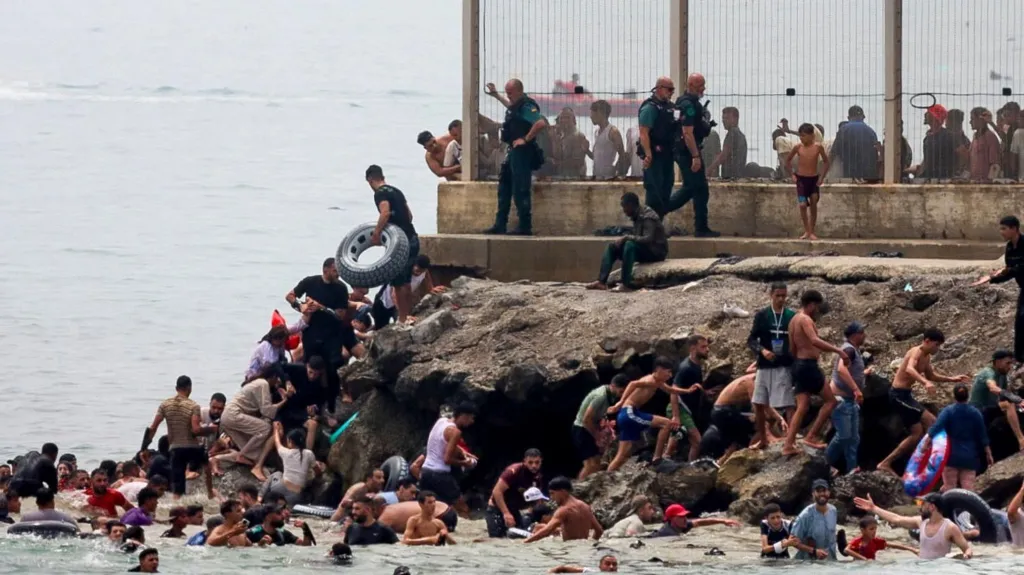
Spain is facing a major border and humanitarian challenge after officials estimated that approximately 49,000 migrants entered the Spanish enclave of Ceuta from Morocco within a 24-hour period. The unprecedented influx, involving crossings by both land and sea, has overwhelmed local authorities and prompted Madrid to deploy additional security forces to the region.
The sudden rise in arrivals comes against the backdrop of evolving legal rulings, ongoing migration pressures across the Mediterranean, and continued cooperation between Spain and Morocco on border management. Officials have also confirmed that thousands of those who crossed are minors, while multiple fatalities have been reported during attempts to reach Spanish territory, highlighting the humanitarian risks associated with irregular migration.
The latest developments have once again placed Ceuta at the center of Europe’s migration debate, raising questions about border security, asylum procedures, international cooperation, and the protection of vulnerable migrants.
What Happened in Ceuta?
According to Spanish authorities, an estimated 49,000 migrants crossed into Ceuta over the course of a single day, making it one of the largest migration surges ever recorded at the enclave.
Images and videos circulating from the area showed thousands of people attempting to reach Spanish territory by swimming around coastal barriers or entering through land routes. Local reports indicated that crossings continued beyond daylight hours, placing additional strain on emergency services and border authorities.
The estimated number of arrivals represents more than half of Ceuta’s resident population, illustrating the extraordinary scale of the situation.
Timeline of the Crisis
| Event | Development |
|---|---|
| Recent Weeks | Authorities report an increase in attempted crossings. |
| Supreme Court Decision | Spain’s highest court issues a ruling affecting migrant return procedures. |
| Mass Crossings Begin | Thousands enter Ceuta by land and sea. |
| Emergency Response | Spain deploys armed forces to reinforce border security. |
| Government Action | Authorities coordinate with Morocco on border management and migrant returns. |
| Political Visit | Prime Minister Pedro Sánchez is expected to visit Ceuta. |
Why Ceuta Is Strategically Important
Ceuta is one of two Spanish autonomous cities located on the northern coast of Africa, the other being Melilla. Although geographically situated on the African continent, both territories are part of Spain and, therefore, form part of the European Union’s external border.
This unique geographical position makes Ceuta one of the most significant entry points for migrants seeking access to Europe. Because of its proximity to Morocco, the enclave has experienced repeated migration pressures over many years.
Who Are the Migrants?
Officials estimate that approximately 7,000 of those who entered Ceuta during the latest surge are minors. The large number of children and teenagers among the arrivals presents additional legal and humanitarian responsibilities for Spanish authorities.
Managing such a large influx requires coordination across multiple government agencies responsible for border security, emergency healthcare, child protection, temporary accommodation, and immigration processing.
Authorities have also reported that at least 18 people died in recent days while attempting to reach Spanish territory, underscoring the dangers associated with irregular sea crossings.
Spain’s Response
In response to the unprecedented influx, Spain moved quickly to strengthen security in both Ceuta and Melilla.
- Deployment of additional armed forces.
- Reinforcement of border security operations.
- Coordination with Moroccan authorities.
- Preparation for migrant reception and processing.
- Emergency support for local administration.
The Interior Ministry also stated that it is working with Morocco regarding the return of migrants who entered illegally, in accordance with applicable legal procedures.
The Impact of the Supreme Court Ruling
The latest migration surge follows a significant decision by Spain’s Supreme Court concerning migrants intercepted while attempting to reach Ceuta or Melilla by sea.
The ruling established legal standards regarding how migrants intercepted during maritime crossings should be treated, increasing attention on due process and applicable legal protections.
Although migration experts caution against linking any single legal decision directly to migration flows, judicial rulings often influence how border authorities implement operational procedures.
Ceuta 2026 Compared With Previous Migration Surges
| Aspect | 2021 Crisis | 2026 Situation |
|---|---|---|
| Estimated Arrivals | Over 10,000. | Approximately 49,000 reported. |
| Border Response | Emergency deployment. | Military reinforcement and expanded operations. |
| Humanitarian Concerns | High. | Significant, with thousands of minors involved. |
| Political Attention | National and European. | Renewed focus on migration policy. |
Humanitarian Challenges
Large-scale migration events create immediate humanitarian needs that extend beyond border enforcement.
Authorities must ensure access to food, temporary shelter, medical assistance, sanitation, and protection for vulnerable individuals, particularly children traveling without family members.
At the same time, governments must balance humanitarian responsibilities with immigration enforcement and national security considerations.
Why This Matters for Europe
The situation in Ceuta has implications well beyond Spain.
As one of the European Union’s external borders, developments in Ceuta often influence broader discussions on migration management, border cooperation, asylum policy, and responsibility-sharing among EU member states.
Large migration movements also require close diplomatic coordination between Spain and Morocco, whose cooperation remains central to managing cross-border movements in the region.
A Unique Insight: Migration Is Increasingly Driven by Multiple Overlapping Factors
Modern migration flows rarely have a single cause. Economic pressures, regional instability, legal developments, climate-related challenges, family reunification, and human smuggling networks often interact simultaneously.
The latest developments in Ceuta illustrate how changes in legal frameworks, border management practices, and regional conditions can combine to produce rapid increases in migration. This complexity means that long-term solutions require more than stronger border controls alone—they also depend on international cooperation, humanitarian planning, and addressing the underlying factors that encourage irregular migration.
For policymakers, balancing border security with humanitarian obligations will remain one of the most significant challenges in managing future migration flows.
What Happens Next?
Spanish authorities are expected to continue processing new arrivals while strengthening security operations in Ceuta and Melilla. Cooperation with Moroccan authorities is also likely to remain a central element of the government’s response.
The visit by Prime Minister Pedro Sánchez is expected to provide further direction on Spain’s immediate strategy and longer-term approach to managing the situation.
European institutions and international organizations will also closely monitor developments as the humanitarian and political implications continue to unfold.
Conclusion
The arrival of an estimated 49,000 migrants in Ceuta within 24 hours represents one of the most significant migration events affecting Spain in recent years. The unprecedented scale of the crossings has tested border management systems, intensified humanitarian concerns, and renewed debate over migration policies across Europe.
As Spain strengthens security while coordinating with Morocco and addressing immediate humanitarian needs, the crisis highlights the growing complexity of migration management in the Mediterranean region. The coming weeks will be critical in determining how authorities balance legal obligations, border security, humanitarian protection, and international cooperation in responding to one of Europe’s most challenging migration situations.
For breaking news and live news updates, like us on Facebook or follow us on Twitter and Instagram. Read more on Latest World on thefoxdaily.com.



COMMENTS 0