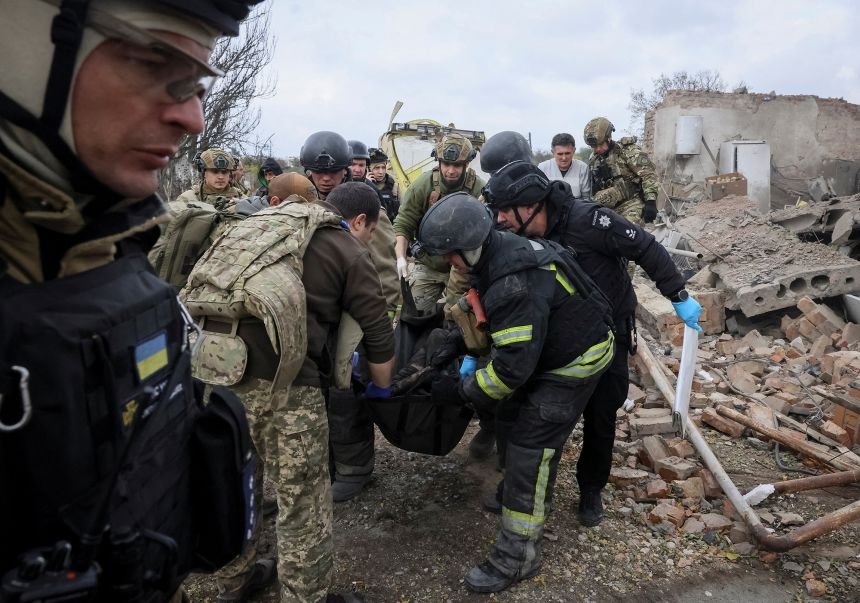
Russian forces struck the village of Komyshuvakha in Ukraine‘s southeastern Zaporizhzhia region on November 2, hitting a school building that had been repurposed as a civilian shelter and humanitarian aid distribution centre. The attack involved multiple aerial bombs and left the building severely damaged, trapping civilians and emergency personnel beneath the rubble.
Ukrainian President Volodymyr Zelensky described the incident as one of the deadliest attacks of the war. The death toll has changed as rescue operations have progressed. By November 4, regional authorities had confirmed at least 37 deaths, while dozens of people remained missing. The United Nations had previously reported at least 31 civilian deaths as verification and recovery efforts continued.
What Happened in the Russian Attack on Komyshuvakha?
The bombing took place on the morning of November 2, when residents of Komyshuvakha had gathered at a local school to receive humanitarian assistance. The facility was no longer operating as a conventional educational institution because of the proximity of Russian forces and the continuing threat of attacks in the region.
Instead, local authorities had converted the premises into an administrative centre, civilian shelter and distribution point for essential supplies. Residents who remained in the settlement relied on the location for humanitarian support, making it an important facility for the surrounding community.
According to Ukrainian regional officials, Russian aircraft dropped multiple aerial bombs on the settlement. The school and an underground shelter were struck during the attack, causing extensive structural damage and triggering a fire.
The United Nations Human Rights Monitoring Mission in Ukraine said the bombing occurred while civilians were gathering to receive humanitarian assistance. The distribution had been publicly announced in advance, including its location and scheduled hours.
The scale of destruction made it difficult for emergency services to reach people trapped inside the damaged structure. Concrete sections collapsed, debris covered the underground areas and the fire further complicated rescue operations.
By November 4, the third day of recovery efforts, authorities had reported 37 confirmed deaths. Regional officials also reported that 59 people were missing, although the exact number of people still trapped and the final casualty figures remained subject to verification.
Why the Humanitarian Aid Centre Was Particularly Vulnerable
The building struck in Komyshuvakha had originally been constructed to support education during wartime. Its reinforced underground section was designed to provide protection from aerial attacks and allow children to continue attending classes despite the security situation.
However, as fighting moved closer to the settlement, many families left the area. The facility subsequently became more important as a place where remaining residents could seek shelter and collect humanitarian supplies.
The underground structure was intended to offer protection against many conventional threats. Nevertheless, the force of the bombs reportedly caused the reinforced concrete section to collapse.
This highlights a serious problem facing communities close to the front line: even buildings specifically designed as protective shelters cannot guarantee safety against every type of modern aerial weapon.
For residents, the situation creates difficult choices. Staying inside a settlement means maintaining access to homes, essential services and humanitarian assistance, but travelling to a distribution centre or taking shelter in a public building can also expose civilians to danger when attacks occur.
The destruction of the facility could also affect humanitarian operations in the surrounding area. When a local distribution point is damaged, aid organisations and municipal authorities must find alternative locations, assess security conditions and determine how to reach residents who may have limited transportation options.
United Nations Raises Concerns Over International Humanitarian Law
The circumstances surrounding the Komyshuvakha bombing have raised serious questions about the protection of civilians and humanitarian facilities under International Humanitarian Law.
Danielle Bell, head of the United Nations Human Rights Monitoring Mission in Ukraine, highlighted that the location and timing of the aid distribution had been widely publicised before the attack.
She raised two possibilities: Russian armed forces either knew that civilians were gathering to receive assistance or failed to take basic steps to establish what was happening in the settlement before carrying out the operation.
The United Nations said the circumstances appeared to raise concerns about compliance with fundamental principles of international humanitarian law.
What International Humanitarian Law Requires
International humanitarian law, including the rules governing the conduct of hostilities, establishes protections for civilians and civilian infrastructure during armed conflicts.
Three principles are particularly relevant when examining attacks on populated areas:
- Distinction: Parties to a conflict must distinguish between civilians and combatants, as well as civilian objects and legitimate military objectives. Attacks must not be deliberately directed against civilians.
- Proportionality: An attack is prohibited when the expected incidental civilian harm would be excessive in relation to the anticipated concrete and direct military advantage.
- Precautions: Military forces must take all feasible precautions to avoid or minimise civilian casualties and damage to civilian infrastructure.
These principles apply regardless of the type of weapon being used or the military objective being pursued.
The presence of civilians in a building does not automatically establish every legal question surrounding an attack. Investigators must examine the intended target, available information, precautions taken and expected military advantage. However, the use of a facility for humanitarian assistance makes the protection of civilians an especially important consideration.
The United Nations said it would continue monitoring and documenting civilian casualties resulting from the attack. A comprehensive assessment would require further examination of the circumstances and available evidence.
Double-Tap Strikes Raise Additional Concerns
One of the most disturbing aspects of the Komyshuvakha attack was the reported sequence of strikes against the same location.
According to Ukrainian authorities, the initial bombing was followed by additional attacks as emergency personnel and police officers arrived to assist people caught in the destruction.
Such attacks are commonly described as double-tap strikes when a second strike hits the same area after the initial attack, potentially endangering civilians, rescuers and medical personnel responding to the first incident.
In Komyshuvakha, two emergency responders, Denys Konovalenko and Oleksiy Sushchevskyi, both aged 44, were reported killed while responding to the incident.
Four police officers also lost their lives. They were identified as Mykhailo Buzhenko, Mykola Balanda, Mykhailo Romanov and Dmytro Besedin.
According to the Ukrainian Police, officers had been helping local residents reach safety in the underground facility when the subsequent strikes trapped people attempting to escape.
The deaths of first responders illustrate how repeated attacks can compound the consequences of an initial strike. Emergency workers arriving at a damaged building may encounter unstable structures, unexploded ordnance, fires and the possibility of further aerial attacks.
These conditions can prevent rescue teams from reaching survivors quickly, even when emergency services are already operating at the scene.
For families waiting for information about missing relatives, delays also make an already difficult situation more uncertain.
FAB-3000 Bombs and the Scale of Destruction
Ukrainian regional administration head Mykhailo Semikin said Russian forces used different types of aerial bombs during the attack, including KAB-500 guided bombs and FAB-3000 bombs.
He described the FAB-3000 as a three-tonne aerial bomb containing approximately 1.5 tonnes of explosive material. According to his explanation, weapons of this type are primarily designed to destroy heavily reinforced concrete structures and fortifications.
The reported use of such powerful weapons helps explain why the underground shelter suffered extensive damage despite being constructed with reinforced concrete.
Large aerial bombs can generate powerful blast effects and structural damage. When detonated in or near populated areas, their impact can extend beyond the immediate point of impact, affecting surrounding buildings and people taking shelter indoors.
The United Nations Human Rights Monitoring Mission has also highlighted the destructive effects of aerial glide bombs in populated areas. These weapons can be launched from aircraft and fitted with wings and guidance systems that allow them to travel considerable distances before reaching their targets.
According to the UN monitoring mission, aerial glide bombs had already caused at least 478 civilian deaths and 2,667 injuries in Ukraine during 2026 before the November 2 attack. The figures demonstrate the continuing danger posed by these weapons to communities living close to the front line.
The Komyshuvakha incident therefore forms part of a wider pattern of civilian exposure to powerful aerial attacks rather than an isolated challenge involving a single damaged shelter.
Recovery Operations Complicated by Building Collapse
Rescue teams continued searching the damaged school building for survivors and recovering bodies after the bombing. The extent of the destruction made the operation particularly difficult.
Emergency personnel had to work through collapsed concrete, damaged underground structures and debris while dealing with the risks associated with further attacks.
Authorities also faced challenges identifying victims. Some recovered bodies could not be identified immediately because of the condition in which they were found. DNA testing was expected to be necessary in certain cases to establish identities and provide families with confirmation.
Identification is an important part of disaster recovery, particularly when several people are missing and the destruction has made visual identification difficult.
For relatives waiting for news, the process can extend the period of uncertainty even after rescue teams have recovered remains from the site.
The regional authorities also announced a period of mourning for those killed in the attack, reflecting the scale of the tragedy for the local community.
Russian Attacks on Ukrainian Energy Infrastructure Add to the Crisis
The bombing of Komyshuvakha occurred amid another major wave of Russian attacks targeting Ukraine’s energy infrastructure.
Zelensky said the strikes on the humanitarian facility were followed by a large-scale aerial barrage involving hundreds of drones and dozens of cruise and ballistic missiles. The attacks targeted energy facilities and infrastructure across different parts of the country.
Ukraine’s Energy Minister Denys Shmyhal separately reported that three drones had been directed towards a substation considered important for the operation of the Khmelnytskyi Nuclear Power Plant.
Shmyhal said the incident threatened nuclear safety beyond Ukraine’s borders and confirmed that Ukrainian authorities had informed the International Atomic Energy Agency (IAEA).
Why Electricity Substations Matter for Nuclear Safety
Nuclear power plants depend on reliable electrical systems to operate safely. Substations and transmission networks help manage the flow of electricity between power plants and the wider grid.
Even when a nuclear reactor is not directly hit, damage to surrounding electrical infrastructure can create operational challenges. Nuclear facilities require dependable electricity supplies for essential safety systems, including equipment used for cooling, monitoring and controlling plant operations.
Backup systems are designed to provide protection when external electricity supplies are interrupted. However, repeated attacks on electricity infrastructure can place additional pressure on emergency arrangements and complicate the management of the wider power network.
This is why attacks near substations connected to nuclear facilities attract international attention. The potential consequences of disruptions are not limited to electricity shortages or inconvenience for households.
The IAEA’s involvement provides an additional channel for monitoring nuclear safety concerns and communicating relevant information to the international community.
Ukraine’s Civilian Casualties Reflect a Wider Pattern of Aerial Attacks
The Komyshuvakha bombing comes after several other deadly attacks on civilian areas in Ukraine.
The supplied reports describe a series of major incidents during the preceding months, including attacks in Kramatorsk, areas near Kyiv and the Ukrainian capital itself.
- Kramatorsk: At least 33 people were reported killed in an attack involving two civilian buses in the Donetsk region.
- Near Kyiv: A Russian drone strike on an ammunition depot triggered a major fire and multiple explosions in a residential area, resulting in 38 deaths, according to the supplied account.
- Kyiv: A coordinated missile attack in July killed 33 people across the city.
- Komyshuvakha: The November 2 bombing targeted a facility being used for humanitarian assistance and civilian shelter, with at least 37 deaths confirmed by November 4.
These incidents demonstrate the continuing exposure of Ukrainian communities to aerial attacks, including in areas where civilians depend on public facilities and emergency services for protection.
The impact extends beyond immediate casualties. Repeated attacks can damage housing, disrupt essential services, displace families and make it increasingly difficult for humanitarian organisations to maintain regular operations.
For communities near the front line, the destruction of a school, shelter or distribution centre can remove one of the few accessible locations providing essential support.
Trump Administration’s Negotiation Efforts Continue Amid Escalating Attacks
The latest Russian strikes have also taken place amid renewed diplomatic efforts by the administration of US President Donald Trump to move the conflict towards negotiations.
US envoy Steve Witkoff recently met Zelensky in Norway before travelling to St. Petersburg for discussions with Russian President Vladimir Putin.
The diplomatic contacts reflect Washington’s continued efforts to engage both sides, although the latest attacks demonstrate the difficulties involved in pursuing negotiations while military operations continue.
According to the latest reporting on November 4, US officials were also preparing for discussions involving Russian and Ukrainian representatives in Abu Dhabi on November 10 and 11. The proposed talks were expected to address ending the conflict, postwar security arrangements and de-escalation.
One of the central challenges for any diplomatic process is establishing arrangements that can reduce attacks while addressing the security concerns of both countries.
Zelensky has repeatedly called for stronger international support for Ukraine’s air defence systems, arguing that protecting cities and critical infrastructure is necessary to prevent further destruction.
His latest remarks also referred to the importance of American involvement in efforts to establish a lasting peace.
Melania Trump’s Role in the Oleshky Civilian Evacuation
Separately, US First Lady Melania Trump was involved in efforts that helped secure a temporary ceasefire in the Russian-occupied Ukrainian city of Oleshky.
The arrangement enabled hundreds of civilians to leave the area over the weekend. The first lady’s office subsequently announced plans to bring together representatives from Russia and Ukraine at the White House on November 5.
The evacuation demonstrated how limited humanitarian arrangements can provide opportunities for civilians to leave dangerous areas even when a broader political settlement remains unresolved.
However, a temporary ceasefire designed to facilitate evacuation is different from a comprehensive agreement to end hostilities. Its effectiveness depends on both sides respecting the agreed arrangements and allowing civilians and humanitarian personnel to move safely.
What the Komyshuvakha Attack Means for Ukraine’s Humanitarian Crisis
The destruction of the humanitarian centre highlights the growing difficulty of delivering assistance in settlements exposed to repeated aerial attacks.
Humanitarian distribution points are often selected because they are accessible to local residents and can accommodate the movement of supplies. They also provide a practical way for local authorities and aid organisations to reach people who cannot easily travel to larger towns.
When these facilities become unsafe, the consequences can extend across an entire community.
Residents may have to travel farther to collect food and essential supplies, while aid organisations must reassess routes, distribution schedules and security arrangements. People without private transportation, elderly residents and individuals with disabilities can face additional difficulties accessing assistance.
The incident also raises questions about how shelters should be protected in areas where powerful aerial weapons are being used. Reinforced construction can reduce certain risks, but the collapse of the Komyshuvakha underground facility demonstrates that physical protection has limits.
For local authorities, the priority will be identifying alternative locations for humanitarian distribution while ensuring that residents are informed about available assistance and security conditions.
What Happens Next in the Russia-Ukraine War?
The immediate priority in Komyshuvakha remains the search for missing people, recovery of victims and identification of those who have died. Authorities must also assess the damage to the former school and determine how humanitarian operations can continue in the settlement.
International attention is likely to remain focused on the circumstances of the bombing, particularly the reported presence of civilians at a publicly announced aid distribution and the subsequent strikes that killed emergency personnel.
The United Nations’ continuing monitoring and documentation efforts could contribute to a clearer understanding of civilian casualties and the potential violations of international humanitarian law.
Beyond the immediate incident, the proposed US-mediated discussions in Abu Dhabi represent another diplomatic development to watch. Whether these discussions produce meaningful progress will depend on the positions adopted by Moscow and Kyiv, their willingness to consider de-escalation and the security arrangements that could support any agreement.
For Ukraine, protecting civilians, maintaining electricity supplies and securing humanitarian access remain immediate challenges while the war continues.
The Komyshuvakha bombing has brought these issues together in one devastating incident. A building originally designed to protect children during wartime had become a place where residents sought shelter and collected essential supplies. Its destruction, along with the deaths of civilians, police officers and rescuers, demonstrates the severe risks facing communities that continue to live near the front line.
For breaking news and live news updates, like us on Facebook or follow us on Twitter and Instagram. Read more on Latest World on thefoxdaily.com.





COMMENTS 0